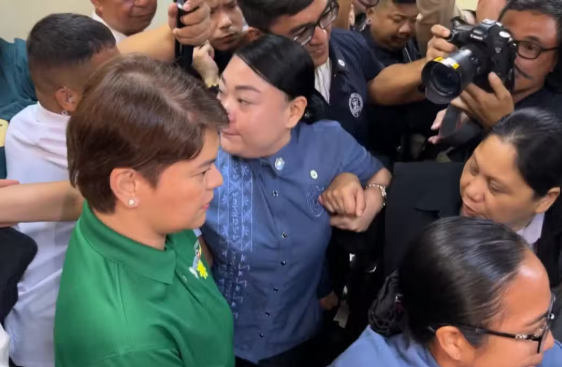
Vice President Sara Duterte arrived at the Philippine Senate on Tuesday to meet with her legal team, using the occasion to reinforce her combative stance toward the impeachment proceedings against her. In remarks to waiting journalists, she employed classical literary language to frame her current predicament, stating that despite the severity of her challenges, she would emerge with her spirit intact. The imagery she deployed—being "bloodied but unbowed"—directly echoes a celebrated line from William Ernest Henley's 1875 poem "Invictus," which celebrates human determination in the face of overwhelming hardship. This rhetorical choice suggests Duterte views the trial not merely as a legal proceeding but as an existential test of her political will.
The Vice President's characterisation of the impeachment process as a "bloodbath" represents a continuation of language she has employed since May 2025, when she first publicly welcomed the prospect of an aggressive confrontation with her political opponents. At that earlier point, she explicitly stated her preference for a "bloodbath," framing the trial as inevitable conflict rather than a neutral judicial examination of the charges against her. The consistency of this aggressive rhetoric indicates a deliberate strategy to shape public perception of the impeachment as a politically motivated attack rather than a constitutional mechanism for accountability.
However, Duterte's combative public statements stand in sharp contrast to her actual participation in the impeachment process itself. Critics and political opponents have highlighted what they characterise as her selective engagement with proceedings, pointing out that she has conspicuously absented herself from most House impeachment hearings during both 2025 and 2026. This pattern of sporadic attendance has drawn particular scrutiny from those who argue that her willingness to declare war on the process verbally does not align with substantive engagement through the formal channels available to her defence.
The charges arrayed against Duterte span a broad spectrum of alleged misconduct that, if proven, could result in her removal from office and a permanent ban from holding any future public position. The first article alleges the misappropriation of substantial public funds, specifically claiming that PHP 612.5 million in confidential allocations from the Office of the Vice President and the Department of Education were improperly utilised. This figure breaks down into PHP 500 million from vice-presidential accounts and PHP 112.5 million from DepEd resources, representing allegations of large-scale financial impropriety.
Beyond financial misconduct, the second article addresses questions of honesty and disclosure, alleging that Duterte has failed to accurately report her assets in official Statements of Assets, Liabilities and Net Worth across the 2022-2024 period. The complaint further suggests she has neglected to divest from business interests as required, maintaining financial stakes in enterprises while holding public office. These allegations strike at issues of transparency and conflict of interest, fundamental to questions of governmental integrity.
The third article presents more serious criminal allegations, suggesting that Duterte engaged in bribery and enabled procurement irregularities involving Department of Education officials. Such charges imply coordinated corruption involving multiple parties and systematic manipulation of government contracting processes. The final and perhaps most incendiary article alleges that Duterte made threats against the lives of President Ferdinand Marcos Jr., First Lady Liza Araneta-Marcos, and former House Speaker Martin Romualdez, representing the most severe category of accusation imaginable against a sitting vice president.
The constitutional framework governing this trial establishes substantial barriers to conviction. Under the 1987 Philippine Constitution, removal of an impeached president or vice president requires the affirmative vote of at least two-thirds of all senator-judges. This supermajority requirement means that Duterte's legal team need only secure sufficient support from a minority of senators to prevent conviction. The trial itself is projected to extend approximately 92 days, a timeline that would likely stretch the proceedings well into early 2027, ensuring that this political crisis will dominate the Philippine political landscape for an extended period.
For Malaysian and regional observers, the Duterte impeachment represents a critical moment in Philippine democratic governance. The case illustrates both the strength and fragility of constitutional mechanisms designed to hold high officials accountable. Unlike systems with prime ministerial structures, the Philippine presidential framework creates direct confrontation between executive and legislative branches, potentially intensifying political conflict. The trial's outcome will signal whether the country's institutions can function effectively as checks against presidential or vice-presidential overreach, or whether political power remains concentrated beyond meaningful institutional restraint.
The regional implications warrant consideration as well. The Philippines, as a major Southeast Asian democracy, influences broader conversations about governance standards and accountability in the region. How successfully the country navigates this constitutional crisis—whether through conviction, acquittal, or some negotiated resolution—may shape expectations regarding executive accountability across neighbouring states. Additionally, the case demonstrates how classical political drama continues to unfold in modern democracies, with literary references and theatrical language complementing substantive legal arguments.
Duterte's invocation of "Invictus" carries particular weight in this context. The poem's famous concluding lines—"I am the master of my fate, I am the captain of my soul"—express defiance against external circumstance. By consciously referencing this work, Duterte positions herself not as a defendant responding to charges but as a protagonist resisting forces beyond her control. Whether this narrative resonates with the Senate judges who will ultimately determine her fate remains uncertain. What is clear is that the coming months will test not only Duterte's political resilience but also the institutional capacity of the Philippine Senate to conduct a trial of unprecedented significance with appropriate gravity and impartiality.

