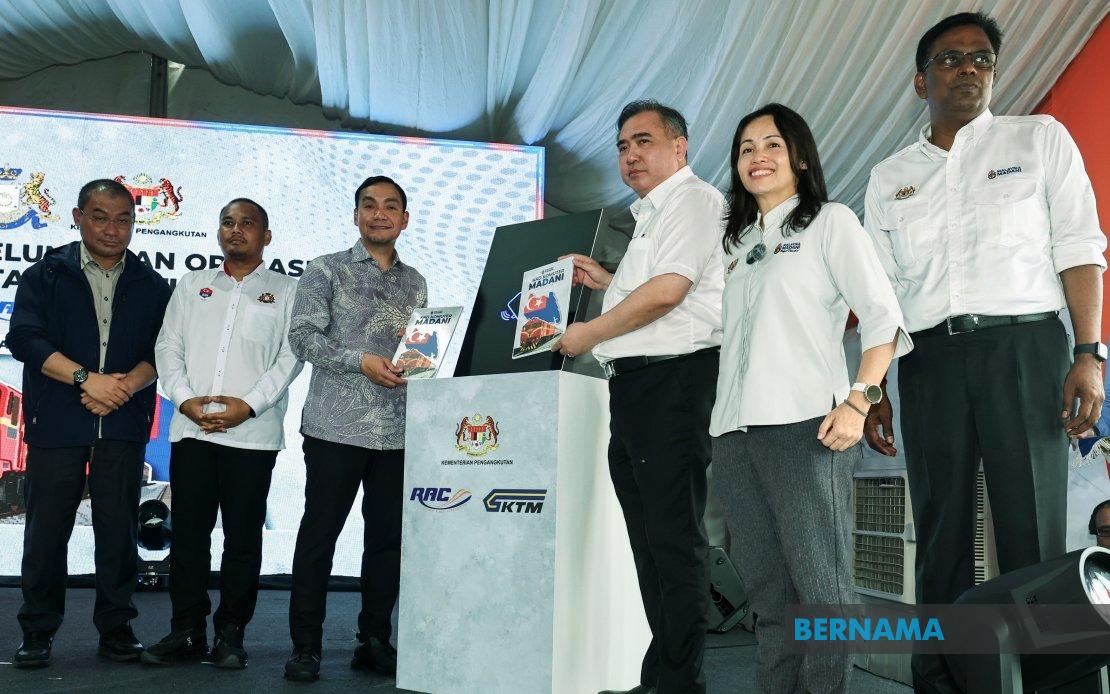
Johor Menteri Besar Datuk Seri Onn Hafiz Ghazi has underscored the necessity of expediting the Elevated Autonomous Rapid Transit (E-ART) project as a safeguard against crippling traffic congestion in Johor Bahru when the Johor Bahru-Singapore Rapid Transit System (RTS) Link becomes operational next year. The statement came during the unveiling of the Southern Shuttle train service at KTM Kulai Station, where Transport Minister Anthony Loke and Deputy Communications Minister Teo Nie Ching, the Kulai Member of Parliament, were also present.
Onn Hafiz characterised the E-ART as indispensable infrastructure to sustain the city's evolving transportation requirements over the long term. The RTS Link's commencement will inevitably draw substantial passenger volumes through enhanced cross-border connectivity, a development that threatens to overwhelm the current road infrastructure without complementary transit solutions. The anticipated surge in user numbers will fundamentally alter travel patterns across the greater Johor Bahru metropolitan area, necessitating a comprehensive public transport ecosystem that extends beyond conventional road-based mobility.
The Menteri Besar acknowledged that interim strategies currently under implementation offer only temporary relief from congestion pressures. These stopgap measures encompass the augmentation of Park & Ride facilities and the deployment of intelligent traffic management systems at JB Sentral. While these initiatives provide near-term respite, they cannot permanently resolve the structural capacity constraints that will emerge once the RTS Link enters service. The current approaches function as holding measures rather than definitive solutions, buying time for more substantial infrastructure projects to materialize.
Onn Hafiz emphasised that authorities cannot rely exclusively on short and medium-term interventions whilst awaiting completion of the primary traffic-dispersal project. The E-ART system represents the cornerstone of a coherent strategy to distribute vehicular and pedestrian flows across multiple transport corridors, preventing any single route or mode from becoming catastrophically congested. Without this foundational infrastructure, the anticipated benefits of the RTS Link—enhanced regional connectivity and economic integration—risk being substantially diminished by transit bottlenecks.
The demographic scale of Johor Bahru underscores the urgency of this planning imperative. With approximately 1.8 million residents, the state capital rivals Penang in population size, yet currently lacks transportation infrastructure proportionate to that scale. This demographic reality compounds the pressure on existing networks and makes the case for transformative projects like E-ART increasingly compelling. The sheer number of daily commuters and potential RTS Link users demands a multi-modal transport architecture capable of handling unprecedented passenger flows.
Johor Bahru's status as Malaysia's premier international gateway amplifies these considerations. The city functions as the nation's primary point of cross-border movement, facilitating daily flows of workers, traders, and travellers between Malaysia and Singapore. This transnational dimension distinguishes Johor Bahru from other major Malaysian cities and elevates the strategic importance of robust transit infrastructure. Inefficient transport systems directly undermine the city's competitive advantages and economic vibrancy, making investment in modern public transport a matter of regional economic competitiveness.
The necessity for an integrated, high-capacity public transportation network reflects contemporary urban planning principles recognised across Southeast Asia and globally. Cities confronting rapid growth and heightened cross-border engagement have consistently discovered that automobile-centric transport paradigms prove inadequate for managing congestion whilst maintaining economic productivity and quality of life. Modern metropolitan areas require systems that seamlessly link various transit modes, enabling commuters to move efficiently between rail, bus, and other services. E-ART would function as a critical connector within this broader ecosystem.
Onn Hafiz framed E-ART implementation as a manifestation of substantive federal intervention responsive to Johor residents' immediate concerns. The project transcends mere infrastructure investment; it represents government commitment to tangible improvements in daily mobility and livelihood. When successfully executed, such visible federal initiatives strengthen public confidence in institutional capacity and reward the electorate's trust. The Menteri Besar recognised that infrastructure achievements resonate more powerfully with constituents than abstract policy announcements, serving as enduring demonstrations of government efficacy.
The acceleration of E-ART development aligns with broader regional trends toward modernised public transport systems across Southeast Asia. As ASEAN nations grapple with the consequences of motorisation and urbanisation, investments in elevated and automated transit represent the technological frontier. Malaysia's positioning as a regional economic hub depends partly on its ability to maintain transport infrastructure competitive with neighbouring jurisdictions. Delays in implementing such systems risk diminishing Malaysia's appeal to international investors and skilled workers.
The convergence of RTS Link operations and E-ART deployment timing carries considerable strategic weight. Should the RTS Link commence service substantially ahead of E-ART completion, Johor Bahru faces a critical window where heightened demand meets constrained supply. This mismatch could generate precisely the congestion crises that planners sought to avoid. Coordinating these projects requires meticulous timeline management and resource allocation, ensuring that complementary infrastructure advances in tandem rather than sequentially. The success or failure of this coordination will significantly influence public perception of transport policy competence.