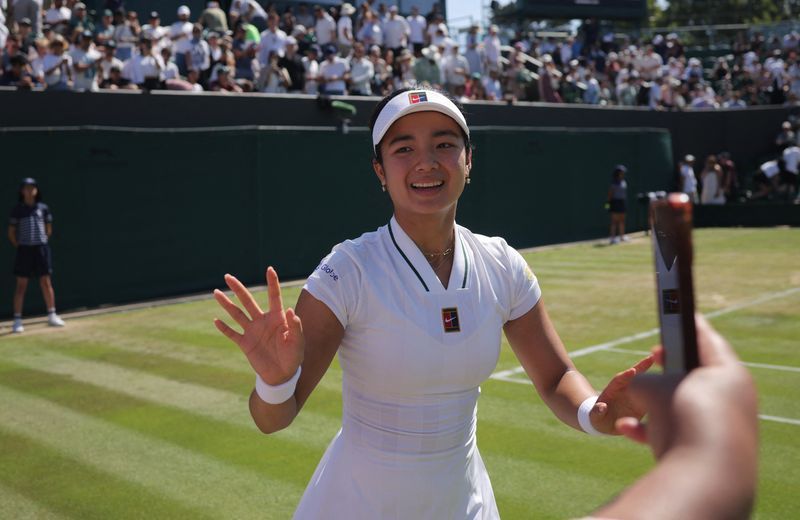
Alexandra Eala etched her name into Philippine sports history on Thursday at Wimbledon, becoming the first player from her nation to break through to the third round of a Grand Slam tournament. The 21-year-old from Quezon City's journey to this milestone was marked not just by her tennis prowess, but by the deeply personal symbols she carried to the grass courts of London. Inscribed on the back of her sun visor were words in Tagalog—"Kapag lumago, hindi na hihinto"—a phrase that translates to "once it grows, it cannot be stopped." The message proved prescient as Eala dismantled Australia's Maya Joint with a commanding 3-6 6-2 6-0 scoreline, the same opponent who had eliminated Serena Williams in the opening round.
The 29th seed's path to this historic victory was not without struggle. Starting slowly against Joint, Eala demonstrated the mental fortitude and tactical awareness that has propelled her ascent through the professional rankings. After losing the opening set, she unleashed a devastating tennis performance, winning twelve consecutive games across the second and third sets to secure her passage forward. The dominance of her comeback will provide considerable confidence as she faces one of the world's most formidable challenges in her next assignment: defending champion and six-time Grand Slam winner Iga Swiatek of Poland. Yet rather than displaying anxiety about the prospect, Eala spoke with measured composure about the upcoming encounter.
Eala's presence at the All England Club represents a watershed moment for Philippine tennis on the global stage. The Southeast Asian nation has produced many sporting talents, but breakthrough moments at the sport's most prestigious tournaments have remained elusive. At just 21 years old and competing in only her sixth Grand Slam tournament, Eala has already surpassed previous benchmarks for Filipino players, signalling that her trajectory may continue upward in the years ahead. Her preparation for these elite competitions has been methodical and supported by world-class infrastructure; she trains at the prestigious Rafa Nadal Academy in Mallorca, Spain, where she benefits from the expertise and facilities that have shaped numerous international tennis champions.
The significance of her achievement extends beyond statistics and rankings. In recent months, Eala has proven particularly comfortable competing on grass courts, the surface that defines the Wimbledon experience. She captured the championship title in Birmingham last month and progressed to the semi-finals at Berlin, demonstrating a specialised skill set that many younger players have not yet developed. This grass-court prowess, combined with her steady climb into the top 50 rankings last year, suggests that Eala possesses the fundamental capabilities to compete consistently at the highest levels of professional tennis. Her representation of the Philippines in the main draw at Wimbledon—as the sole competitor from her nation in the singles competition—carries the weight of national expectation and pride.
Beyond the purely athletic dimension of her achievement, Eala has become a cultural ambassador for her country, and she embraces this role with evident enthusiasm. Her partnership with Nike reflects an understanding that global sports sponsorships can amplify messages of national identity and heritage. For her debut at Wimbledon last year, Nike provided her with a custom hair tie adorned with a single sampaguita bloom, the national flower of the Philippines. This year, the company collaborated with her to imprint the Tagalog motto onto her kit—tangible expressions of where she comes from that accompany her onto the court at tennis's most prestigious venues.
Eala has articulated clearly the emotional resonance of representing her nation on such elevated platforms. When asked about the historical significance of her achievement, she acknowledged the profound impact of being the first Filipino to reach a Grand Slam's third round. Yet she balanced this recognition with genuine personal investment, describing the moment as both deeply emotional and intrinsically connected to her individual ambitions and values. She does not frame her success as a burden or an obligation imposed from outside, but rather as an organic extension of who she is and the goals she has set for herself. This grounded perspective suggests maturity beyond her years and a healthy framework for managing the pressures that inevitably accompany pioneering achievements.
The broader implications for Southeast Asian tennis are worth considering. Eala's breakthrough at Wimbledon provides inspiration for emerging players from the region who have historically faced greater barriers to accessing world-class coaching, infrastructure, and competition than their counterparts in North America and Europe. The Philippines, with a population exceeding 110 million, has the demographic foundation to produce elite athletes across numerous disciplines. However, translating that potential into sustained international success requires investment, institutional support, and the visibility that comes from individual achievements at the sport's biggest stages. Eala's advancement serves as evidence that such pathways are possible.
Looking ahead to her confrontation with Swiatek, Eala faces a daunting task. The Polish champion has won six Grand Slam titles, including the 2022 and 2023 Wimbledon championships. Her tactical command, physical conditioning, and experience at the highest level of the sport far exceed what Eala has previously encountered in her professional career. Nonetheless, Eala's recent performances on grass suggest she may be better equipped than many younger players to compete against elite opponents. Her mental resilience—demonstrated by her comeback against Joint—and her willingness to embrace the challenge rather than shrink from it indicate that she will approach Saturday's match with genuine competitive intent rather than mere participation.
Eala's journey reflects broader trends in global professional tennis, where the traditional geographic advantages that once concentrated elite players in a handful of wealthy nations have begun to erode. With enhanced access to training facilities, coaching expertise, and international competition through digital connectivity and scholarship programmes, players from emerging markets can now compete on equivalent footing with their counterparts from tennis's traditional strongholds. Eala represents the frontier of this democratisation, and her success at Wimbledon provides tangible evidence that Philippine tennis—and Southeast Asian tennis more broadly—possesses genuine competitive potential on the world stage. Whether she can extend her run at the tournament depends on her ability to maintain the momentum and confidence that carried her through to the third round.

