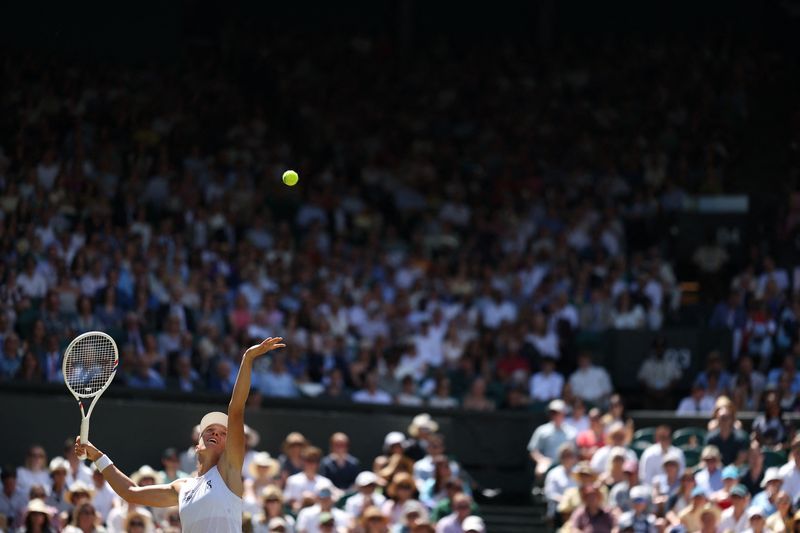
Alexandra Eala has announced her arrival among tennis's elite with a stunning victory over defending Wimbledon champion Iga Swiatek in the third round at the All England Club on Saturday. The rising Filipino star dismantled the Polish third seed 7–6(9) 6–2 in a fiercely contested Centre Court battle, signalling that the 25-year-old Swiatek's hold on the grass-court crown will not extend beyond a single season. The result represents a watershed moment for Eala's career, validating her rapid ascent through the professional ranks and establishing her credentials as a genuine threat to established title contenders on the sport's most prestigious stages.
Swiatek arrived at Wimbledon with the weight of expectations that accompany title defence, yet her preparation for the tournament sent troubling signals about her readiness. An unexpected early exit from the Bad Homburg warm-up event had left questions about her form and consistency, even as she carried the distinction of having finally conquered the grass-court surface that had long eluded her during previous campaigns. Her victories over Taylor Townsend and Karolina Pliskova in the first two rounds suggested a gradual return to peak form, but those performances masked underlying vulnerabilities that Eala would ruthlessly exploit.
The opening set unfolded as a tightly contested affair, with neither player prepared to yield momentum. Swiatek and Eala traded powerful strokes in an exhibition of modern baseline tennis, each refusing to surrender ground without a fierce struggle. The tiebreak that decided the set proved to be the crucial moment of the match, with Eala's superior movement and aggressive shot-making in crucial points allowing her to secure the 9–7 victory. The psychological blow of losing that first set appeared to affect Swiatek's composure, as evidenced by her animated reactions in the stands, including a moment when she struck her chair in frustration after remonstrating with her coaching team.
Eala's demeanour presented a stark contrast to her opponent's mounting frustration. The left-handed Filipino competitor thrived under the pressure of Centre Court, her powerful baseline shot-making and tactical acumen drawing admiration from a crowd that appreciated her composed aggression. The enthusiastic applause that greeted her aggressive play suggested the crowd had embraced the underdog story, creating an atmosphere that amplified the challenge facing the defending champion as the match progressed into its decisive stages.
The second set witnessed Eala take complete command of the contest. Her aggressive approach from the baseline, particularly her devastating forehand, created immediate problems for Swiatek's defensive positioning. By establishing a commanding 3–0 lead courtesy of a double break of serve early in the set, Eala had effectively seized control of the match's narrative. While Swiatek briefly clawed back to within striking distance by breaking serve once, Eala's experience in high-pressure situations proved decisive. She quickly re-established her dominance by securing another break, ultimately clinching victory with a precision forehand winner that left no doubt about her superior tennis during the critical phases of the encounter.
The history between these competitors added additional layers to this matchup. When they previously encountered each other in Miami, Eala had secured a notable victory that demonstrated her capacity to trouble elite opposition. Swiatek had subsequently earned revenge on the red clay of Madrid, reasserting her dominance on her preferred surface. However, the grass courts of Wimbledon proved to favour Eala's aggressive style and movement, rendering Swiatek's usual clay-court superiority irrelevant. The Filipino player's willingness to engage in rallies from the baseline, combined with her powerful striking ability, created a tactical framework within which she could flourish.
Swiatek's defeat represents a significant disappointment for a player who had finally demonstrated her capacity to excel on grass after years of scepticism about her suitability to the surface. Her 2023 Wimbledon triumph had appeared to silence those critics permanently, yet this early exit raises fresh questions about her consistency across different court surfaces. The defending champion now faces a concerning pattern of inconsistent results that could undermine her standing among the sport's top tier, particularly on surfaces where traditional grass-court specialists maintain historical advantages.
Eala's progression to the fourth round sets up an intriguing encounter with Jasmine Paolini, the 2024 runner-up who represents another formidable challenge. The Italian competitor brings her own impressive credentials to the match, having demonstrated exceptional form throughout the current campaign. Should Eala continue her upward trajectory, she would establish herself as a genuine major championship contender rather than merely an emerging talent with potential. For Southeast Asian tennis enthusiasts, Eala's presence among the tournament's final stages represents a source of considerable pride and validation that the region can produce players capable of competing at the sport's highest echelon.
The implications of Eala's breakthrough extend beyond the immediate match. Her comprehensive dismissal of the defending champion on grass suggests that the hierarchy of women's tennis continues to evolve, with established names increasingly vulnerable to determined challengers possessing superior movement, shot-making variety, and tactical sophistication. Swiatek's exit confirms that previous tournament success provides no guarantee of sustained excellence, particularly when facing opponents with complementary playing styles that exploit technical or tactical weaknesses. For Malaysian observers of professional tennis, Eala's triumph serves as a reminder that persistent excellence across multiple surfaces, not merely dominance on preferred terrain, ultimately determines success at the sport's most prestigious tournaments.

