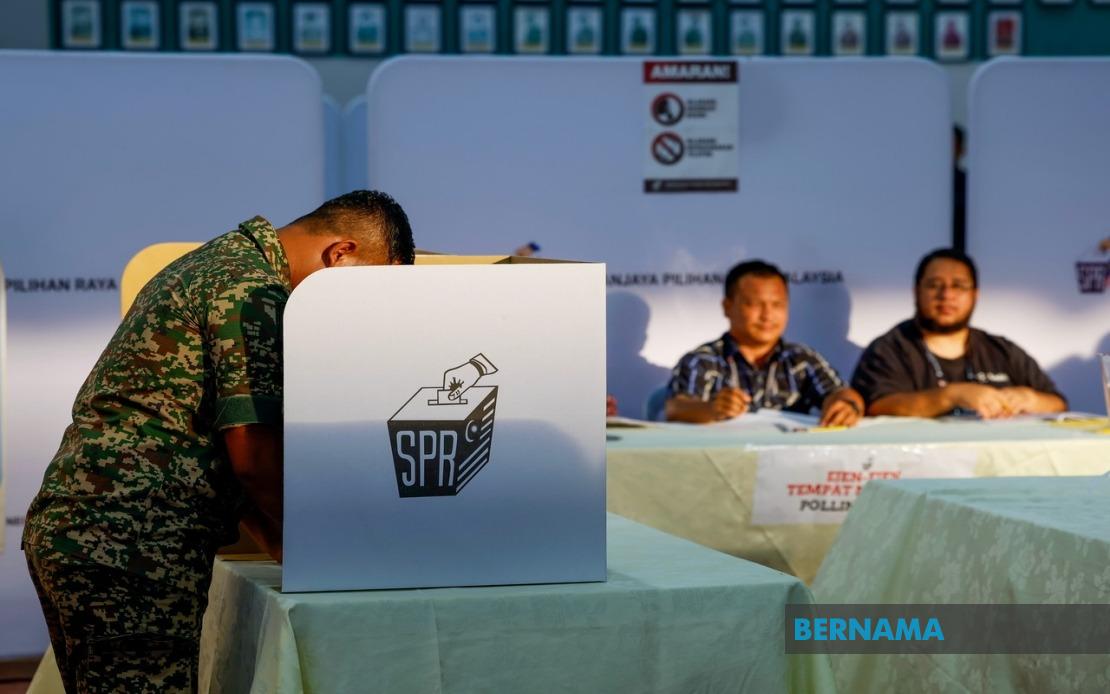
The 16th Negeri Sembilan state election got off to a steady start on July 28 as early voting commenced across the state, with preliminary data from the Election Commission showing that just over one in seven eligible early voters had already cast their ballots by mid-morning. The 14.31 per cent turnout by 9 am represented 2,356 individuals from the defence and law enforcement sectors who exercised their right to vote ahead of the general polling day. These figures encompassed 1,431 military personnel and 925 police officers alongside their respective spouses, all of whom registered to cast their votes in the designated early voting window.
The logistics of early voting across Negeri Sembilan reflected careful planning by the Election Commission, with 38 polling centres opened simultaneously at 8 am to accommodate 22,389 registered early voters throughout the day. The staggered closing times between noon and 5 pm, tailored according to each centre's location and voter registration numbers, aimed to prevent congestion and ensure orderly proceedings at individual stations. This approach represents a standard mechanism in Malaysian electoral practice, allowing critical personnel whose duties may conflict with general polling day to fulfil their democratic responsibilities.
The early voting phase serves as a barometer for broader participation trends in the upcoming main election scheduled for the same day. With 103 candidates competing across 36 state seats, the Negeri Sembilan contest represents a significant electoral exercise for the state. The general polling day on July 28 is expected to draw the participation of 889,490 registered voters across the state, a figure substantially larger than the early voter contingent. Understanding the demographic composition of early voters—predominantly military and police officers—provides insight into the security sector's stake in state governance and reflects institutional arrangements that prioritise continuity of essential services during elections.
The deployment of early voting mechanisms across Malaysia's electoral system recognises the unique constraints faced by uniformed personnel and their families. Military and police staff cannot absent themselves from duty stations on general polling day without compromising national security and public order operations. By permitting these groups to vote earlier, the Election Commission ensures inclusive participation while maintaining the operational readiness of security forces. This dual accommodation underscores a foundational principle in democratic systems: balancing the right to vote with the necessity of maintaining essential public services.
Negeri Sembilan's 16th state election carries particular significance within Malaysia's broader political landscape. As one of the country's nine states and three federal territories, the state's electoral outcomes influence the composition of the Dewan Negeri and the state government's ideological direction and policy priorities. The contest among 103 candidates signals vigorous political competition, with multiple parties presumably fielding representatives across the 36 constituencies. Early voting turnout patterns may forecast the overall engagement level expected when general voting begins, offering campaign strategists preliminary indicators of voter enthusiasm.
The Election Commission's decision to publish real-time voting statistics on its official Facebook page represents transparency in electoral administration, allowing the Malaysian public and interested observers to monitor proceedings as they unfold. Such openness builds confidence in the electoral process by making the machinery of voting verifiable and subject to public scrutiny. However, early voting figures alone cannot predict general election outcomes, as the composition and preferences of early voters—concentrated among security personnel—may differ substantially from the broader voter population participating on July 28.
For Malaysian voters generally, the Negeri Sembilan election offers an opportunity to assess how political messaging and campaign strategies resonate beyond urban centres and federal territories. State elections often serve as testing grounds for emerging political trends and provide clearer signals about support for particular parties or independent candidates than might emerge from national surveys or commentary. The outcome will influence inter-party dynamics within Negeri Sembilan's political system and may carry implications for coalition mathematics at the state level.
The timing of early voting completion, with centres closing between noon and 5 pm depending on their circumstances, means that comprehensive turnout figures across all early voting locations will not be immediately available. The Election Commission typically consolidates and releases complete early voting statistics before general polling begins, allowing for detailed analysis of participation patterns. Comparing early voting turnout percentages with historical precedent offers analysts clues about whether voting enthusiasm is elevated or diminished in this election cycle relative to previous contests.
As the Negeri Sembilan state election enters its crucial early voting phase, the participation of military and police families reflects institutional and practical recognition that democratic processes must accommodate those whose professional duties place them outside normal voting locations on general polling day. The 14.31 per cent figure by 9 am suggests steady, orderly progression through the early voting window, with the remaining hours before noon closures and afternoon sessions providing additional opportunities for eligible personnel to participate. The focus now turns toward July 28, when the general electorate will determine the state's political direction through their collective choices across the 36 contested seats.

