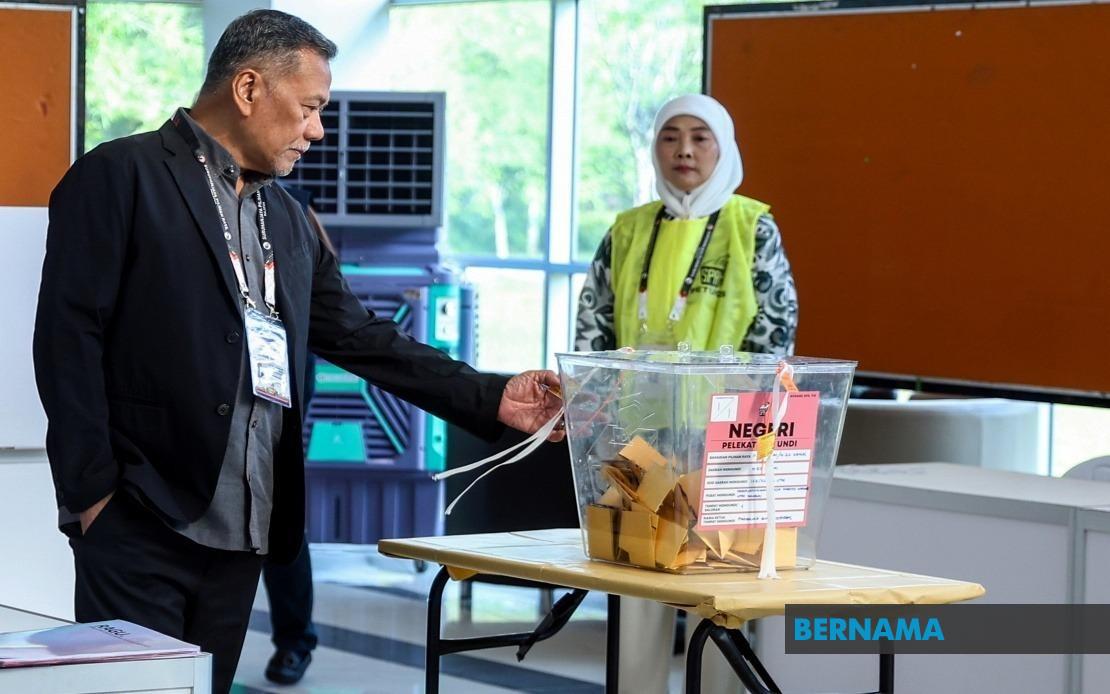
Election Commission chairman Datuk Seri Ramlan Harun conducted a comprehensive inspection of voting operations across four major polling centres in Johor Bahru on July 11, overseeing the 16th Johor state election to ensure procedures remained organised and compliant with electoral standards.
Ramlan commenced his tour at approximately 8.50 am at Dewan Raya Taman Ungku Tun Aminah, the designated polling venue for the Skudai constituency. This location operated seven separate polling streams, reflecting the voter concentration in this urban district. The early morning timing allowed the EC chairman to observe the critical opening hours of the election, when poll workers establish procedures and initial voter batches arrive to cast their ballots. Skudai represents a competitive constituency in Johor's political landscape, making its smooth administration particularly important for the election's overall credibility.
Following his assessment at Skudai, Ramlan proceeded northward to the Raja Zarith Sofiah Library situated within the Universiti Teknologi Malaysia campus in Senai. This academic institution served as a polling centre for the Senai constituency, accommodating a younger demographic of voters including university students and staff. The library facility operated two polling streams, a smaller configuration reflecting either lower voter density or the physical constraints of conducting elections within an educational institution. University-based polling venues require special coordination to balance voting accessibility with institutional operations, making their inspection particularly relevant for maintaining democratic participation among youth voters.
The EC chairman's itinerary subsequently included Sekolah Agama Taman Bukit Mewah, serving voters in the Kempas constituency. This facility managed six polling streams, suggesting moderate to substantial voter numbers in this particular district. The choice of a religious school as a polling venue reflects Malaysia's common practice of utilising diverse community institutions for electoral purposes, spanning secular schools, religious institutions, and government facilities. Such inclusivity in venue selection demonstrates efforts to provide accessible voting locations distributed across various neighbourhoods and demographics.
Ramlan concluded his inspection circuit at Sekolah Menengah Kebangsaan Bandar Uda Utama in the Perling constituency, the most extensively staffed location on his tour with nine polling streams. This substantial operational scale indicated significant voter population in Perling, likely reflecting its urban or densely populated characteristics within the greater Johor Bahru area. The increasing number of polling streams at successive venues demonstrated how the EC adapts infrastructure based on constituency size and expected voter turnout.
During each facility visit, election officials provided detailed briefings to Ramlan regarding voting procedures, ballot management, and adherence to established protocols. These consultations enabled the EC leadership to understand operational realities on the ground, identify potential bottlenecks, and recognise effective practices that could be documented for future elections. Direct engagement between senior leadership and ground-level personnel strengthens institutional learning and helps identify problems before they escalate into wider issues affecting voting integrity.
Beyond procedural discussions, Ramlan examined the physical infrastructure and amenities provided to both voters and election staff. Adequate facilities significantly impact the voting experience and staff efficiency—factors that influence voter turnout and election administration quality. Assessments likely encompassed queuing systems, voter information displays, accessibility provisions for elderly and disabled voters, sanitation facilities for long polling day shifts, and security arrangements protecting ballot integrity.
For Malaysian voters and observers, such high-level EC inspections carry significant symbolic and practical weight. They demonstrate institutional commitment to electoral standards and provide reassurance that election administration receives appropriate oversight. These visits also create opportunities for EC leadership to address concerns directly and ensure consistency in standards across different polling locations, preventing disparities that might undermine public confidence in results.
The Johor state election holds considerable implications for Malaysia's broader political landscape. Johor, as the nation's second-largest state by population and economically significant, influences national political trajectories. Smooth administration of voting and credible results strengthen democratic institutions and public trust in electoral processes across the federation. The EC chairman's active participation in election day monitoring reinforces the institutional independence and professionalism expected of Malaysia's electoral body, particularly important given ongoing discussions about election integrity and transparency within Southeast Asia's democratic context.

