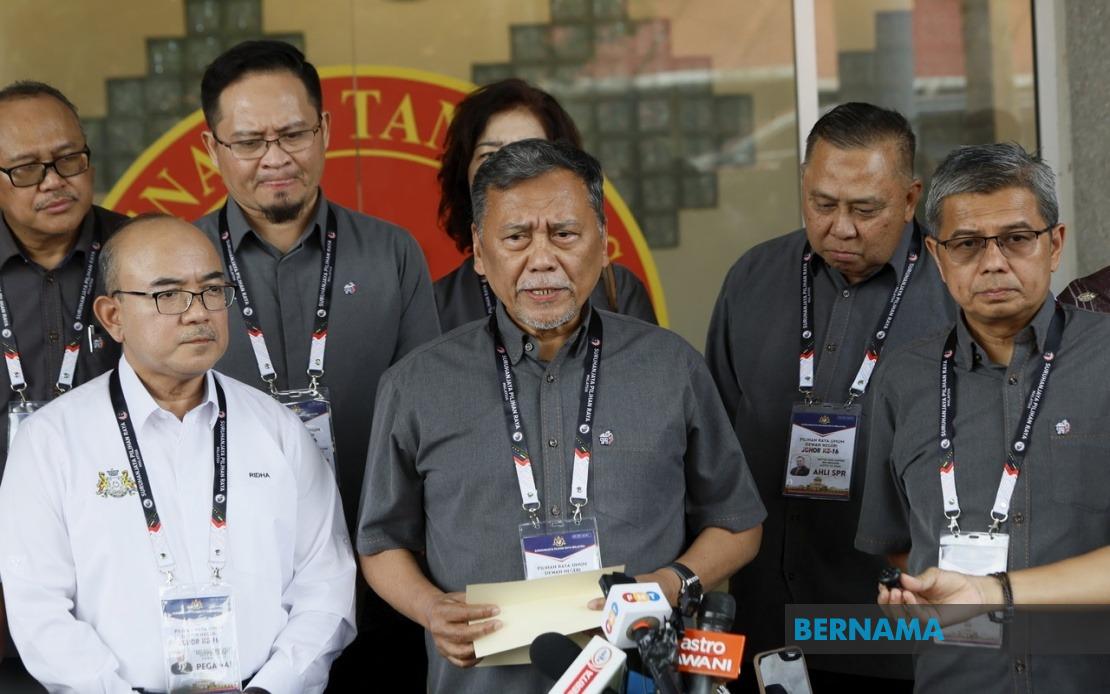
The Election Commission is banking on strong participation from military and police personnel in the Johor state election's early voting phase, setting a 96 per cent turnout target grounded in the electoral body's track record across previous polls. Election Commission chairman Datuk Seri Ramlan Harun outlined the projection during observations at Kem Mahkota in Kluang, signalling confidence that established patterns of civic engagement among uniformed services would hold firm.
Early voting logistics unfolded across 62 designated centres distributed throughout Johor, each opening their doors at 8 am to facilitate personnel unable to vote during the main polling day. The staggered closing schedule reflected operational needs, with 29 centres shuttering at noon, five at 2 pm, and the remaining 28 continuing until 5 pm. This arrangement acknowledges the varied shift rotations and deployment schedules affecting military and police workforces across the state.
The eligible early voter pool totalled 20,607 individuals, comprising 8,544 armed forces personnel and their spouses alongside 12,063 police officers and their families. This demographic represents a disciplined, organised voting cohort with institutional mechanisms supporting their participation—a factor that historically translates into consistently high turnout rates. The inclusion of family members recognises that spousal engagement in electoral processes strengthens overall participation frameworks within uniformed service communities.
Ramlan's confidence in the 96 per cent projection stems from empirical evidence gathered across multiple electoral cycles. Early voting among military and police contingents has demonstrated resilience as a reliable indicator of broader democratic engagement, particularly when voters face logistical constraints that might otherwise suppress participation. The Commission's willingness to publicly commit to this ambitious figure underscores institutional confidence that preparatory measures and voter familiarity with established procedures would translate into strong turnout.
Vote security emerged as a critical procedural element in the Commission's planning. Early ballot boxes would be transported to police stations immediately following centre closures, where they would remain sealed and under guard until counting commenced on Saturday evening. This custodial arrangement addresses legitimate concerns about ballot integrity and provides transparent chain-of-custody protocols that strengthen public confidence in electoral outcomes.
Counting operations were scheduled to begin at 5 pm on Saturday, with the Election Commission projecting complete results availability between 10 pm and midnight. This compressed timeline, made feasible through careful logistical coordination, reflects modern electoral management practices that balance accuracy with public expectations for timely result dissemination. The early vote tally would be incorporated into final constituency-level calculations, potentially influencing outcome announcements depending on early voting margins.
Beyond the uniformed services contingent, the broader Johor electorate faced mobilisation efforts targeting 2.7 million eligible ordinary voters. The Election Commission framed Saturday's polling day as a civic opportunity, appealing to voters to exercise their democratic franchise and contribute to national governance through established constitutional mechanisms. This messaging sought to reinforce democratic participation norms across the wider population, particularly important in state-level contests that sometimes register lower turnout than federal elections.
The 16th Johor State Election represented a significant test of electoral machinery and democratic engagement in Malaysia's southern industrial heartland. Early voting patterns among military and police communities often serve as leading indicators for overall participation trends, providing the Commission with preliminary data to gauge enthusiasm levels and identify potential operational challenges before main polling day arrived. Strong early voting performance typically signals broader voter mobilisation and public interest in electoral outcomes.
From a Southeast Asian perspective, Malaysia's demonstrated capacity to conduct orderly early voting procedures across diverse operational environments—military camps, police stations, remote postings—reflects institutional maturity in electoral administration. Regional counterparts frequently struggle with similar logistical challenges, making the Malaysian framework noteworthy for its systematic approach to accommodating service personnel whose deployment schedules would otherwise restrict voting access. This operational sophistication strengthens democratic legitimacy by removing structural barriers to political participation.
The staggered centre closing times and geographic distribution of voting facilities revealed sophisticated understanding of voter flow management and resource allocation. Rather than imposing uniform hours that might create bottlenecks or inconvenience specific personnel contingents, the Commission adapted procedures to accommodate operational realities while maintaining security and procedural integrity. Such flexibility demonstrates how election management can evolve without compromising the democratic process's fundamental safeguards.

