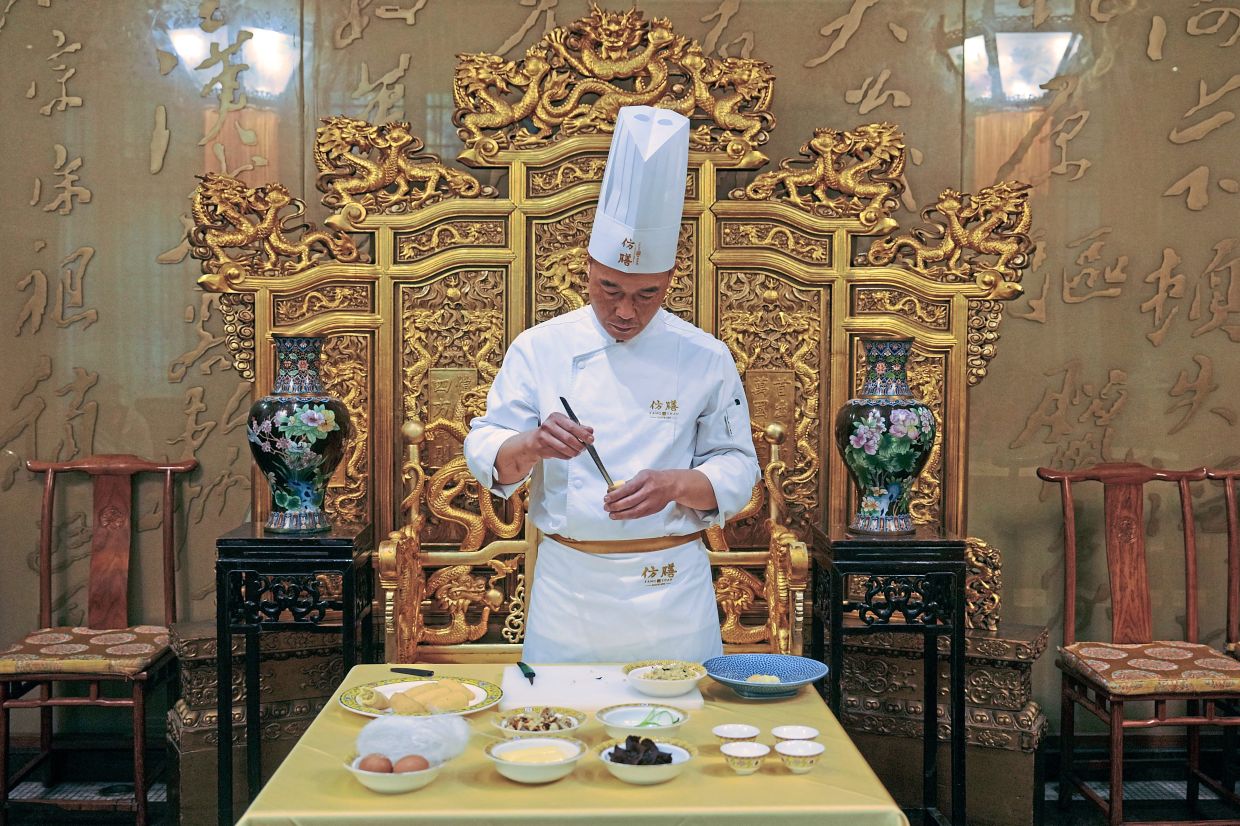
The legend of Empress Dowager Cixi's dream pastry exemplifies how Chinese imperial cuisine transcends mere sustenance, transforming food into cultural memory and political ritual. According to tradition, after the empress dowager envisioned a particular pastry, her kitchen staff presented it at her breakfast table the following morning. So delighted was she with this prescient offering that she rewarded the chef responsible with a silver ingot. What had originally been called a simple minced pork pancake became immortalised as the dream pastry, a name that would endure through China's dynastic collapse and into the modern era. Today, this dish remains a centrepiece at Fangshan Restaurant in Beijing, where it carries not merely the memory of imperial favour but an entire narrative of court life and culinary excellence.
Fangshan Restaurant itself stands as a living archive of imperial dining practices, founded in 1925 by former chefs who once served the Qing Dynasty court. Situated within Beihai Park—a classical garden where emperors once conducted government business and performed essential ritual sacrifices—the restaurant deliberately positions itself as custodian of an endangered culinary heritage. The establishment's very name announces its purpose: Fangshan translates literally as imitating imperial cuisine, an honest declaration that its mission involves resurrection and preservation rather than innovation. Complementing Fangshan's efforts, Beijing's Palace Museum actively preserves artefacts of court dining, including elaborate pastry moulds and ritual vessels that illuminate how emperors and their courts approached food as an instrument of governance and spiritual practice.
Imperial cuisine operated according to elaborate ceremonial protocols that invested eating with political and spiritual significance. During Qing Dynasty banquets, milk tea service opened proceedings with ritualistic formality, establishing the hierarchical framework within which food and drink would circulate. The emperor controlled the distribution of wine and delicacies among princes and officials, who in turn performed prescribed acts of deference before consuming what they received. This choreography of consumption reinforced court hierarchy and demonstrated imperial authority through the seemingly simple act of offering food. Beyond secular banquets, sacrificial rituals created parallel systems where unseasoned meat—particularly pork prepared without salt—became offerings to heaven and ancestors. The Palace of Earthly Tranquillity hosted ceremonies in which fatty pork was boiled plain, then distributed among assembled guests as tokens of extraordinary honour.
The philosophical underpinnings of these practices ran deeper than mere ceremonial convention. Classical Chinese ritual texts such as the Book of Rites prescribed unseasoned broths for sacrificial meals, a practice rooted in symbolic meaning rather than culinary preference. Scholars interpret this absence of flavouring as deliberate evocation of an earlier, simpler cooking tradition, thereby connecting contemporary ritual to ancient cultural origins. The unseasoned dish functioned as edible history, visually and sensorially reminding participants of their cultural continuity with distant ancestors. This understanding transforms imperial cuisine from a collection of recipes into a philosophical system where food becomes the medium through which dynasties communicated values, asserted legitimacy, and maintained continuity with China's classical past.
Pastries occupied a particularly exalted position within imperial culinary hierarchies, warranting the establishment of dedicated court institutions for their production. The technical mastery required to create imperial pastries represents a knowledge system entirely distinct from everyday cooking, demanding apprenticeship under qualified masters and transmission across generations through demonstration rather than written instruction. Zhou Tong, a pastry chef at Fangshan, learned his craft from a mentor who acquired techniques from his own teacher, creating an unbroken lineage stretching back to the imperial kitchens themselves. Contemporary diners eating Cixi's dream pastry or the delicate steamed corn buns served at Fangshan are, in effect, consuming the accumulated expertise of multiple generations of craftspeople whose names largely remain anonymous in historical records.
The technical distinctions separating imperial pastry-making from industrial food production illuminate why this culinary tradition cannot be mechanised without fundamental compromise. All labour must occur by hand; electrical blenders and food processors remain strictly prohibited within Fangshan's kitchen. Dried beans require pulverisation through sieves rather than mechanical grinding, while certain flours must be handled exclusively in custom-made copper vessels that distribute heat differently than contemporary cookware. These constraints produce specific textural qualities—a delicate graininess and sandy mouthfeel—that machines fundamentally cannot replicate. What might seem like inefficient traditionalism actually represents sophisticated knowledge about how different techniques produce qualitatively distinct sensory experiences. The pea flour cakes that sell more than two hundred units daily during peak seasons command their popularity precisely because handcrafted production yields qualities that industrialised baking cannot match.
Executive chef Fan Liangliang's professional journey illustrates the demanding apprenticeship required to master imperial culinary traditions. Upon joining Fangshan as a kitchen apprentice, he discovered that conventional culinary training had actually misdirected him, teaching speed and convenience over the slower, more deliberate processes that characterise imperial court cooking. He learned techniques entirely novel to his previous experience, including Nizihuo—a process involving the careful mincing of fish, shrimp, or chicken into smooth pastes that are then reshaped into decorative animals and flowers. Fan describes this approach as a hallmark of imperial cuisine because every dish required simultaneous achievement of multiple objectives: visual innovation, nutritional superiority, aesthetic beauty, and inherent worthiness of presentation before imperial diners. This comprehensive quality framework governed kitchen decision-making in ways utterly foreign to restaurants organised around efficiency or profit maximisation.
Adaptation rather than rigid authenticity guides contemporary imperial cuisine preservation. Because the imperial court once served rare ingredients such as bear paws—now impossible to obtain legally or ethically—modern chefs modify recipes while attempting to preserve the essential spirit of each dish. This pragmatic approach acknowledges that culinary traditions cannot remain frozen in time without becoming museum exhibits disconnected from living practice. Instead, Fangshan and similar establishments engage in dialogue between historical knowledge and contemporary constraints, asking how imperial principles might be honoured within present ethical and practical boundaries. This philosophy recognises that all traditions inevitably transform as they travel through time, and that the goal of preservation involves maintaining continuity of purpose and principle rather than exact replication of ingredients or methods.
The significance of imperial cuisine extends far beyond the dining table into the realm of political symbolism and cultural meaning. A classical Chinese poet once memorialised cold noodles made with pagoda-tree leaves not as a mere description of food but as an expression of political loyalty and thwarted ambitions to serve the emperor directly. This poetic transformation reveals how Chinese culinary traditions have historically functioned as vehicles for expressing ideas about politics, governance, aesthetics, and cultural identity. Food narratives embedded meanings that resonated across social hierarchies and temporal distances, allowing subsequent generations to read political and personal aspirations within descriptions of dishes. Understanding this symbolic dimension becomes essential for those attempting to preserve culinary heritage seriously—preservation requires taking history genuinely seriously, recognising that how contemporary society chooses to remember and consume imperial cuisine reveals contemporary values and anxieties as much as it illuminates dynastic practices.
Fangshan's stewardship of imperial cuisine ultimately represents an act of cultural negotiation between Manchu and Han culinary traditions. The Qing Dynasty's Manchu rulers incorporated Han Chinese cuisine into their court while maintaining distinct Manchu preferences and techniques. This fusion created something categorically new—neither purely Manchu nor purely Han, but rather a syncretic cuisine that reflected the hybrid character of Qing imperial culture itself. By maintaining this fusion today, Fangshan preserves not merely recipes but evidence of how imperial power operated across ethnic boundaries, how foreign conquerors adopted and adapted the culinary traditions of their subjects while maintaining distinct identity. The restaurant thus functions as a edible archive of early modern multiculturalism, demonstrating how conquest and coexistence produced cultural synthesis rather than erasure.
For Southeast Asian readers and Malaysian audiences with historical connections to imperial Chinese culture, Fangshan's work carries particular resonance. Many families throughout Malaysia, Singapore, and the region maintain ancestral links to China, and understanding how the motherland preserves its imperial heritage illuminates possibilities for maintaining cultural continuity amid rapid modernisation. Imperial Chinese cuisine represents centuries of accumulated knowledge about how food creates meaning, community, and connection to ancestral tradition. As globalisation and rapid urbanisation challenge local food systems throughout Southeast Asia, Fangshan's careful preservation model offers an alternative framework—one suggesting that culinary heritage deserves investment, that slow handcraft remains valuable, and that stories embedded within traditional dishes warrant preservation and transmission.
The servers at Fangshan routinely narrate the histories behind dishes, recognising that contemporary diners derive meaning from understanding context and heritage alongside taste. This practice transforms restaurant visits into educational experiences where customers connect with China's imperial past through sensory experience, storytelling, and deliberate reflection. The dream pastry becomes more than sweetened dough; it becomes a tangible link to Empress Dowager Cixi, to the chef who achieved imperial favour, and to the countless apprentices who refined the recipe across generations. Through this integration of narrative, history, and craft, Fangshan demonstrates that preserving culinary traditions requires simultaneously preserving the stories that give them meaning. For Malaysia and Southeast Asia, this model suggests that regional cuisines deserve similar investment in historical recovery, apprenticeship systems, and narrative frameworks that connect contemporary eating to deeper cultural continuities. The restaurant's success reveals that diners increasingly seek meaning alongside nourishment, and that restaurants functioning as cultural institutions rather than mere commercial establishments can thrive while advancing preservation of endangered heritage.

