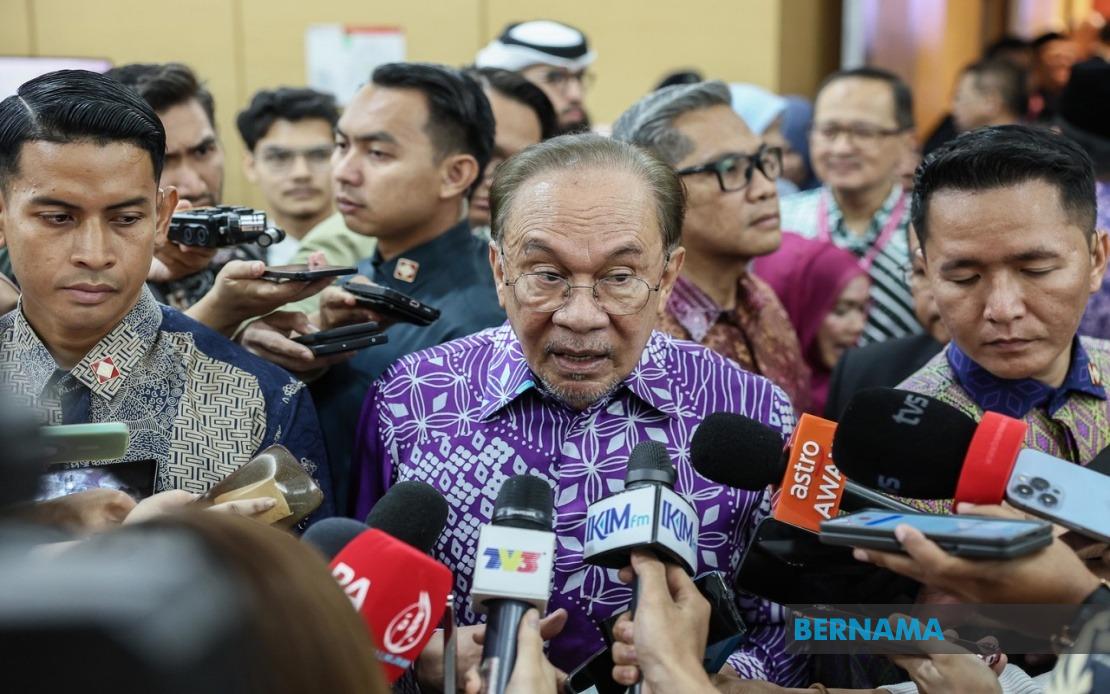
Prime Minister Datuk Seri Anwar Ibrahim has issued a powerful reminder that Malaysia's economic ambitions must ultimately serve humanity rather than exist as an end in themselves. Speaking at the Humane Economy Global Discourse event in Kuala Lumpur on July 23, Anwar stressed that regardless of how aggressively the nation pursues growth, technological innovation or progressive policies, these efforts will ring hollow unless they are anchored in genuine concern for people's welfare and dignity.
The Prime Minister's remarks come at a critical juncture for Malaysia and indeed the entire Asia-Pacific region, where the rush to capitalise on emerging technologies and attract foreign investment can sometimes overshadow the fundamental question of whom development is supposed to benefit. Anwar's intervention signals that his administration views this tension as something that demands explicit political attention rather than assumption that growth will automatically translate into improved lives for ordinary Malaysians.
Acknowledging the transformative forces reshaping global economies, Anwar noted that Malaysia faces a landscape being rapidly reshaped by artificial intelligence, renewable energy transition, advanced manufacturing techniques and biotechnology breakthroughs. These forces present both immense opportunity and genuine peril for a middle-income nation trying to maintain competitiveness while ensuring that prosperity is broadly distributed rather than concentrated among elites.
The challenge Anwar articulated reflects a growing international consciousness that purely technocratic approaches to development have created societies where economic indicators appear healthy even as large segments of the population experience stagnation or decline in living standards. For Southeast Asian nations watching closely, Malaysia's attempt to explicitly weave moral and ethical considerations into its development framework offers an alternative model to the purely metrics-driven approach that has dominated policy discussions for decades.
Central to Anwar's message is the assertion that Malaysia must remain ambitious in attracting investment and maintaining productivity while simultaneously reorienting its economy toward genuine human flourishing. This is not a call to abandon competitiveness or retreat from global markets, but rather an insistence that economic policy should be evaluated not solely through the lens of GDP growth but through measures that capture whether ordinary people have access to dignified employment, adequate housing, quality healthcare, and meaningful participation in their communities.
The distinction Anwar drew—that the economy functions as a means rather than an end—carries particular significance for Malaysian society, where rising living costs, housing affordability crises, and inequality have become increasingly salient political issues. By reframing the purpose of economic policy in this manner, the Prime Minister is attempting to redirect national conversation away from abstract metrics and toward tangible improvements in the quality of life that citizens experience.
The presence of Minister in the Prime Minister's Department (Religious Affairs) Dr Zulkifli Hasan at the event underscores that this framing of economics is not merely utilitarian but carries moral and spiritual dimensions. This positioning suggests that Malaysia intends to develop an economic model that deliberately integrates values traditionally associated with religious and ethical frameworks, challenging the notion that capitalism and moral purpose are inherently at odds.
Chairman of Forum Ekonomi Manusiawi and HEGD 2026 director Prof Datuk Dr Saadiah Mohamad's involvement indicates that this initiative has intellectual backing from respected academics and thought leaders, lending credibility to what might otherwise be dismissed as political rhetoric. The Humane Economy Global Discourse platform itself represents an attempt to create sustained dialogue around these questions rather than treating them as one-off policy pronouncements.
For Malaysian stakeholders across business, civil society and government, Anwar's emphasis on moral purpose raises important questions about how existing economic institutions and policies should be evaluated and potentially reformed. It suggests that upcoming policy decisions—whether regarding technology regulation, labour standards, environmental protection or wealth distribution—will be assessed not merely on their efficiency but on their contribution to broader human flourishing.
The regional implications extend beyond Malaysia's borders, as neighbouring Southeast Asian economies grapple with similar pressures to modernise rapidly while managing growing inequality and social dislocation. If Malaysia successfully integrates ethical considerations into its development framework, it could establish a template that other nations in the region might adapt to their own contexts, potentially reshaping how development itself is conceptualised across Asia.
Implementing such vision requires more than rhetorical commitment; it demands alignment between stated values and actual policy choices, particularly regarding taxation, education, healthcare investment and labour protections. The true test of Anwar's pronouncement will lie in whether his administration pursues concrete measures that subordinate narrow economic metrics to broader measures of human welfare, and whether it can maintain this commitment even when such choices create short-term economic friction.

