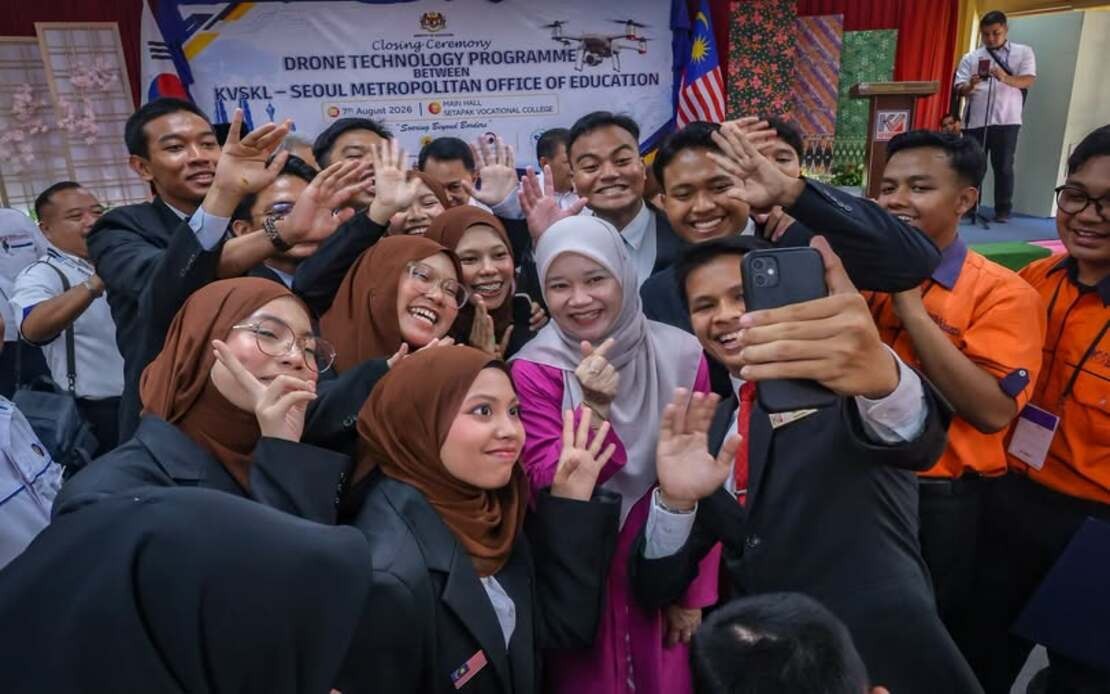
Education Minister Fadhlina Sidek has set an ambitious task for vocational students at Setapak Vocational College: devise practical applications of drone technology to strengthen security measures on their campus. The initiative, unveiled during a collaborative exchange with South Korea's Seoul Metropolitan Office of Education, reflects a broader push to embed emerging technologies into Malaysia's educational landscape and encourage problem-solving approaches among young learners. Students have been allocated one month to research, develop, and ultimately present their proposals directly to the minister, marking a hands-on challenge that bridges classroom learning with real-world application.
The challenge emerged from a bilateral education programme that brought South Korean expertise in robotics and drone operations to Malaysian vocational students. The visit of South Korean Ambassador to Malaysia Yeo Seung-bae underscored the significance of the exchange, positioning it as more than a routine skills-sharing exercise but rather a strategic partnership aimed at modernising technical education. By pairing Malaysian students with South Korean institutional knowledge, the collaboration creates opportunities for cross-cultural learning while exposing local talent to global standards in vocational training.
Fadhlina's intervention reflects a deliberate ministerial strategy to position vocational education as a vehicle for technological advancement rather than a parallel track to academic study. Her insistence that students move beyond merely operating drones—to instead conceptualise solutions to tangible institutional challenges—demonstrates an understanding that technical proficiency without problem-solving capability remains incomplete. This approach aligns with evolving workforce demands, where employers increasingly seek graduates who can not only use technology but strategically deploy it to address operational inefficiencies.
During campus demonstrations, Fadhlina observed students piloting drones, programming robotic systems, and engaging with various technological platforms. Her public acknowledgment of their persistence despite occasional failures carries particular weight; by celebrating the learning process itself rather than exclusively rewarding success, the minister signals that experimentation and iteration are intrinsic to competency development. This messaging is crucial in vocational education, where confidence and risk-taking often distinguish capable technicians from merely competent ones.
The minister articulated a broader philosophical position regarding technological literacy in contemporary Malaysia. Robotics, drone systems, and artificial intelligence are no longer theoretical concepts confined to academic research; they represent the operational reality of modern workplaces across manufacturing, agriculture, logistics, and security sectors. Educational institutions that fail to integrate these technologies into their curricula risk graduating students unprepared for the labour market they will enter. Conversely, institutions embedding such training provide graduates with competitive advantages in an increasingly technology-dependent economy.
Campus security represents a particularly apt domain for this challenge. Malaysian educational institutions face ongoing concerns about unauthorised access, monitoring of large perimeters, and rapid response to incidents. Drone technology offers scalability and cost-effectiveness compared to traditional security infrastructure. Student-generated proposals may range from autonomous perimeter surveillance systems to rapid-response protocols triggered by drone-detected anomalies, potentially offering administrators innovative approaches to existing challenges. Even if not immediately implemented, the exercise cultivates entrepreneurial thinking among vocational learners.
The one-month timeframe reflects realistic project parameters, allowing sufficient time for research and prototyping without extending into academic calendar complications. This compressed schedule also mirrors professional project management practices, teaching students to work within constraints while maintaining deliverable quality. The requirement to present directly to the education minister adds accountability and prestige to the exercise, transforming it from a classroom assignment into a genuine stakeholder engagement.
Setapak Vocational College's participation in this initiative positions it as a leading institution in technical education innovation within the Klang Valley region. The success of this programme may well influence how other vocational colleges approach curriculum development and industry partnerships. If student proposals generate implementable solutions, the college could become a demonstration site for how problem-based learning integrates theoretical knowledge with practical outcomes.
The broader context involves Malaysia's ongoing efforts to develop a technically skilled workforce sufficient to support manufacturing, infrastructure, and digital economy ambitions outlined in various national development plans. Vocational education has traditionally served as a pathway for students not pursuing university degrees, but its status and quality have sometimes lagged behind academic streams. Initiatives like this one, directly linking vocational training to ministerial priorities and international partnerships, help elevate vocational education's profile and resource allocation.
Fadhlina's emphasis on students identifying real problems and designing technological solutions reflects global best practices in STEM education. Rather than passive consumption of knowledge, learners become active agents in knowledge application. This pedagogical shift encourages deeper engagement with material and increases retention of concepts. Students who solve problems they care about—particularly when their solutions gain official recognition—develop stronger professional identities and greater confidence in their technical capabilities.
The involvement of South Korean expertise merits particular attention given that nation's global leadership in robotics and drone manufacturing. South Korea's educational system has heavily emphasised technical innovation and export-oriented manufacturing, making it a logical knowledge partner for Malaysia. The exchange facilitates not merely technology transfer but institutional learning about how education systems cultivate innovation ecosystems.
Looking forward, the minister's challenge could establish a template for engaging other vocational institutions with contemporary technological challenges. If successful, this model might expand to include other institutions and technology domains—autonomous vehicles for logistics, IoT applications for agriculture, or digital security systems for banking. Each represents genuine sectoral needs where vocational graduates could contribute meaningfully.

