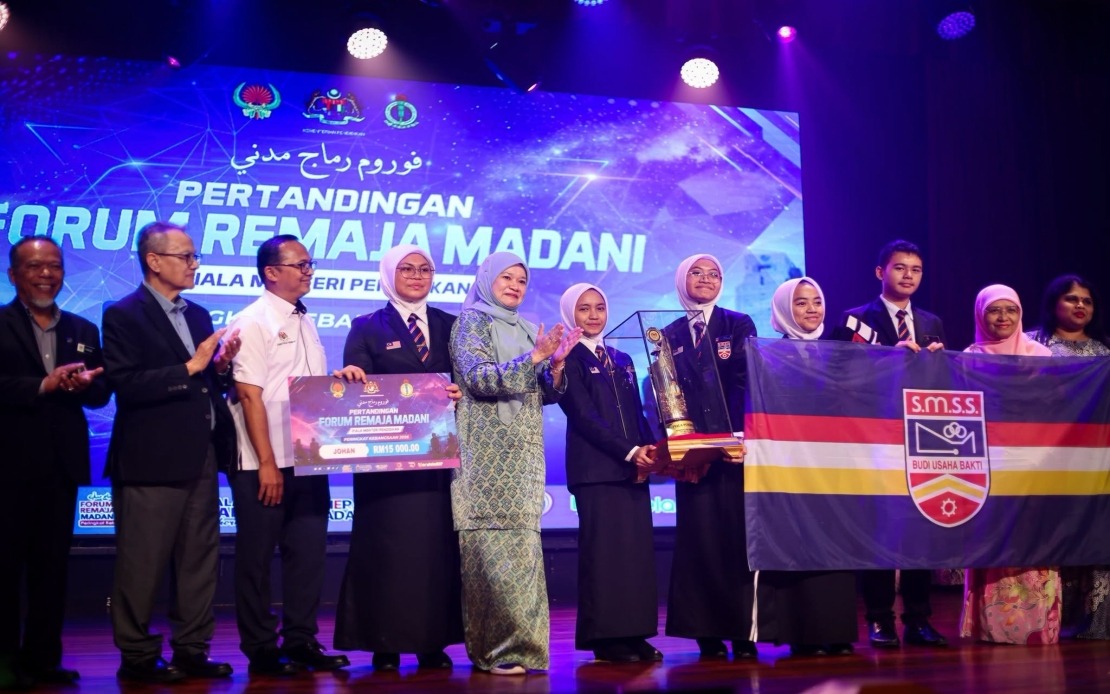
Education Minister Fadhlina Sidek has outlined a vision for character education that extends far beyond traditional notions of good behaviour, instead positioning young Malaysians as confident thinkers capable of engaging in reasoned debate while maintaining mutual respect. Speaking at the National MADANI Youth Forum in Kuala Lumpur, Fadhlina observed firsthand how participants were developing the ability to articulate their positions, listen to opposing viewpoints, and defend their arguments with substance and courtesy. Her remarks reflect a deliberate shift in how Malaysia's education system seeks to prepare the next generation for participation in civic life and democratic discourse.
The minister's emphasis on critical thinking represents a significant departure from purely didactic approaches to character development. Rather than positioning educators as arbiters of correct thought or behaviour, Fadhlina articulated a model where young people are actively encouraged to question, analyse, and formulate independent positions. This approach aligns with contemporary educational theory that links critical thinking skills to improved academic outcomes, better problem-solving abilities, and enhanced civic engagement. For Malaysia, a diverse nation navigating complex social and economic challenges, fostering this capacity among youth holds particular significance.
Fadhlina's insistence on respectful disagreement as a hallmark of mature nationhood challenges a common perception in Malaysian political discourse, where divergence of opinion is sometimes characterised as divisive or disloyal. By framing constructive disagreement as a strength rather than a weakness, the Education Minister is signalling that the government envisions a future where differences in viewpoint are acknowledged as inevitable and even desirable features of a functioning society. This conceptualisation has direct implications for how schools design curricula and classroom environments, potentially encouraging debate clubs, forums for student expression, and pedagogical methods that value dialogue over conformity.
The integration of character education with efforts to strengthen the Malay language forms another crucial dimension of Fadhlina's vision. She contends that the Malay language will flourish only when the younger generation perceives it as a dynamic, versatile medium capable of expressing complex ideas and contemporary thought. This perspective moves beyond preservation-focused arguments about language and instead frames Malay as an evolving tool for intellectual discourse. When young people feel empowered to use the language to articulate sophisticated arguments, defend positions, and engage in nuanced discussion, the language itself becomes more vibrant and relevant to their lives.
Fadhlina's comment that educators should not determine what young people should say, but rather ensure they possess the knowledge and courtesy to express themselves effectively, draws a careful distinction between content and capacity. This principle acknowledges the tension between guidance and autonomy that runs through educational philosophy. Teachers are positioned as facilitators who build communicative competence and encourage ethical thinking rather than gatekeepers of acceptable viewpoints. Such an approach requires educators themselves to be comfortable with uncertainty and the expression of diverse perspectives, suggesting a need for professional development and pedagogical support.
The practical implications for Malaysian schools are substantial. Implementing this vision would require creating spaces—both physical and psychological—where young people feel secure voicing unpopular or unconventional ideas. It would necessitate training educators to manage controversial topics without shutting down discussion, and to model the kind of respectful engagement the minister advocates. Classroom practices would need to shift toward more open-ended enquiry, debate frameworks, and collaborative problem-solving that genuinely values multiple perspectives rather than merely tolerating them.
Fadhlina's emphasis on listening with courtesy as a complement to speaking confidently underscores an often-overlooked aspect of democratic discourse. In societies where communication increasingly occurs through social media platforms that reward provocative statements and punish nuance, the minister's call for courteous attention to opposing views represents a countercurrent to prevailing digital norms. Teaching young people to listen actively and respectfully is as important as teaching them to articulate their positions, yet far less commonly emphasised in character education frameworks.
The timing of these remarks carries significance in Malaysia's current political context. With a new generation approaching voting age and increasing youth participation in public discourse, investing in character education that produces thoughtful, respectful citizens capable of navigating disagreement takes on heightened importance. The minister's vision suggests that educational institutions have a role not merely in imparting knowledge but in shaping the civic culture itself.
However, translating this vision into consistent practice across Malaysia's diverse education system presents genuine challenges. Resource constraints, examination-driven pressures that prioritise content coverage over dialogue, and varying educator capacity all pose obstacles. Additionally, fostering critical thinking and respectful disagreement requires parents, media, and political leaders to model these behaviours—a broader cultural shift that cannot be achieved through schooling alone.
Fadhlina's articulation of these principles represents an important public commitment to a particular model of education and citizenship. Whether schools and teachers possess the support, training, and institutional space to realise this vision remains to be seen. Nevertheless, her framing offers a compelling counter-narrative to more authoritarian or conformity-focused approaches to character education, one that aligns with democratic values and the complex realities of contemporary Malaysia.

