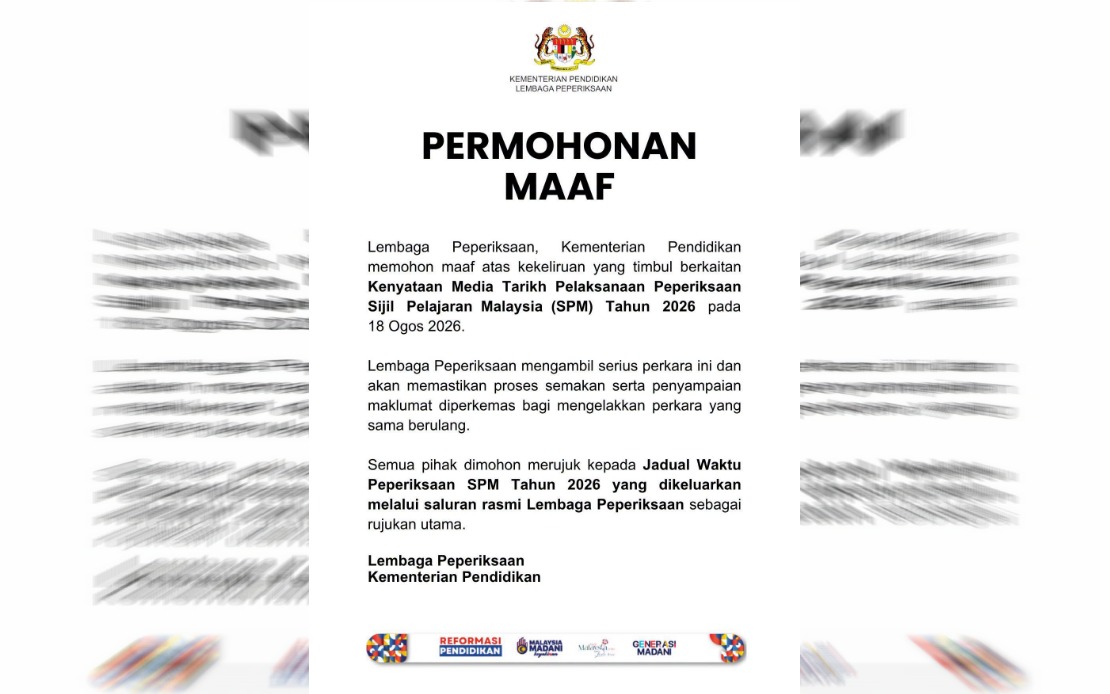
The Examination Board under Malaysia's Ministry of Education has publicly apologised for creating confusion with contradictory announcements regarding the implementation schedule for the 2026 Sijil Pelajaran Malaysia (SPM) examination. The error, which emerged from a press release distributed on August 18, prompted immediate clarification and an acknowledgement that information dissemination procedures require strengthening.
In its formal response issued on August 19, the Examination Board acknowledged the seriousness of the miscommunication and committed to reviewing its internal processes to ensure such incidents do not recur. The statement emphasised that streamlining both the review mechanisms and information delivery channels would be prioritised moving forward, signalling recognition that accuracy is paramount when communicating with stakeholders across the national education system.
The board has now explicitly directed all parties—including students, parents, educators, and school administrators—to exclusively reference the official 2026 SPM Examination Timetable released through the Examination Board's designated channels. This guidance is intended to eliminate any lingering ambiguity and establish a single authoritative source for scheduling information, preventing candidates and institutions from acting on potentially outdated or conflicting details.
The scope of this examination cycle is substantial, with 420,879 candidates having registered nationwide to sit for the 2026 SPM. These students will take their examinations across 3,334 examination centres distributed throughout the country, reflecting the logistical complexity involved in coordinating such a large-scale national assessment. The sheer number of participants underscores why clear, timely, and accurate communication from education authorities is critical to ensuring smooth administration and reducing unnecessary anxiety among test-takers and their families.
According to the finalised timetable, the 2026 SPM examination will commence on November 23 and conclude on December 17, providing a defined four-week window during which all assessments will be conducted. This schedule allows schools to plan their academic calendars accordingly and gives students a concrete timeline for their preparation efforts. The compressed examination period also reflects the education ministry's approach to efficiently completing assessments while minimising disruption to the broader school year.
For Malaysian secondary students and their families, clarity on examination dates carries significant weight. The SPM remains a critical qualification for progression to tertiary education and vocational training pathways, making scheduling certainty essential for effective revision planning and mental preparation. Any confusion about when examinations will actually take place can disrupt study routines and create unnecessary stress during an already demanding period for Year 12 students.
This incident also highlights the importance of institutional quality assurance in government communications, particularly in sectors directly affecting public welfare such as education. The ministry's willingness to acknowledge the error and outline corrective measures demonstrates accountability, though it also raises questions about the checks and balances that should have prevented the initial confusion from being released publicly.
The clarification process underscores that Malaysia's education administration is operating at substantial scale, managing hundreds of thousands of student assessments across diverse geographic locations. Coordination challenges are inevitable in such systems, but the ministry's response suggests a commitment to minimising future disruptions through procedural improvements.
For schools and educational institutions nationwide, the clear directive to use only official examination board channels for scheduling information should simplify their administrative preparations. This centralised approach reduces the risk of individual schools or district offices acting on outdated or incorrect information, which could have cascading effects on student welfare and academic planning.
Looking ahead, the 2026 SPM examination represents a significant educational milestone for the cohort of students now in their final secondary year. With over 420,000 candidates preparing for assessments across diverse subjects and skill areas, the success of this examination cycle depends not only on student preparation but also on institutional competence and transparent communication from the education ministry. The board's commitment to improving its information management processes will be tested as this large student population progresses through their final months of secondary education and approaches the November-December examination window.

