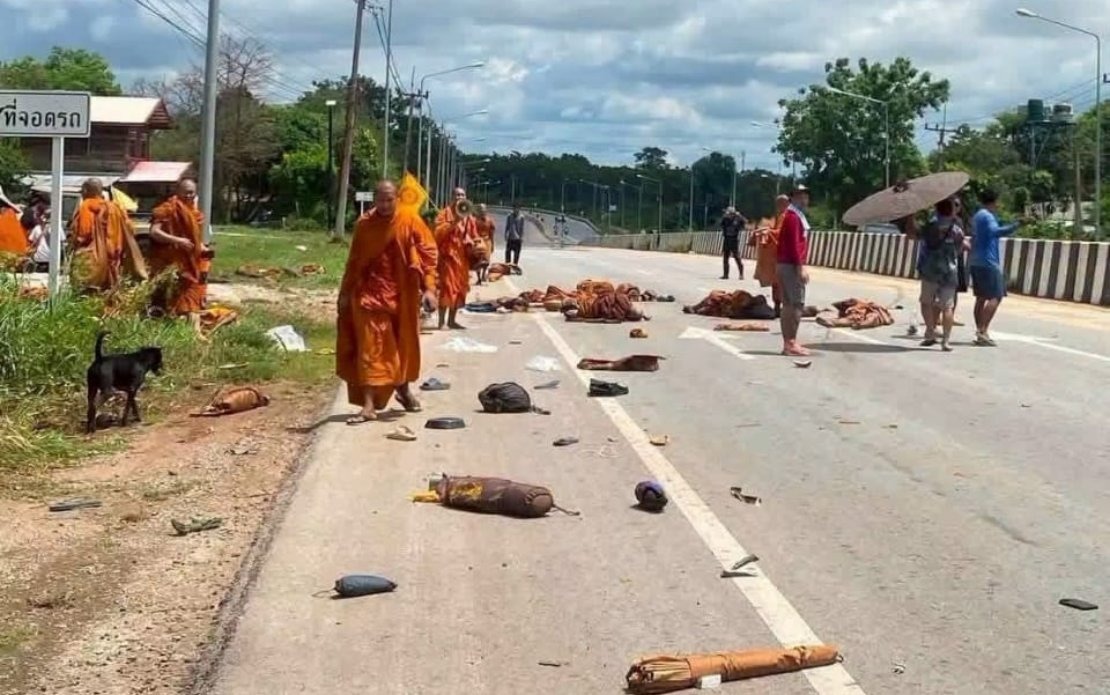
A devastating road accident in Thailand's northeastern Mukdahan province has claimed the lives of eight Buddhist monks, casting fresh scrutiny on vehicle safety and juvenile driving privileges in the region. The tragedy unfolded Thursday when a pickup truck lost control and veered into a pedestrian group comprising monks engaged in a foot pilgrimage to Nam Khun district in the neighbouring Ubon Ratchathani province. Five monks died instantly at the scene, while three more succumbed to severe injuries while receiving treatment at hospital. The incident has reignited broader concerns across Southeast Asia regarding road discipline, particularly involving young drivers and the enforcement of traffic regulations.
According to Mukdahan authorities, the monastic group had commenced their religious journey at approximately 11 am, walking along Ban Na Si Nuan Road in Mueang district in a direction deliberately chosen against oncoming traffic flows—a standard pedestrian safety measure designed to maximise visibility. The monks maintained a position approximately two metres from the road's verge as they processed during daylight hours. However, the pickup truck suddenly veered off its intended path, striking the monks travelling at the rear of the group. The initial five monks in the procession managed to evade the vehicle, but those following were not as fortunate, absorbing the full force of the collision.
The scale of injuries extends considerably beyond those who perished. According to Dr Narong Chankaew, Mukdahan Provincial Public Health Chief, four additional victims sustained injuries classified as critical, whilst ten others experienced moderate trauma. Hospital admissions ultimately involved 23 patients, comprising 22 monks and one accompanying layperson, straining local medical resources and triggering an urgent public appeal for blood donations. The distribution of injury severity indicates the indiscriminate nature of the collision, affecting individuals throughout the rear section of the procession regardless of their proximity to the vehicle's primary impact zone.
Mukdahan Governor Warayan Boonnarat's preliminary investigation findings highlight a critical question: how a juvenile gained access to and control of a motor vehicle. The driver, identified as being under 15 years of age, remains in custody whilst police conduct their inquiry. The investigation has expanded to encompass not merely the immediate mechanical or circumstantial cause of the crash, but also the deeper question of parental responsibility and negligence. Investigators are examining whether the young driver operated the vehicle with parental knowledge or permission, and Mukdahan Provincial Police Commander Police Major General Phairoj Thaiputra indicated that parents could face formal negligence charges depending on evidence gathered during questioning.
The mechanics of the crash itself remain under active investigation, though witness accounts to authorities suggest the pickup truck lost operational control before deviating onto the roadside where the monks walked. This distinction between mechanical failure, driver error, or deliberate action carries significant legal and insurance ramifications. Police continue amassing evidence and conducting forensic analysis of the vehicle, though preliminary indications point toward driver inexperience or inattention rather than mechanical defect. The questions surrounding how a child gained unsupervised access to a registered vehicle speaks to broader supervision gaps that extend beyond this single tragic incident.
For Malaysia and other Southeast Asian nations, this tragedy serves as a sobering reminder of recurring road safety challenges. Thailand continues to grapple with elevated traffic fatality rates, and incidents involving young drivers frequently feature in regional accident statistics. The involvement of a juvenile driver raises uncomfortable questions about enforcement of age restrictions, vehicle access controls, and parental oversight that resonate throughout the region's transport sector. Many Southeast Asian countries maintain legal driving ages of 16 or 17, yet underage operation of vehicles remains persistent, particularly in rural areas where enforcement intensity diminishes.
The religious dimension of this tragedy adds particular poignancy to the broader safety discussion. Buddhist monks represent spiritually significant members of their communities, and mass casualties among monastic orders carry deep cultural weight across Buddhist-majority nations including Thailand, Myanmar, Cambodia, and Laos. The pilgrimage itself—a religious obligation and spiritual practice—was undertaken during daylight hours with apparent attention to pedestrian safety protocols. The randomness of the collision underscores how even careful adherence to safety measures cannot guarantee protection when vehicle operators lack the judgment, training, or physical capability to maintain control of powerful machinery.
Police investigation protocols indicate that legal consequences will be pursued in accordance with Thai law, which typically treats juvenile offenders under specialised judicial frameworks. However, the potential extension of liability to parents represents a significant development in accountability structures. If negligence charges proceed against the child's parents for permitting unsupervised vehicle use, this could establish precedent affecting how regional jurisdictions approach parental responsibility in traffic incidents. Such prosecutions remain relatively uncommon in Southeast Asia, where enforcement often focuses primarily on the direct operator rather than those facilitating access to vehicles.
The immediate aftermath saw Mukdahan Hospital mobilising community resources to support treatment of the injured, with urgent appeals for blood donations reflecting the severity of injuries sustained and the localised pressure on medical supplies. Rural hospitals in Thailand's northeastern regions frequently operate with constrained resources, and mass casualty events can rapidly exceed their capacity and capability. The hospital's public health emergency response highlights how a single traffic incident can cascade through entire community support systems, extending the tragedy's impact beyond the immediate victims and their families.
This incident arrives during a period of renewed regional focus on road safety initiatives. The Association of Southeast Asian Nations has periodically highlighted traffic mortality as a serious public health crisis, with road deaths representing a leading cause of injury and fatality across the region's younger populations. Thailand specifically has launched various road safety campaigns, yet implementation gaps persist, particularly in rural provinces and regarding enforcement of regulations affecting young drivers. The Mukdahan tragedy provides renewed impetus for substantive reform in vehicle access controls, driver licensing, and parental accountability mechanisms.

