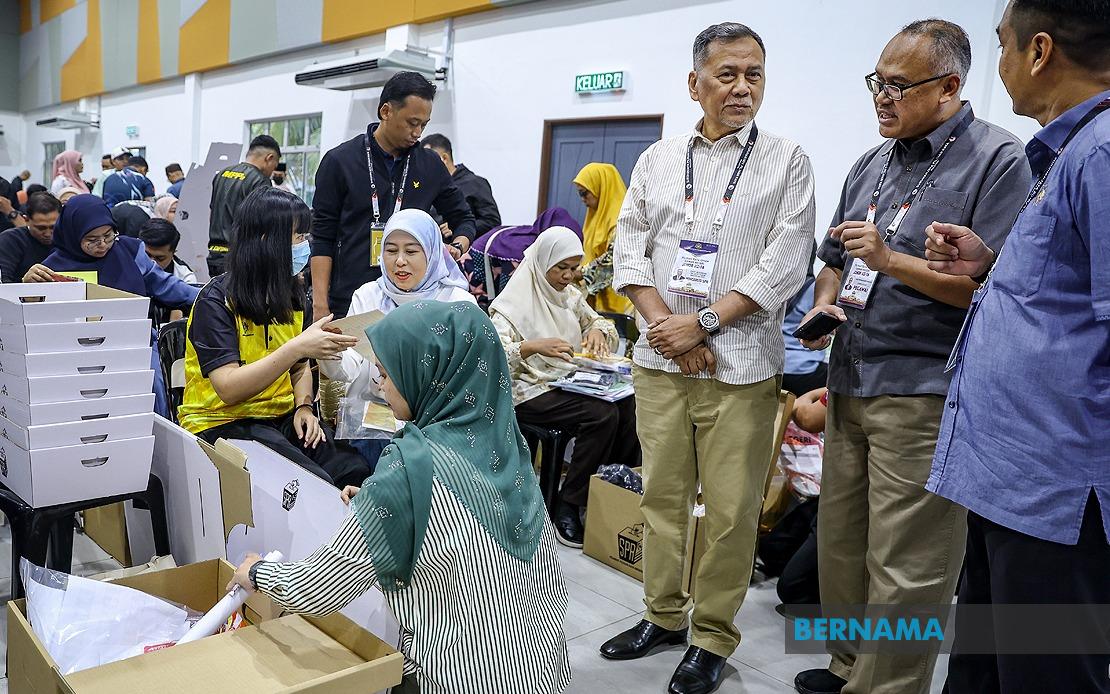
With polling set to commence on July 11, the Election Commission has wrapped up intensive final preparations across Johor to facilitate what officials describe as one of the nation's most significant electoral exercises at the state level. Election Commission Chairman Datuk Seri Ramlan Harun confirmed that rigorous verification of ballot boxes and polling equipment designated for all 56 state seats has been successfully completed, positioning the commission to deliver a seamless voting experience.
The logistical undertaking represents a substantial operational exercise involving thousands of personnel deployed across the state's diverse geography and demographics. Ramlan emphasised that these verification procedures rank among the most vital safeguards underpinning electoral integrity, essential given that nearly 2.7 million eligible voters will participate in fulfilling their democratic obligations. He noted that Returning Officers stationed at the 56 separate electoral centres had substantially concluded their preparatory duties, with the commission confident in its readiness to manage the anticipated voter participation.
Visibility of these arrangements extended to ground-level activity, with a visit to Sekolah Kebangsaan Bukit Mutiara in Johor Bahru revealing intensive final-stage work underway. Classrooms were being converted into distinct polling streams, with election personnel engaged in labelling materials, positioning furniture, and installing navigational signage. The polling centre supervisor for Puteri Wangsa constituency, Mohd Rasib Ngadiman, detailed that 12 classroom spaces would function as independent voting stations, supported by a contingent of 74 election staff and 12 police officers assigned for security. The commission had also prioritised accessibility provisions, arranging wheelchair facilities for elderly citizens and voters living with disabilities.
Preparations replicated this meticulous approach across additional centres. In Kluang, staff at Sekolah Kebangsaan Kampong Melayu organised five distinct polling streams designed to accommodate approximately 3,000 voters within the Mahkota state seat, with 30 personnel managing the configuration. Similarly, in Batu Pahat's Yong Peng locality, preparations at Sekolah Menengah Kebangsaan Dato' Seth placed particular emphasis on ergonomic design and accessibility features to serve senior voters, first-time electors, and citizens with mobility challenges.
The election campaign reflects substantial political competition, with 172 candidates contesting the 56 state assemblies across multiple parties. Both Pakatan Harapan and Barisan Nasional have fielded candidates throughout all constituencies, representing the dominant established political forces. Perikatan Nasional has mounted a challenge with 33 candidates, while several newer or smaller political entities—Parti Bersama Malaysia (15 candidates), Muda (4 candidates), the Malaysian Orang Asli Party and Socialist Party of Malaysia (each with one candidate)—have also entered the contest. Additionally, six independent candidates will appear on ballots, illustrating the fragmentation visible across Malaysia's contemporary political landscape.
One of the more operationally demanding aspects of the election involves the maritime components of Johor's electoral geography. The Tenggaroh constituency encompasses four islands—Pulau Aur, Pulau Pemanggil, Pulau Sibu, and Pulau Tinggi—requiring ballot boxes to be transported via Mersing Jetty with specialised security protocols. Tenggaroh's Returning Officer, Jamil Hasni Abdullah, explained that this logistical challenge necessitates approximately 50 dedicated personnel, accompanied by armed escorts from the Marine Police Force and Mersing district police headquarters to guarantee the integrity of election materials during transit.
The commission has issued formal guidance to voters to enhance operational efficiency and reduce queuing delays. Citizens are urged to participate during their designated time slots to prevent congestion at polling centres, carry identification documentation, and comply with instructions issued by election officials. These measures reflect international best practices in electoral administration while acknowledging the practical constraints of managing 2.7 million simultaneous voters across geographically dispersed locations.
For Malaysian readers, this election carries particular significance as Johor represents the nation's third-most populous state by registered voters and historically serves as a political bellwether influencing national electoral dynamics. The strong competition between Pakatan Harapan and Barisan Nasional, previously dominant state fixtures, against the challenge posed by Perikatan Nasional's expanded candidacy, signals the ongoing realignment within Malaysian politics following the 2020 general election. The turnout and results from this election will likely provide important indicators of voter sentiment ahead of potential future federal elections.
The presence of multiple smaller political parties and independent candidates also reflects Malaysia's evolving electoral environment, where single-party dominance has progressively diminished across recent electoral cycles. This diversification creates both administrative complexity and logistical demands that electoral commissions must accommodate to maintain public confidence in democratic processes. The Johor election thus represents not merely a state-level contest but a microcosm of broader trends reshaping Malaysian democracy and political competition.
The commission's extensive preparatory work demonstrates the sophisticated technical and human resources infrastructure required to administer competitive democratic elections across a diverse, geographically dispersed population. With nearly 2.7 million voters eligible to participate tomorrow, successful delivery of a well-organised, accessible, and secure electoral process remains critical for maintaining institutional credibility and public trust in democratic institutions throughout Malaysia.

