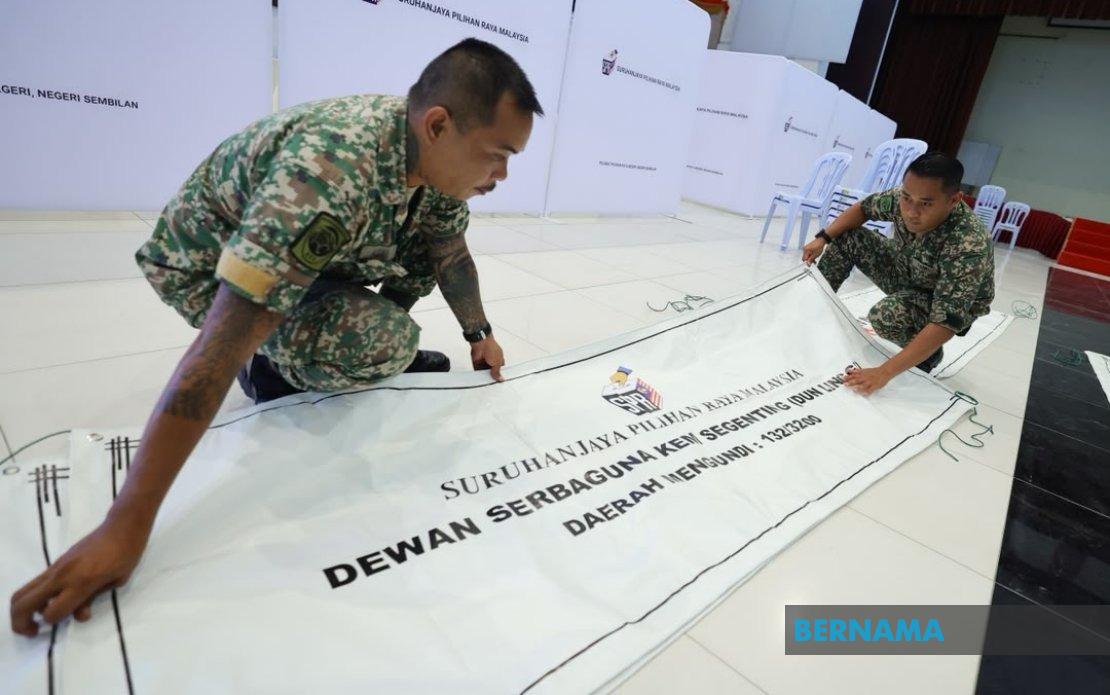
The Election Commission has declared itself ready to conduct early voting for the 16th Negeri Sembilan State Election, with Datuk Seri Ramlan Harun, the EC chairman, confirming that all necessary arrangements have been finalised to guarantee the process unfolds without incident. The announcement came as EC teams completed their preparations across 38 designated polling centres, signalling the machinery is in place for what represents a critical preliminary phase ahead of the state-wide election scheduled for August 1.
The early voting framework accommodates a substantial bloc of the electorate who would otherwise be unable to cast ballots on the standard polling day. Approximately 16,884 military personnel and their spouses, combined with 5,455 police officers and their eligible family members, will exercise their franchise during this advance voting period. This totals 22,339 individuals, a figure that underscores the significance of the military and security establishment within Negeri Sembilan's electoral participation. The geographical distribution of these voters necessitated the deployment of multiple polling stations, each strategically positioned to service specific security and defence installations throughout the state.
Field observations conducted by journalists at several key early voting locations, including the Seremban District Police Headquarters, the Negeri Sembilan Contingent Police Headquarters, and Kem Segenting in Port Dickson, confirmed that EC personnel were undertaking final procedural checks and equipment verification. These inspections represent standard protocol designed to eliminate potential operational bottlenecks and ensure that technological and administrative systems function correctly once voting commences. The presence of police and military staff assisting EC officials at these venues reflected coordinated logistical planning, with personnel stationed according to pre-arranged security and administrative protocols.
Operational hours for the early voting exercise commence at 8 am across all participating centres, though closing times vary based on the specific location and anticipated voter turnout at each site. This staggered approach to opening and closing acknowledges practical realities on the ground, allowing the EC to manage crowds efficiently and prevent queuing issues that might compromise voting security or voter experience. The flexibility in scheduling also reflects logistical realities inherent in servicing military and police installations, where operational requirements may necessitate adjustments to the standard voting window.
The 16th Negeri Sembilan State Election follows the official dissolution of the state assembly on June 5, triggering the electoral process. A total of 103 candidates are competing for 36 state seats, suggesting a moderately competitive field with multiple candidates contesting many constituencies. This level of competition indicates that the election is likely to generate substantive political engagement across the state, with various parties and independent aspirants seeking to capture voter support. The overall election narrative will unfold progressively through the early voting phase and culminate in the main polling day on August 1, when the broader electorate will determine the composition of the Negeri Sembilan State Assembly for the coming term.
For Malaysian observers and participants, the Negeri Sembilan election carries significance beyond the state's borders. Negeri Sembilan has historically functioned as a political bellwether for Malaysian politics more broadly, with shifts in voting patterns sometimes presaging broader national trends. The early voting process itself represents a standard feature of Malaysian electoral administration, recognising that members of the security forces and their dependents maintain special voting arrangements to accommodate operational demands. The efficiency and integrity of this early voting phase thus assumes importance not merely for Negeri Sembilan but as a test of EC operational competence ahead of any potential future national elections.
The EC's public confirmation of readiness carries procedural and political weight. By formally asserting that preparations are complete and systems are functioning as intended, the commission seeks to project confidence in the electoral process and reassure stakeholders that voting will proceed fairly and transparently. In Malaysia's political context, where electoral administration has occasionally attracted scrutiny and commentary from various quarters, such public assurances serve to establish baseline expectations regarding EC performance. Any significant disruptions or procedural irregularities during the early voting phase could provoke questions about broader electoral management.
The Negeri Sembilan election emerges at a particular moment in Malaysia's political calendar and development. The state represents a diverse electorate encompassing both urban centres and rural communities, with varying socioeconomic profiles and policy priorities. The competition for the 36 state seats will reflect broader conversations occurring within Malaysian politics concerning economic management, social policy, development priorities, and governance approaches. Early voting results, once officially released, may provide preliminary indicators of voter sentiment before the full picture emerges from August 1 polling.
The coordination evident in preparations for early voting also underscores the institutional maturity of Malaysia's electoral machinery. Despite occasional controversies, the EC has developed sophisticated systems for managing complex voting scenarios, whether involving military personnel, overseas voters, or other special categories. The deployment of officers to 38 separate centres, the synchronisation of equipment and procedures, and the coordination with security force authorities all reflect institutional capacity that has evolved over multiple electoral cycles. This administrative competence, while often taken for granted, represents a foundation upon which Malaysia's democratic processes rest.
As voting commences tomorrow morning, the focus will shift to practical implementation and the actual casting of ballots by military and police personnel across Negeri Sembilan. The early voting exercise will provide the first concrete test of these preparations, with any operational issues becoming apparent as voters proceed through polling booths. The conduct of early voting may also influence media narratives and public perception ahead of August 1, should provisional figures or anecdotal reports emerge regarding participation rates or voter sentiment. The EC's stated readiness will ultimately be validated through successful, incident-free completion of the early voting phase.

