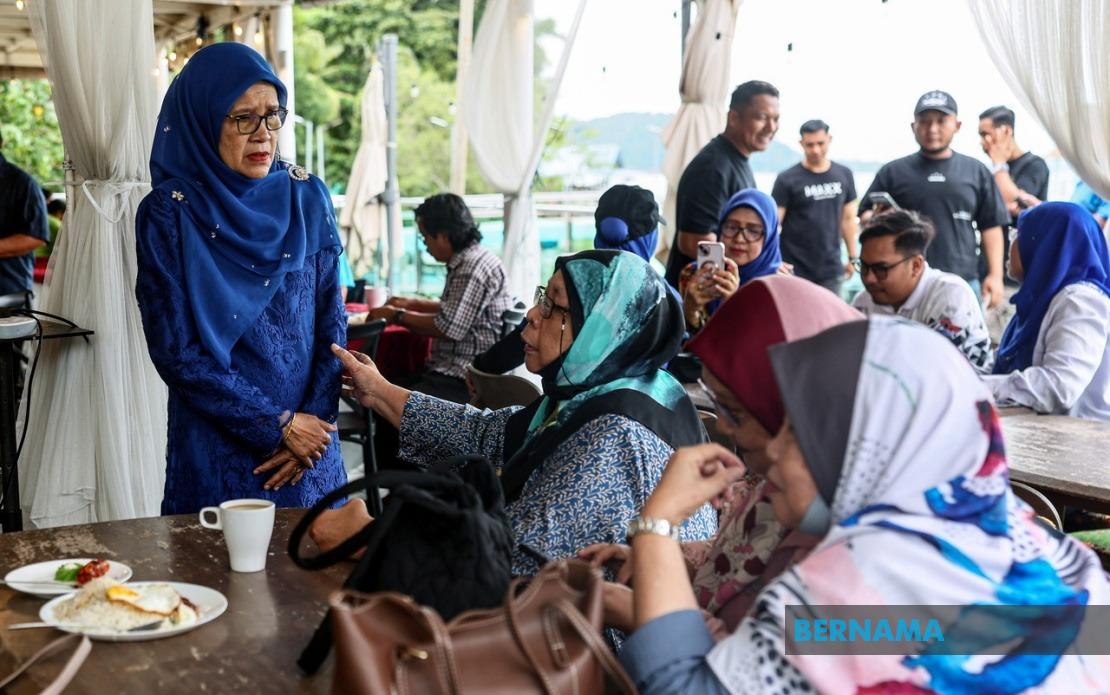
The Endau state constituency in northern Johor is shaping up to be one of the more substantive electoral contests in the 16th state election, with voters facing a clear ideological choice between proven incremental development and a sweeping economic reform platform. Incumbent Alwiyah Talib, affectionately known as Kak Awi, carries the banner of Barisan Nasional into a four-way race that also includes Pakatan Harapan's Saiful Nizam Samat, Perikatan Nasional's Hasnul Hakimi Hussien, and Parti Orang Asli Malaysia candidate Jati Awang. The contest encapsulates a broader tension in Malaysian politics between consolidating gains through established networks and pursuing structural economic transformation in rural constituencies.
Alwiyah's campaign strategy rests squarely on demonstrating tangible results from her two consecutive terms representing Endau, having initially won the seat on a PN ticket before transitioning to BN. Her flagship initiative involves repositioning the Mersing district as a comprehensive tourism destination rather than merely a transit hub to surrounding islands. Currently, the coastal economy relies heavily on island tourism, with visitors treating Mersing as little more than a boarding point for ferries. Alwiyah envisions a complementary inland tourism infrastructure anchored on homestay ventures in locations such as KampungStay@Teluk Buih, Penyabong, and Tanjung Resang, where preliminary success is evident through weekend occupancy rates. This dual-pronged tourism strategy would theoretically distribute economic benefits more evenly across the constituency while differentiating Mersing from competing coastal towns.
Beyond tourism infrastructure, Alwiyah is championing educational expansion in Endau, recognising that the constituency currently depends on a single secondary institution, Sekolah Menengah Kebangsaan Ungku Husin. Her commitment to construct an additional secondary school addresses a genuine pedagogical bottleneck whilst signalling intent to prevent educational inequity across different student cohorts. She frames these initiatives as requiring sustained commitment to prevent stalling midway, implying that her re-election is necessary for project continuity. This emphasis on completing initiated projects resonates with voters who have witnessed infrastructure programmes abandoned by previous administrations, though it necessarily frames Alwiyah as the indispensable custodian of Endau's development trajectory.
Saiful Nizam, the 42-year-old first-time PH candidate currently pursuing a PhD in Economics, presents a markedly different analytical framework centring on systemic economic restructuring. Rather than complementing existing tourism sectors, his platform prioritises revitalising primary production industries through what he terms the 'Fishermen's Economy 2.0' agenda. This approach acknowledges that Endau's coastal fishing communities remain economically vulnerable despite proximity to tourism hubs, with fishery modernisation offering potential spillover benefits to dependent entrepreneurs and service providers. By strengthening fisheries sustainability and profitability, the secondary economy of boat maintenance, equipment suppliers, and processing enterprises would correspondingly expand, theoretically creating employment opportunities that discourage youth migration to urban centres.
The 'Fishermen's Economy 2.0' framework reflects broader policy thinking within PH regarding agricultural modernisation and rural retention. Saiful Nizam's approach involves transitioning traditional fishing practices toward contemporary sustainable methods whilst simultaneously establishing institutional support through SME empowerment programmes. Digital marketing training and business development assistance would enable individual fishermen and small operators to capture greater value from their catch, potentially shifting the industry from volume-based competition toward quality-differentiated markets. This systemic intervention contrasts with Alwiyah's infrastructure-centric model by prioritising productive capacity enhancement over amenity development.
Complementing fisheries policy, Saiful Nizam's education platform encompasses Technical and Vocational Education and Training alongside STEM initiatives and English proficiency programmes. The proposed Endau Children's Education Fund represents a targeted poverty alleviation mechanism distinct from school infrastructure provision, addressing financial barriers that prevent capable students from accessing secondary and tertiary pathways. These educational interventions would theoretically prepare the younger demographic for both the modernised fisheries sector requiring technical skills and alternative employment sectors requiring adaptability. The emphasis on continuous community programming additionally suggests commitment to social cohesion beyond purely economic metrics.
Food security emerges as an explicit concern within Saiful Nizam's platform, with promotion of modern farming methodologies intended to enhance agricultural productivity within the constituency. In the context of Malaysian rural demographics where older populations increasingly dominate, such initiatives might prove symbolic as much as substantive, yet they address legitimate anxieties about supply chain fragility and import dependence. The integration of food security, fisheries, and SME support into a coherent economic narrative provides intellectual coherence that appeals to voters seeking comprehensive rather than narrowly sectoral approaches.
The electoral dynamics are complicated by Alwiyah's party realignment, having initially secured her seat under PN before transferring allegiance to BN. This trajectory raises questions about her long-term political stability, though she frames her motivation as pragmatic governance rather than opportunistic affiliation. Her candid description of electoral competition as demanding sincerity without hypocrisy suggests awareness of voter scepticism regarding political volatility. Conversely, Saiful Nizam's positioning as a policy intellectual without prior electoral experience represents both vulnerability and opportunity, potentially attracting voters fatigued by professional politicians whilst inviting concerns about inexperience in navigating bureaucratic implementation.
The constituency itself presents moderate-scale electoral stakes within Johor's broader political economy. With 28,767 registered voters, Endau represents a mid-sized constituency where ground organisation and personalised constituent engagement remain consequential. The presence of PN and ASLI candidates introduces additional complexity, potentially fragmenting anti-incumbent or anti-PH votes depending on local sympathies and community networks. Indigenous voter concentrations may particularly influence ASLI's performance, whilst PN's organisational residues from its previous control of state government could mobilise residual loyalists uncomfortable with BN's return.
Saiful Nizam's emphasis on infrastructure matters—specifically fishermen's welfare, internet access, and logistical deficiencies—suggests he has conducted granular constituency analysis identifying genuine governance failures unaddressed by Alwiyah's administration. These targeted criticism vectors, if they resonate with affected communities, could shift voter calculations beyond abstract economic philosophy toward concrete service delivery failures. The 172 candidates contesting 56 state seats across Johor indicates competitive intensity throughout the state, with Endau's contest likely reflecting microcosmic versions of broader tensions between incumbency and reform narratives playing out across multiple constituencies.
The July 11 polling date provides limited campaign runway for candidates to crystallise messaging and mobilise supporters. Early voting on July 7 will likely establish initial momentum that may prove difficult to reverse, making the intensity and efficiency of ground organisation paramount. For Endau voters, the choice ultimately represents competing visions of rural economic development: Alwiyah's institutional consolidation and amenity infrastructure, or Saiful Nizam's production-side restructuring and human capital investment. Both approaches contain logical merit and potential shortcomings, ultimately depending on implementation capacity, bureaucratic coordination, and sustained political commitment beyond the electoral cycle itself.

