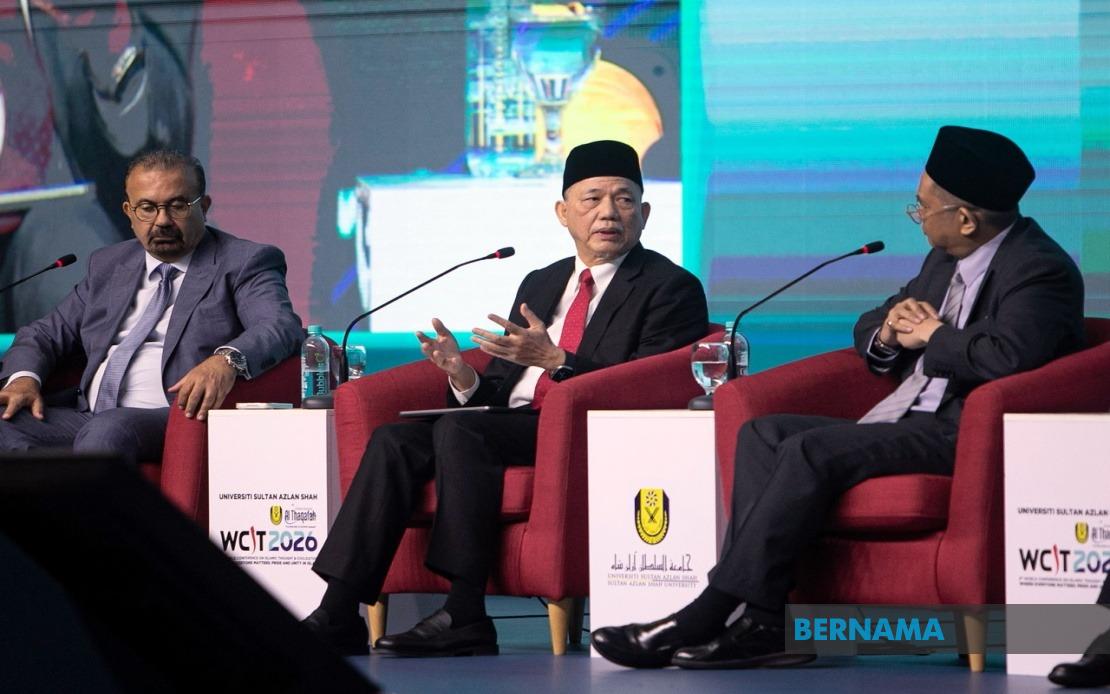
The boundaries separating energy security from maritime stability have fundamentally dissolved, according to Deputy Prime Minister Datuk Seri Fadillah Yusof, who warned that distant geopolitical upheavals now cascade through the world economy with immediate consequences for ordinary Malaysians. Speaking as a panellist during a distinguished royal session at the 8th World Conference on Islamic Thought and Civilisation (WCIT): "Everyone Matters: Pride and Unity in Islam" in Ipoh on July 21, Fadillah, who holds the concurrent portfolio of Energy Transition and Water Transformation Minister, articulated how recent tensions between the United States and Iran exemplify this new reality of interconnected vulnerabilities spanning continents.
The Deputy Prime Minister illustrated the practical mechanics of this interdependency with precision, explaining that disruptions occurring thousands of kilometres distant now reverberate through Malaysia's power grid, petrol pumps, and logistics networks simultaneously. When geopolitical friction emerges in critical chokepoints like the Strait of Hormuz, the reverberations extend far beyond oil markets into the granular details of household economics. The sequence of transmission is straightforward yet inexorable: energy market volatility begets increased insurance premiums, which inflates shipping costs, which expands supply chain expenses, ultimately landing as higher prices on Malaysian supermarket shelves and utility bills.
Malaysia's geographic positioning as guardian of the Strait of Melaka compounds this exposure to external shocks. As one of the world's most critical maritime passages, handling a substantial portion of global seaborne trade, any instability cascading through international waters inevitably affects Malaysia's standing as a trading nation. Fadillah underscored that the country's prosperity rests upon the continuation of open, stable, and rule-based trading systems—a framework that has anchored Malaysian commerce for over a century. When maritime corridors become contested or dangerous, insurance costs soar, vessel routing becomes circuitous, and supply chain reliability deteriorates, creating ripples throughout an economy deeply embedded in global commerce.
The escalating entanglement between energy availability and shipping security reflects structural shifts in the global economy that policymakers cannot ignore. Fadillah's analysis suggests that traditional compartmentalisation of security threats—treating energy independence as separate from freedom of navigation—no longer reflects strategic reality. A single spark in the Persian Gulf, whether military confrontation or accident, simultaneously threatens oil supplies bound for Asian markets and disrupts insurance mechanisms that enable international shipping. This convergence means that Malaysia cannot compartmentalise its policy responses; securing energy supplies now demands concurrent attention to maritime stability, and vice versa.
Confronted with these interconnected vulnerabilities, Malaysia has consciously adopted a diplomatic posture rather than confrontational positioning. Fadillah articulated that the nation approaches such developments with measured calm, rational deliberation, and commitment to multilateral dialogue rather than antagonistic positioning. This measured approach reflects Malaysia's historical experience navigating great power competition while maintaining equidistant relationships with multiple powers. By refusing to align rigidly with any single bloc, Malaysia preserves flexibility to pursue its economic interests across diverse partners and markets, a strategic necessity for a trading nation dependent on global supply chain stability.
The interconnectedness Fadillah described extends beyond immediate price fluctuations into deeper systemic vulnerabilities. Electricity generation in Malaysia depends on fuel imports, particularly liquefied natural gas sourced through maritime routes that pass through or near contested waters. Any disruption to these supply lines immediately threatens Malaysia's power generation capacity, affecting industrial production, data centres, and residential consumption simultaneously. Insurance institutions operating in these spaces simultaneously price in geopolitical risk premiums, effectively spreading the cost of distant conflicts across Malaysian businesses and households through elevated premiums and shipping costs.
Fadillah's remarks at the WCIT conference, delivered in the presence of Sultan Nazrin Shah of Perak, carried particular weight given his dual ministerial responsibilities encompassing both energy transitions and water resources. His emphasis on diplomacy over confrontation suggests that Malaysia views these interconnected challenges as amenable to cooperative solutions rather than zero-sum competition. The underlying implication is that Malaysia will continue advocating for international arrangements that stabilise energy markets and protect maritime freedom, positioning itself as a responsible stakeholder in the international system rather than a destabilising actor.
The regional implications of Fadillah's analysis extend throughout Southeast Asia, where multiple nations depend on the same maritime passages and energy import routes. Vietnam, Thailand, the Philippines, and Indonesia similarly experience vulnerability to disruptions in the Strait of Hormuz and other chokepoints. This shared exposure creates opportunity for regional cooperation on maritime security and energy diversification strategies that could collectively buffer against external shocks. Fadillah's comments suggest Malaysia recognises this interdependence and may advocate for enhanced ASEAN coordination on these critical infrastructure protection issues.
The Deputy Prime Minister's framing also implicitly addresses Malaysia's strategic pivot toward renewable energy and domestic power generation diversification. By acknowledging how external energy security threats affect domestic stability, Fadillah indirectly reinforces the rationale for energy transition initiatives that reduce reliance on imported fossil fuels and maritime-dependent supply chains. Accelerating adoption of solar, wind, and hydroelectric capacity, alongside development of domestic natural gas reserves, becomes not merely an environmental objective but a fundamental security strategy reducing exposure to geopolitical disruption thousands of kilometres distant.
For Malaysian policymakers, Fadillah's analysis suggests that future security planning must integrate energy, maritime, and economic resilience into unified frameworks rather than treating these as separate domains. The practical implication is that investments in naval capacity, maritime surveillance infrastructure, and port security become legitimate components of national energy security strategy. Simultaneously, energy infrastructure investment must account for maritime vulnerability, potentially diversifying supply routes and port facilities to reduce concentration risk and resilience to single-point disruptions.

