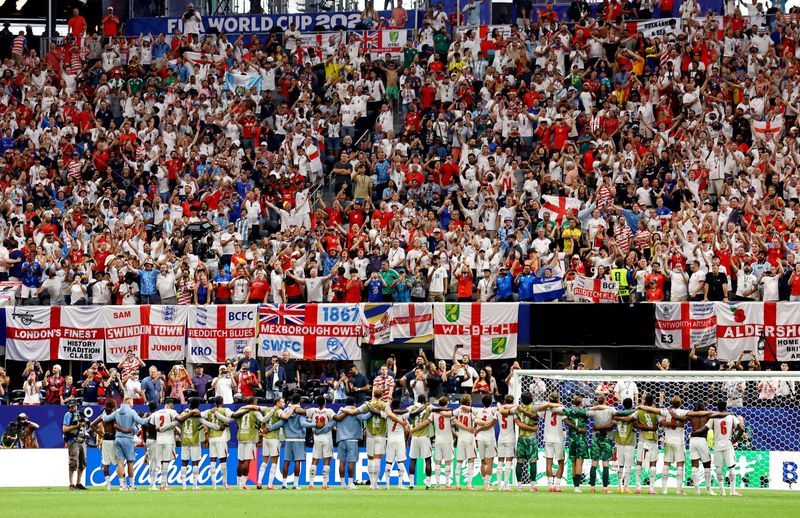
England's World Cup journey took a nerve-wracking turn on Wednesday in Atlanta when they were forced to stage an unlikely comeback against a determined DR Congo side, eventually prevailing 2-1 to secure a last-16 berth. The Three Lions, who had entered the knockout stages with considerable optimism following their opening victory over Croatia, discovered that tournament football at its business end demands more than slick passing and attacking prowess. Thomas Tuchel's squad had shown vulnerabilities throughout the group phase—a goalless draw with Ghana and a laboured 2-0 victory over Panama had already signalled defensive concerns—but nothing quite prepared them for the intensity of Wednesday's examination.
The match began disastrously for the English when Brian Cipenga fired DR Congo ahead within ten minutes, shattering the psychological advantage England had constructed with their earlier wins. The significance of that moment cannot be overstated: for the first time in the tournament, England found themselves trailing on the scoreboard. More troubling still was an uncomfortable historical fact hanging over the team—they had never previously won a World Cup match after going behind at halftime. Inside Atlanta Stadium, the atmosphere shifted from expectant celebration to palpable anxiety. England fans, some with St. George's Cross painted across their faces, sat in uncomfortable silence, nursing their beverages and shifting restlessly as the clock advanced.
DR Congo's performance revealed more about modern tournament football than most conventional analyses can capture. The underdogs displayed tactical discipline and relentless determination, requiring England to win possession repeatedly whilst conceding almost nothing in terms of scoring chances. Their goalkeeper Lionel Mpasi emerged as a mountain of resilience, repeatedly denying England's attacking players with saves that ranged from routine to genuinely spectacular. The Congolese defence seemed content to absorb pressure, knowing that if England faltered even momentarily, they possessed the pace and intensity to punish it. Yoane Wissa tested England's resolve by striking the post shortly before halftime, whilst Harry Kane's appeals for a penalty fell on deaf ears. England's backline, already stretched by injuries and prior performances, looked increasingly vulnerable as the first half progressed.
Tuchel's halftime team talk evidently resonated, for England emerged with renewed purpose after the interval. Jude Bellingham produced a magnificent headed opportunity that Mpasi somehow kept out, while Declan Rice began whipping dangerous crosses into the box with increasing regularity. Marcus Rashford encountered desperate defending on the goal-line, and Bellingham was frustrated again in the dying moments of normal time by another outstanding Mpasi intervention. The pressure mounted visibly, with Tuchel prowling his technical area in evident frustration, at one point audibly remonstrating with defender Djed Spence over a poorly executed throw-in. Tactical adjustments—moving Rice to right back and introducing Eberechi Eze for creative impetus—signalled the manager's determination to find a breakthrough.
The turning point arrived in the 75th minute when Kane orchestrated a glancing header that brushed the fingertips of the Congolese goalkeeper before crossing the line. The release of tension was almost physical; the stadium erupted with the kind of cathartic noise that only comes when a team narrowly avoids disaster. Kane's 83rd international goal represented not merely an equaliser but a psychological lifeline, restoring belief when it had begun to flicker dangerously. Eleven minutes later, Kane struck again to seal a 2-1 victory that represented England's first World Cup comeback win since 1990, when they defeated Cameroon in the quarter-finals—a coincidence of precisely 36 years that lent the moment an unexpected historical resonance.
Tuchel's post-match comments reflected both relief and the demanding mentality required at this tournament stage. The German manager emphasised the importance of maintaining belief under pressure and acknowledged that the team's spirit and commitment had been tested in ways that might not have been anticipated given their earlier performances. His observations proved perspicacious: knockout football demands not merely technical excellence but psychological fortitude. England had discovered, sometimes painfully, that pedigree and attack-minded football cannot guarantee progression when defensive solidity wavers and opposition determination runs at championship intensity.
However, the nature of tournament scheduling offers England minimal respite. Their reward for surviving the DR Congo examination is a confrontation with Mexico that presents entirely different challenges. Where DR Congo concentrated on defensive resilience and counter-attacking incision, Mexico will likely probe England's capacity to withstand sustained attacking pressure. Kane's observation about having to grind out wins in knockout football reflected the tactical reality: England must now demonstrate they can contain Mexico's attacking threats whilst still maintaining enough offensive threat to exploit opportunities. The psychological momentum from the comeback provides some benefit, yet experience suggests that comebacks can occasionally mask underlying issues rather than solve them entirely.
Compounding the difficulty substantially is the venue itself. Mexico City's Azteca Stadium sits more than 2,200 metres above sea level, creating atmospheric conditions fundamentally different from those in Atlanta. At that elevation, oxygen levels diminish noticeably whilst the ball travels through thinner air with greater speed and reduced predictability. After expending enormous physical and mental energy battling through the tension against DR Congo in sweltering conditions, England's players must now acclimatise to reduced oxygen availability whilst facing a team playing on familiar ground where they have developed tactical understanding suited to those specific conditions. The altitude factor cannot be dismissed as mere geography; it represents a genuine physical test that has historically unsettled teams unaccustomed to high-altitude football. England's preparation over the coming days will determine whether they can overcome not merely Mexican opposition but also the atmospheric challenges of playing in one of world football's most demanding venues.

