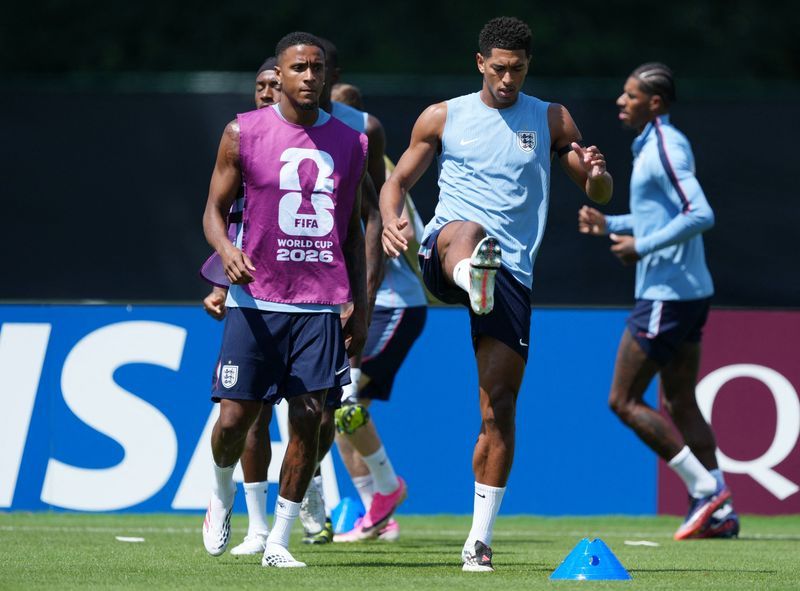
England's campaign towards World Cup glory will be tested in a high-stakes encounter with Argentina on Wednesday, but the squad appears focused on presenting a united front rather than engaging with the swirling media narratives that have surrounded their preparations. The English contingent has made deliberate efforts to insulate itself from external commentary, with defender Ezri Konsa emphasising that whilst attention inevitably accompanies international football, the team has developed the mental fortitude to compartmentalise such distractions and concentrate on the task ahead.
The backdrop to this semi-final features the kind of intrigue that often accompanies major tournaments. Following England's quarter-final victory over Norway, a two-one extra-time win secured by midfielder Jude Bellingham's brace, friction emerged between manager Thomas Tuchel and his talented midfielder. Tuchel's public dissatisfaction with the overall team performance contrasted sharply with Bellingham's assertion that his coach might lack understanding of the intensity of playing under such demanding circumstances against resilient opposition. Such divergences, under different circumstances, might fester within a squad, yet the narrative that England's players are now advancing suggests the opposite trajectory entirely.
Konsa's remarks to the gathered press corps on Tuesday carried particular weight given the defender's experience at the highest level. He acknowledged that noise and speculation represent an unavoidable component of representing England but stressed that compartmentalisation remains essential. The squad's maturity, he suggested, stems from collective experience within international football's pressure cooker. Critically, he insisted there have been no underlying tensions or divisive episodes within the group, framing the unit as fundamentally cohesive and aligned around shared objectives.
Marc Guehi, Konsa's fellow defender, extended his praise beyond mere solidarity by explicitly commending Tuchel's contribution to fostering this environment. The German manager has apparently succeeded in establishing a particular type of team culture that emphasises collective purpose above individual prominence. Guehi highlighted Tuchel's infectious energy, both in formal settings and behind closed doors where team dynamics truly crystallise. The defender's portrayal suggests that under Tuchel's stewardship, belief in the collective endeavour has become the dominant mindset, with every player genuinely invested in supporting their teammates and the manager's vision.
Guehi ventured that the post-Norway period, despite the surface-level conflict between Tuchel and Bellingham, actually strengthened rather than weakened the squad's bonds. Adversity, it appears, has functioned as a unifying force, prompting the players to rally behind their manager and one another. This psychological dynamic represents precisely the intangible quality that separates tournament winners from capable but ultimately unsuccessful sides. When difficulty arises, stronger groups emerge more cohesive, whilst weaker ones fracture.
Tuchel himself addressed these observations in a separate press conference held at Atlanta Stadium, acknowledging the players' characterisation of the team environment he has cultivated. His response revealed a manager acutely conscious of football's fundamental nature—that success at the highest level demands subordinating individual ego to collective enterprise. He noted that this principle extends beyond England alone; the broader World Cup tournament has demonstrated that even the planet's most celebrated individual talents consistently prioritise team cohesion and national pride.
The German tactician elaborated on what he perceives as the distinguishing quality of his squad: an unwillingness to surrender under pressure. This resilience, he suggested, emerges primarily through work conducted away from public scrutiny, in training sessions and team meetings where real bonds are forged. Tuchel expressed considerable pride in the mental constitution his players have displayed, framing their commitment as genuinely exceptional rather than merely adequate.
The potential pathway forward from Wednesday's encounter against Argentina shapes the broader narrative trajectory. Should England prevail, they would face Spain in what would represent a repeat of the Euro 2024 final, a match the Spanish won. Spain has already secured their position in the final by dispatching France two-nil in their semi-final fixture on Tuesday evening. The Spanish national team's advancement occurred whilst England's squad travelled to Atlanta from their Kansas base, meaning players such as Guehi remained uninformed of the outcome. When quizzed about whether he had observed Spain's performance, Guehi simply noted he had slept throughout the flight, highlighting the squad's strategic focus on their own preparation rather than opponent tracking.
For Malaysian and Southeast Asian observers, this narrative carries particular relevance. England's demonstration of how internal cohesion transcends fleeting controversies offers a masterclass in professional team management. The willingness of Tuchel and his players to emphasise unity publicly, rather than allowing minor disagreements to metastasise into squad-wide dysfunction, reflects mature institutional thinking. In regional football contexts, where personality clashes and ego frequently undermine national programmes, England's approach provides instructive precedent for how elite teams navigate inevitable tensions.
The psychological dimension of tournament football cannot be overstated. Argentina represents formidable opposition with their own cohort of world-class performers, yet England's apparent mental equilibrium—their capacity to acknowledge external commentary whilst refusing to be destabilised by it—may prove decisive. International football increasingly rewards not merely technical brilliance but emotional intelligence and collective purpose. England's squad appears to have cultivated both.

