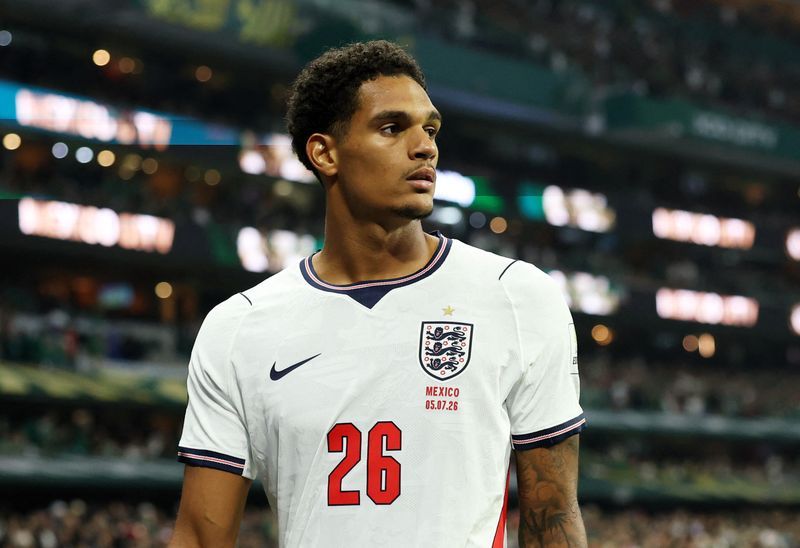
The controversy surrounding Folarin Balogun's suspended ban has widened dramatically, with British politicians now explicitly demanding that FIFA apply identical treatment to England defender Jarell Quansah following his red card against Mexico in the World Cup. The intervention marks a critical juncture in what has become the tournament's defining disciplinary saga, transforming what FIFA characterised as an isolated judicial decision into a test case for the consistency of global football governance.
Quansah received a straight red card during England's 3-2 victory at the Azteca Stadium on Sunday, triggering the automatic one-match suspension that would normally force him to sit out upcoming knockout matches. However, the precedent set just days earlier when Balogun received a near-identical reprieve has emboldened British lawmakers to challenge FIFA's handling of disciplinary matters. Labour MPs Noah Law and Melanie Onn have written directly to FIFA President Gianni Infantino, invoking the Balogun decision as grounds for deferring Quansah's suspension until after the World Cup concludes, a position they argue is legally and ethically defensible given the circumstances.
The political dimension of this dispute cannot be overstated. U.S. President Donald Trump's public admission that he contacted Infantino regarding Balogun's case has cast a shadow over FIFA's credibility and independence. Although Infantino has maintained that FIFA's judicial bodies made their decision autonomously, the appearance of political influence has prompted scrutiny from elected representatives across Europe. For Malaysian and Southeast Asian observers, this episode underscores how even the world's most prestigious sporting institutions remain vulnerable to pressure from powerful actors, a dynamic that regional football associations must navigate carefully.
Law's letter, shared publicly on social media, specifically acknowledges the legitimacy of Quansah's original red card while arguing that the timing of his suspension creates an inequitable situation. He contends that deferring the ban until after the tournament concludes would be the fair course, particularly given FIFA's demonstrated willingness to exercise discretionary flexibility. This nuanced position—accepting the card's validity while challenging the suspension's application—proves more difficult for FIFA to dismiss than blanket demands for leniency, as it frames the debate around consistency rather than leniency.
Melanie Onn has taken a broader institutional approach, warning FIFA that the organisation risks serious reputational damage unless its rules are applied uniformly across all players and nations. She has explicitly stated that permitting one player to benefit from a deferred suspension while denying identical treatment to another creates an indefensible double standard. This line of argument strikes at FIFA's fundamental legitimacy: a governance system perceived as arbitrary or subject to political capture loses the voluntary compliance that makes such systems functional.
Caroline Dinenage, Chair of the House of Commons Culture, Media and Sport Committee, has elevated the matter to parliamentary level by formally calling on FIFA to provide urgent explanations for its decision. Her statement acknowledges England's impressive victory while warning that FIFA's disciplinary ruling threatens to taint the tournament with accusations of unfairness. Dinenage has explicitly framed the issue as one of equal application of laws—a principle central to any legitimate regulatory system. Her language suggests that simply reasserting independence without explaining the actual basis for the decision will prove insufficient to restore confidence.
The English FA has indicated it is exploring appeal options, according to sources familiar with the matter, though the organisation has not yet committed to a specific course of action. This measured approach reflects awareness of the political sensitivities involved; overly aggressive appeals could invite accusations of hypocrisy given British criticism of the Balogun decision. Conversely, accepting Quansah's suspension without challenge would undermine the parliamentary case being made on his behalf. The FA must navigate between these positions carefully.
FIFA's silence on whether Article 27—the provision that allowed Balogun's reprieve—applies equally to Quansah's case has become conspicuous. The governing body's failure to respond to multiple requests for clarification suggests either that internal deliberations remain ongoing or that FIFA recognises the legal and political minefield it has created. Any statement FIFA releases will face intense scrutiny from both British lawmakers and international football authorities who have questioned the consistency of the original Balogun decision.
The broader implications of this dispute extend far beyond these two players or even beyond the current World Cup. The incident demonstrates how political pressure can penetrate the supposedly insulated realm of sports governance, particularly when major powers perceive their interests as affected. For Southeast Asian nations with less geopolitical leverage than the United States or United Kingdom, this precedent raises uncomfortable questions about whether equal treatment under sporting regulations is truly guaranteed or merely aspirational.
England faces Norway in Saturday's quarter-final match in Miami, meaning the timing of any FIFA decision on Quansah carries immediate competitive consequences. A ruling in England's favour could be perceived as vindication of parliamentary pressure, while denial might suggest FIFA is attempting to distinguish between the two cases or is resisting what it views as inappropriate political interference. Either outcome will leave questions about the legitimacy and consistency of FIFA's disciplinary processes unanswered, reinforcing criticisms that the organisation operates according to unstated hierarchies of power rather than transparent, uniform principles.
The controversy has exposed fundamental weaknesses in FIFA's governance structures. An organisation genuinely committed to independent decision-making would benefit from establishing clear, public criteria for exercising discretionary powers like Article 27. The current situation, where such provisions are invoked seemingly arbitrarily and subsequently weaponised by political actors, serves neither FIFA's interests nor the broader credibility of international sports governance. As this dispute unfolds, the world will observe whether FIFA prioritises consistency with principle or capitulates to further pressure, a distinction with consequences that extend far beyond football.

