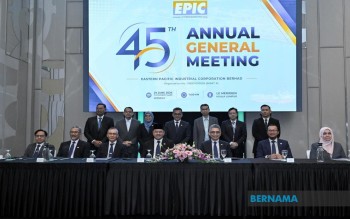
Eastern Pacific Industrial Corp Bhd (EPIC) has unveiled an ambitious financial roadmap targeting RM700 million in annual revenue and RM1 billion in net asset value by 2030. The integrated oil and gas solutions provider plans to achieve these milestones through strategic expansion across its three core business pillars—oil and gas, port management, and renewable energy—as detailed in its EPIC Strategic Business Plan 2025-2030 (EPIC BEST 2530). Group chief executive officer Dr Ts Muhtar Suhaili outlined the targets following a year of exceptional financial performance, signalling confidence in the company's trajectory as it navigates both domestic opportunities and regional expansion.
The company's latest results underscore strong momentum heading into the ambitious 2030 timeline. For the financial year ended December 31, 2025, EPIC reported a net profit of RM20.6 million, marking a 24 percent increase from RM16.6 million the previous year. Revenue climbed to a record RM411.9 million from RM403.8 million, representing the group's fourth consecutive year of growth since 2022. This sustained upward trend reflects both operational excellence and successful market positioning in Malaysia's energy sector, where EPIC has established itself as a critical service provider to major oil and gas operators.
Several factors underpinned the strong 2025 performance, providing insight into EPIC's revenue drivers moving forward. The acquisition of Rahar Niaga Sdn Bhd expanded the company's service capabilities, while newly secured contracts—notably the Pan Malaysia Maintenance, Commissioning and Modification and Hook-Up and Commissioning agreement—injected significant revenue streams. Higher volumes of offshore rig arrivals and increased cargo handling activity at EPIC's port facilities further bolstered results. These elements collectively demonstrate how diversification across the energy services value chain has insulated the company from sector volatility while creating multiple growth vectors.
Looking ahead to 2026, management expects the growth momentum to accelerate. Dr Muhtar expressed confidence that the coming year would deliver record-breaking revenue figures, buoyed by a substantial pipeline of secured contracts. EPIC's approved contract value for its oil and gas operations currently ranges between RM1.3 billion and RM1.5 billion, though actual earnings remain contingent on work orders and purchase orders from clients. This caveat reflects the realities of energy sector contracting, where project execution timelines can vary, yet the sheer contract value underscores deep client relationships—particularly with Petronas, Malaysia's national oil company.
Petronas contracts form the backbone of EPIC's growth strategy across multiple Malaysian regions. The company has secured work beyond its traditional stronghold in Terengganu, penetrating the southern peninsula through major industrial hubs in Pengerang and Melaka. More significantly, EPIC has recently expanded into Sabah, a region poised for substantial petrochemical and downstream expansion in coming years. This geographical diversification reduces dependence on any single operational base while positioning the company to service Malaysia's broader oil and gas infrastructure development. The multi-regional footprint also enables EPIC to capture synergies across port operations, maintenance services, and logistics.
Renewable energy represents a strategic pillar within the 2030 vision, reflecting Malaysia's national energy transition objectives. EPIC intends to deepen participation in the renewable sector through various mechanisms, including a proposed hybrid hydro-solar project at Kenyir undertaken in partnership with its parent company, Terengganu Inc. The company is currently bidding for this project, which would represent a significant pivot toward clean energy generation. Such initiatives align with Malaysian government policy encouraging private sector participation in renewable capacity expansion, creating potential for both financial returns and portfolio diversification as fossil fuel demand remains uncertain over the decade.
Beyond Malaysia's borders, EPIC's board has mandated management to pursue expansion into neighbouring Southeast Asian markets as part of the 2030 strategic framework. This regional aspiration reflects the broader opportunity set across ASEAN energy infrastructure, where rising demand and ageing facilities create openings for specialized service providers. Simultaneous exploration of West Asian opportunities, despite acknowledged geopolitical uncertainties, indicates management's willingness to pursue higher-margin contracts where EPIC's expertise commands premium valuations. The balance between Southeast Asian expansion—where cultural and regulatory familiarity provides advantage—and West Asian ventures suggests a calculated risk approach.
Recent developments illustrate EPIC's execution capability in new markets. In February 2025, EPIC OG Sdn Bhd, a subsidiary, entered a collaboration agreement with Begas Energy Sdn Bhd to provide project management services for a Terminal Turnaround, Maintenance and Modification contract in Sabah. This partnership model—leveraging local partnerships to access new regional opportunities—has proven effective in Southeast Asia's energy sector. The arrangement strengthens EPIC's position in both Sabah and Sarawak, regions where oil and gas activities remain substantial and growing sectors of economic activity. Through such strategic partnerships, EPIC can expand service delivery without bearing full capital requirements or operational risks.
The financial growth targets set through 2030 imply a revenue compound annual growth rate of approximately 5.4 percent from 2025 levels—a modest but achievable pace given current contract backlog and market conditions. However, reaching RM1 billion in net asset value requires not only profit accumulation but also strategic capital deployment and potentially accretive acquisitions. EPIC's track record of acquiring complementary businesses like Rahar Niaga suggests management will pursue bolt-on acquisitions to accelerate value creation. The gap between current NAV of approximately RM700 million and the 2030 target of RM1 billion implies anticipated capital growth of 43 percent, requiring disciplined investment and operational leverage across all business segments.
EPIC's positioning within Malaysia's energy ecosystem reflects broader sectoral dynamics. Despite global energy transition pressures, Malaysian oil and gas infrastructure requires ongoing maintenance, modification, and expansion services that EPIC's integrated service platform is uniquely positioned to provide. The company's diversification into ports and renewable energy hedges against pure fossil fuel exposure while maintaining core competencies in energy infrastructure. For Malaysian investors and regional stakeholders, EPIC represents a compelling exposure to energy transition dynamics—neither purely defensive nor purely transformational, but pragmatically calibrated to capture value across multiple energy futures through 2030.

