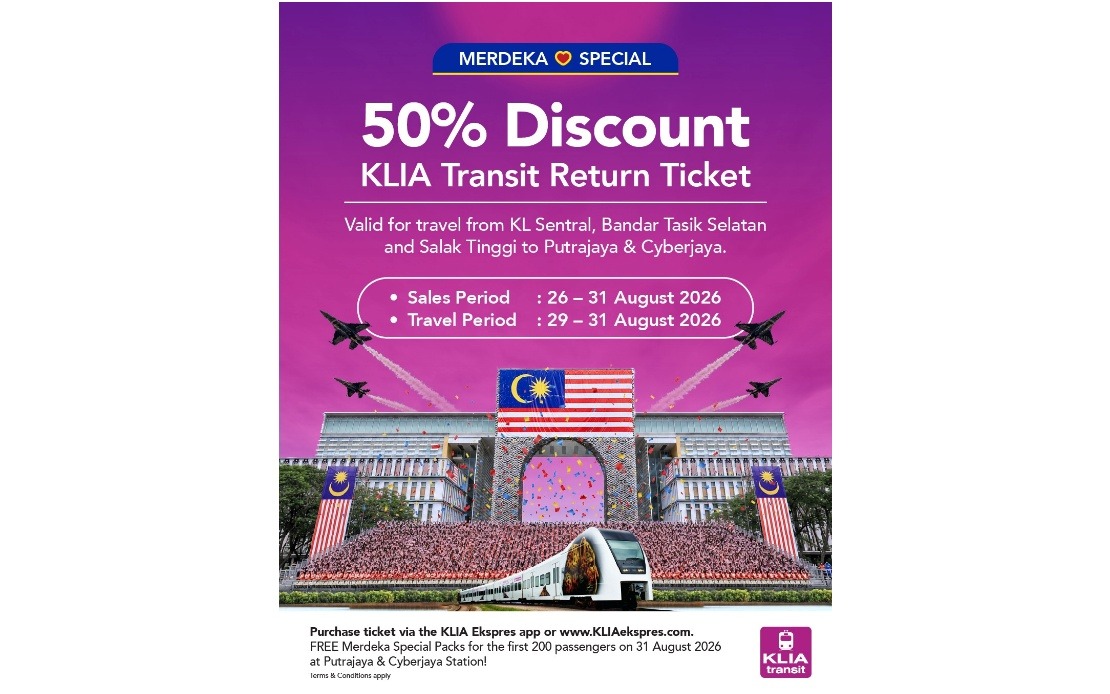
Express Rail Link Sdn Bhd has rolled out a significant fare reduction on its KLIA Transit service to coincide with Malaysia's 69th National Day celebrations, aiming to draw crowds to Putrajaya for a slate of patriotic events culminating in the 2026 National Day Parade. The half-price promotion applies to return tickets from any of the railway line's stations directly to the Putrajaya and Cyberjaya Station, removing a traditional barrier to participation in national festivities for families and commuters across the Klang Valley.
The discount structure reveals ERL's strategic focus on driving leisure travel while protecting premium airport connections. Notably, the promotional pricing excludes journeys to KLIA Terminal 1 and Terminal 2, meaning passengers heading to the airport will not benefit from the special rates. This carve-out suggests the airline industry's influence on rail pricing decisions and ERL's calculation that airport passengers represent a more price-inelastic market segment. The company is essentially using surplus capacity on non-airport routes to boost ridership during the festive period.
The promotional window runs from August 29 through August 31, strategically timed to cover both the full-dress rehearsal on August 29 and the main National Day Parade itself on August 31. Tickets can be purchased exclusively through digital channels—the KLIA Ekspres mobile application and the official website—from August 26 onwards. This digital-first approach reflects broader transportation sector trends toward contactless transactions while simultaneously managing distribution costs and crowd flow data collection.
Family-oriented pricing remains central to ERL's appeal strategy. The promotion extends to both adult and child passengers aged 6 to 15 at equivalent discounts, effectively doubling the value proposition for households. Furthermore, children aged five and under travel entirely free when accompanying a paying adult, with allowances for up to three young children per ticket. This generosity toward younger travellers acknowledges both the demographic composition of Malaysian families and the cultural importance of exposing children to national celebrations.
To amplify festive excitement beyond the core fare discount, ERL will distribute exclusive Merdeka Pack giveaways to the first 200 passengers arriving at Putrajaya and Cyberjaya Station on August 31. While the contents remain unspecified in the announcement, such branded merchandise typically serves dual purposes: creating viral social media moments and establishing emotional associations between the transport operator and national pride. This limited-quantity approach generates scarcity-driven urgency among potential travellers.
The integration with broader Putrajaya transport infrastructure demonstrates how coordinated planning can remove barriers to event attendance. From Putrajaya Sentral station, passengers gain access to complimentary shuttle bus services operated by Prasarana and Perbadanan Putrajaya, connecting the rail terminus to scattered event locations throughout the administrative capital. This seamless last-mile solution transforms KLIA Transit from merely a point-to-point transport service into the anchor of a comprehensive mobility ecosystem for National Day visitors.
The event programming itself spans multiple days and experiences. Beyond the main National Day Parade on August 31, the full-dress rehearsal on August 29 provides an alternative viewing opportunity for those unable to attend the principal ceremony. Additionally, complementary Merdeka-themed attractions including Riuh Merdeka and the Ambang Merdeka 2026 celebration extend the festivities across the entire promotion period, giving passengers multiple reasons to justify their rail journey and time spent in Putrajaya.
For Malaysian readers and the broader Southeast Asian travelling public, this promotion signals the government's commitment to making national commemorations accessible beyond Kuala Lumpur's core urban centre. Putrajaya's elevation as the focal point for 2026 celebrations reflects its evolving status as a prestige destination and administrative hub. The decision to subsidise transport costs implicitly acknowledges that distance and expense remain genuine obstacles for provincial Malaysians wishing to participate in national events.
ERL's promotional strategy also sits within the competitive transportation landscape. Rail operators across the region face mounting pressure from ride-hailing services and private vehicle travel, particularly for discretionary leisure journeys. By offering compelling pricing on signature routes during high-visibility national moments, ERL reinforces rail transport as a reliable, economical choice for family outings. The success of this campaign may influence pricing strategies for future major events and holidays.
From a logistical perspective, the digital-ticketing requirement serves multiple stakeholder interests. For ERL, it enables real-time capacity management and reduces onsite congestion from queuing passengers. For authorities coordinating Putrajaya's event management, sales data provides advance notice of expected visitor volumes, facilitating security and crowd control planning. The technology infrastructure supporting this promotion represents an investment in modern, scalable transportation systems that will benefit Malaysian travellers long after the National Day celebrations conclude.

