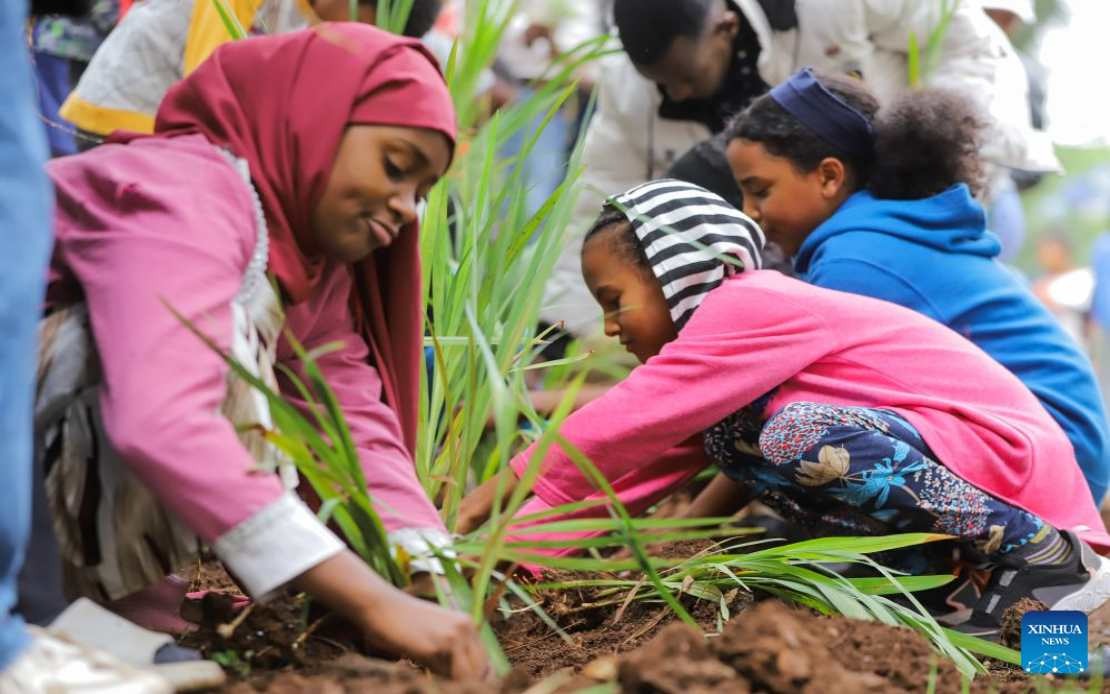
Ethiopia executed an unprecedented environmental mobilisation on Monday as millions of citizens and expatriates participated in a coordinated tree-planting campaign designed to establish a new global record. The initiative sought to plant 800 million seedlings in a single day across the nation, representing a significant escalation in the country's commitment to reversing decades of deforestation. The campaign underscores Ethiopia's determination to transform its environmental trajectory whilst simultaneously positioning itself as a leader in climate action within East Africa and across the African continent.
The undertaking forms the centrepiece of the Green Legacy Initiative, a flagship environmental programme initiated by Prime Minister Abiy Ahmed in 2019. This year's iteration of the annual campaign carries particular weight, with the government targeting the planting of more than 8 billion seedlings throughout the current rainy season alone. Should this target materialise, Ethiopia would substantially progress towards its broader ambition of planting 50 billion trees since the initiative's inception five years ago. The sheer scale of these numbers reflects a national consensus that large-scale reforestation represents a critical pathway to addressing the country's environmental degradation and building long-term climate resilience.
The participation extended beyond government officials and environmental workers to encompass Ethiopians from diverse socioeconomic and professional backgrounds. Among the participants was Edilawit Legesse, a thirteen-year-old student who joined the planting efforts in the Alembank neighbourhood on Addis Ababa's periphery. Legesse's involvement marked her third consecutive annual participation in the campaign, demonstrating how the initiative has embedded itself within the cultural consciousness of younger generations. Her modest contribution of two seedlings reflected broader grassroots engagement, with family members and community neighbours converging on designated planting zones driven by genuine enthusiasm for the environmental cause.
Healthcare workers similarly mobilised to support the campaign, viewing environmental restoration as integral to public health and community wellbeing. At a site near Entoto Mountain in the capital, Hewan Legesse, a nurse employed at a local hospital, coordinated efforts alongside 34 of her colleagues. The nurse articulated an ambitious personal target of planting ten trees during the day's activities, illustrating how the campaign succeeded in translating national environmental goals into tangible individual commitments. Such widespread professional participation suggests that the Green Legacy Initiative has transcended its original environmental framing to become a unifying national endeavour that cuts across occupational and social divides.
Prime Minister Abiy Ahmed emphasised the deeper significance of the annual planting day, characterising it as a moment when Ethiopians across all social strata converge to establish environmental legacies benefiting future generations. His framing shifts focus beyond the immediate quantitative achievement of tree numbers to the qualitative dimension of national unity and shared purpose. In social media communications, Abiy highlighted that eight consecutive years of commitment had strengthened the initiative through sustained public participation and a collective belief that coordinated action could facilitate transformation towards a greener, more sustainable national future.
The environmental imperative driving this campaign reflects Ethiopia's degraded landscape conditions. Historical deforestation has stripped significant portions of the country's land area, reducing forest cover from an estimated 35 percent of total landmass in the 1950s to less than 3 percent currently. This catastrophic loss has precipitated multiple environmental consequences including soil erosion, water scarcity, reduced agricultural productivity, and heightened vulnerability to climate variability. The Green Legacy Initiative thus addresses not merely abstract environmental concerns but concrete threats to food security, livelihoods, and national prosperity that directly impact millions of Ethiopians dependent on agricultural production.
Beyond its immediate environmental objectives, the initiative represents a strategic positioning by Ethiopia within global climate discourses. As African nations increasingly assert their roles in international climate negotiations, large-scale domestically-driven reforestation programmes enhance Ethiopia's credibility and influence. The country signals serious commitment to achieving climate neutrality targets whilst simultaneously mobilising its substantial population for productive environmental engagement. This approach contrasts with external pressure or donor-driven conservation models, instead demonstrating autonomous national agency in environmental management.
For Southeast Asian observers and policymakers, Ethiopia's model offers instructive lessons regarding scaled environmental mobilisation. Whilst the region faces distinct ecological challenges—primarily deforestation driven by palm oil cultivation, logging, and agricultural expansion—the Ethiopian approach demonstrates that reforestation can achieve both environmental and social objectives simultaneously. The integration of youth, healthcare workers, and diverse professional cohorts reflects how environmental initiatives can transcend technical specialisation to become genuine national movements. Similarly, the annual rhythm of the campaign builds momentum and ensures sustainability through regular recommitment rather than depending on isolated, ephemeral interventions.
The specific environmental outcomes of planting 800 million trees warrant careful analysis. Whilst the number represents an undeniable achievement, the long-term success of any reforestation programme depends critically on survival rates, species selection, and land tenure security. Historical tree-planting campaigns globally have sometimes suffered from poor seedling survival, inadequate maintenance, and inappropriate species selection for local ecological conditions. Ethiopia's ambitious scale necessitates robust monitoring mechanisms, adequate resources for post-planting care, and integration with broader landscape restoration strategies addressing soil conservation and water management.
The economic dimensions of this initiative also merit consideration. Large-scale reforestation creates employment opportunities in nursery operations, land preparation, planting, and ongoing ecosystem management. For a nation with significant youth unemployment and limited industrial capacity, environmental restoration programmes can provide meaningful livelihood opportunities whilst simultaneously addressing national environmental challenges. The integration of communities into implementation processes increases local ownership and ensures that environmental benefits accrue directly to populations bearing the costs of historical degradation.
Moving forward, Ethiopia's 8 billion seedling target for this year positions the country to achieve its 50 billion tree goal within the next several years, assuming consistent participation and adequate resource allocation. Such achievement would represent a monumental environmental undertaking and would constitute one of the world's most significant reforestation efforts. The campaign demonstrates that mobilising large populations around shared environmental objectives remains feasible when initiatives receive high-level political commitment, are framed around tangible national benefits, and enable meaningful grassroots participation.
The implications for climate resilience remain substantial. Expanded forest cover enhances carbon sequestration capacity, moderates local temperature and rainfall patterns, protects watersheds, and supports biodiversity conservation. For a nation already experiencing increasing climate variability and facing potential food security challenges, forest expansion represents essential adaptive infrastructure. Ethiopia's Green Legacy Initiative thus embodies recognition that environmental restoration and climate adaptation are not luxury objectives but essential components of national development strategy and population security.

