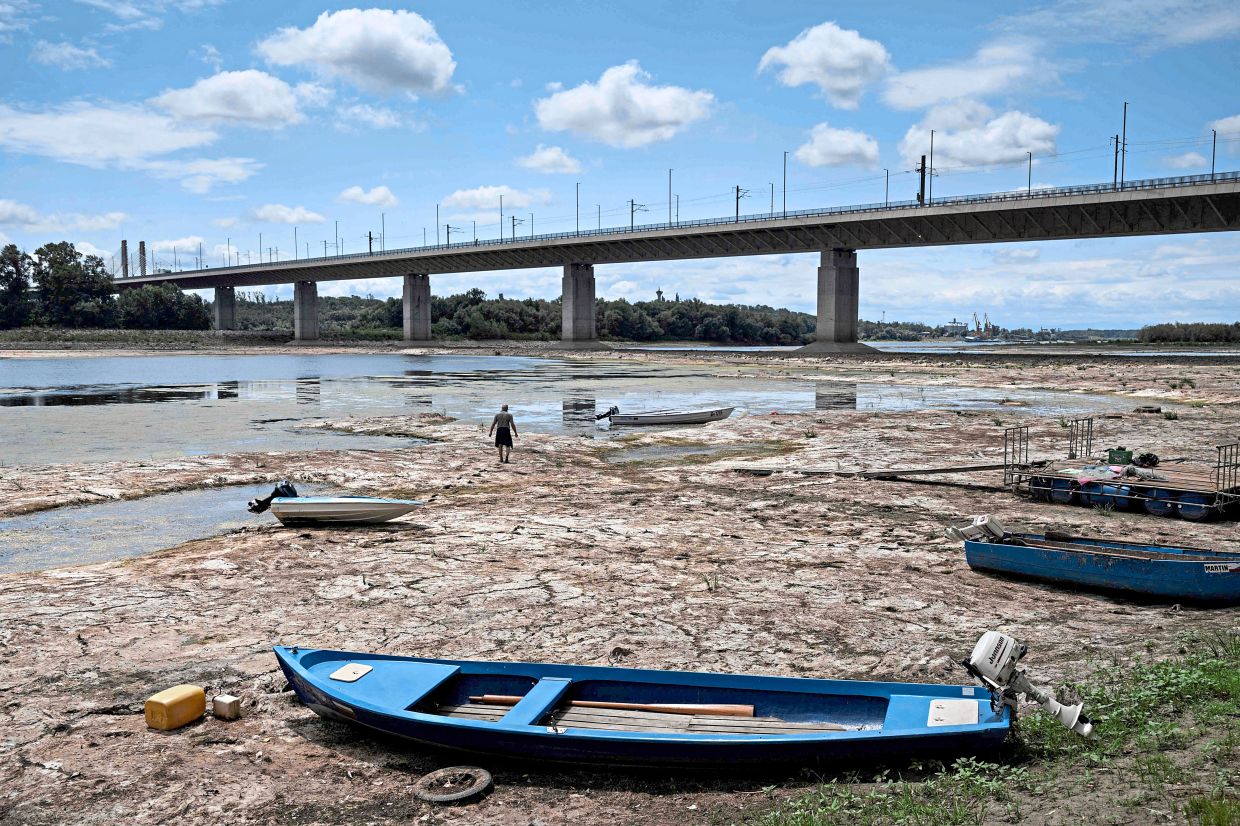
One of Europe's most critical waterways is experiencing an environmental crisis that carries implications far beyond its immediate riparian states. The Danube River, flowing through a tenth of the continent's nations from Germany to the Black Sea, has receded to unprecedented levels as a combination of prolonged drought and successive heat waves drains the system. In Budapest, water authorities recorded measurements of just 23 centimetres on 29 July, shattering the previous record of 33 centimetres established in 2018. The forecasts offer little comfort: meteorologists predict further decline with minimal precipitation expected and temperatures climbing above 38 degrees Celsius across the region, suggesting the crisis will deepen before improvement arrives.
The visual transformation occurring along the Danube's course captures the stark reality of climate change in real time. Where water once flowed continuously, exposed rock formations, expansive sand bars, and the haunting remains of sunken vessels now dot the riverbed. Photographer Gabor Kertesz documented the shocking contrast between the river's usual state and its current exposed condition at Budapest's Margaret Bridge, articulating the dissonance many residents feel witnessing such dramatic environmental change. The dried-out landscape speaks to broader climatic patterns gripping Central Europe, where the Hungarian Meteorological Service reports ninety-day precipitation totals running 80 to 130 millimetres below historical norms across virtually the entire nation. This sustained moisture deficit has accelerated evaporation rates, creating conditions unseen in living memory.
The economic reverberations extend across multiple sectors dependent on reliable water transport. River cruises that normally bring substantial tourism revenue to Budapest now face severe operational constraints, with vessels forced to moor far upstream, unable to navigate to their intended docking points. The cargo shipping industry has virtually ceased operations, according to Hungary's Ministry of Transport and Investment, eliminating a critical transport artery for goods moving through Central Europe. The implications for trade patterns in the region warrant serious attention, as businesses accustomed to cost-effective waterborne logistics must now absorb higher expenses through alternative road and rail networks, ultimately affecting consumer prices and supply chain efficiency across the region.
The human cost of the crisis crystallised in late July when Bulgarian police conducted a dramatic rescue operation. The cruise ship Viking Ullur, operating under the expectation of normal navigation conditions, ran aground on a shallow bar near Vidin and became trapped. One hundred eighty-six passengers required evacuation after the vessel, unable to reach the port for scheduled resupply, exhausted its food and water reserves. The fifty-two crew members faced extended isolation aboard the grounded ship, dependent on variable navigation conditions and uncertain refloating operations. This incident exemplifies the cascading failures that emerge when critical infrastructure systems encounter stress beyond their design parameters.
In Serbia, the situation presents a portrait of economic paralysis. Hundreds of small watercraft and dozens of commercial cargo ships lie marooned on exposed banks near Novi Sad, their operators watching helplessly as business opportunities evaporate. Radovan Segrt, who operates tourist excursions from his house boat, reported that the Danube had withdrawn between fifteen and twenty metres from its normal shoreline. The seasonal tourism economy, which provides employment and income for river-dependent communities, has effectively collapsed. These are not abstract statistics but tangible losses affecting families and small enterprises throughout the Danube corridor.
Beyond commerce and tourism, the low water crisis has triggered significant concerns in the energy sector. Danube water serves a critical function as a cooling medium for nuclear reactors across multiple countries dependent on this river system. Romania's Cernavoda power plant experienced a dramatic reduction in cooling-water availability, with Danube flow rates dropping to approximately 1,630 cubic metres per second—roughly one-third of typical July volumes. This forced authorities to shut down a reactor unit for safety reasons, with another closure announced to follow. Hungary's Paks nuclear facility, which generates nearly half the country's electricity supply, initiated controlled power-downs of reactor units commencing 29 July as cooling-water supplies became restricted. The facility had already reduced output twice in the preceding forty-eight hours, signalling ongoing operational challenges. These developments raise urgent questions about energy security in Central Europe during a period when demand typically peaks.
The geopolitical and economic dimensions of this crisis extend beyond individual nations. The Danube's reduced capacity creates potential strain on relationships between riparian states dependent on shared water resources. Any extended drought could amplify tensions over allocation of remaining water supplies, particularly if some nations prioritise nuclear plant cooling over agricultural irrigation or drinking water reserves. For Southeast Asian observers, the Danube situation offers a cautionary lesson about the interconnected vulnerabilities of transnational river systems—concerns equally relevant to the Mekong, which sustains hundreds of millions across the region.
The receding waters have also exposed unexpected hazards from Europe's turbulent twentieth century. Budapest authorities closed the Margaret Bridge after a World War II-era bomb surfaced at its base, exposed by the retreating waterline. Unexploded ordnance remains a persistent legacy across European river systems, and the Danube's historical role in two world wars means additional discoveries are virtually inevitable as water levels continue falling. This phenomenon underscores how climate-driven environmental changes can resurrect long-buried historical consequences with immediate public safety implications.
Some have attempted to find opportunity within the crisis. Treasure hunters like Zsolt Horvath have capitalised on the exposed riverbed to recover metal objects using powerful magnets, discovering everything from vintage radio amplifiers to wartime ammunition casings. While Horvath acknowledged the activity brings personal satisfaction, he recognised the broader reality: extraordinarily low water levels, however advantageous for archaeological recovery, represent an environmental curse for the river and its dependent communities. His balanced perspective encapsulates the complicated human response to climate-driven ecological disruption—finding isolated silver linings amid genuine crisis.
The Danube's unprecedented decline serves as a visceral demonstration of climate change's material consequences in Europe. This is not a remote or abstract phenomenon but a present-day disruption affecting energy generation, commercial transport, employment, and public safety across ten nations. For policymakers across Southeast Asia and beyond, the situation illustrates the cascading vulnerabilities within infrastructure systems designed for historical climate conditions. As global temperatures rise and precipitation patterns shift, similar crises will likely emerge in other critical river basins. The Danube experience suggests that adaptation strategies must address not only water scarcity itself but the interconnected failures across energy, transportation, and food systems that result when major waterways decline.

