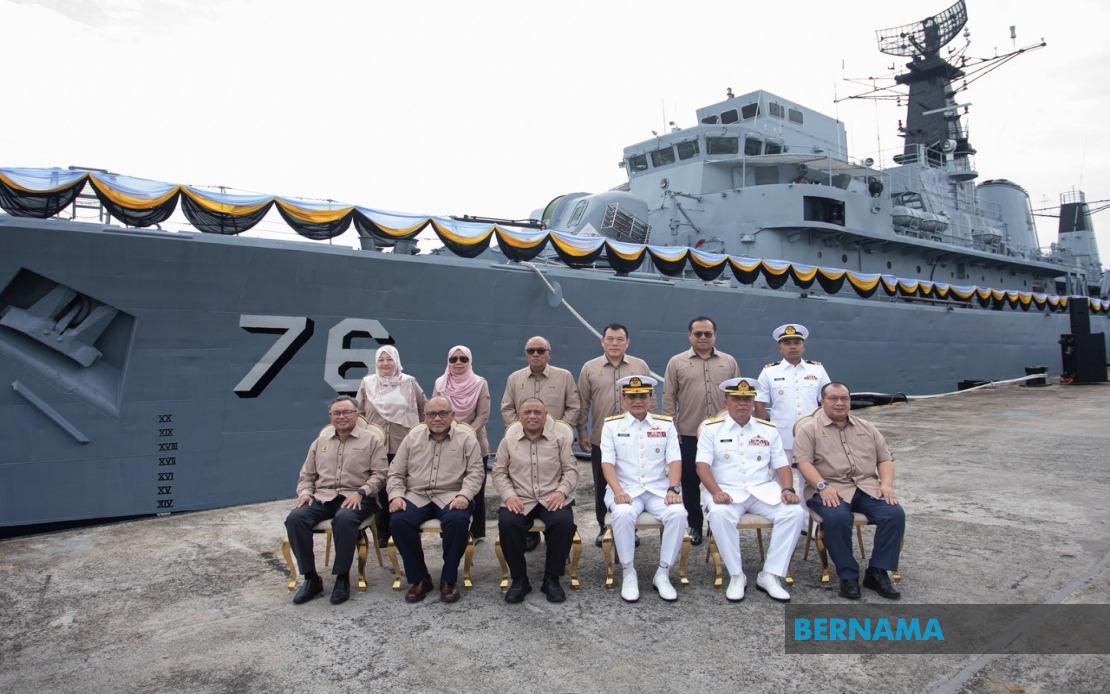
The Royal Malaysian Navy has formally transferred the Ex-Hang Tuah vessel to Perak state authorities, marking the beginning of an ambitious transformation that will convert the decommissioned ship into a comprehensive heritage attraction. The handover ceremony took place at Lumut Naval Base on July 27, with Western Fleet Commander Vice Admiral Datuk Baharudin Wan Md Nor representing the RMN. Menteri Besar Datuk Seri Saarani Mohamad confirmed that the converted vessel will operate as the Royal Ship Hang Tuah Memorial Museum, with public access expected to commence in 2027, establishing a landmark maritime tourism destination for Perak.
The redevelopment initiative represents a multifaceted approach to heritage preservation, blending historical education with economic development. Rather than allowing the vessel to deteriorate or face demolition, the Perak government has secured partnership arrangements with Menteri Besar Incorporated (MB Inc) Perak and private sector partner Aero Art Sdn Bhd to manage the project's execution. This public-private collaboration model enables the state to leverage private sector expertise in museum operations and tourism management while maintaining government oversight of a culturally significant asset. The arrangement demonstrates how decommissioned military infrastructure can transition into productive public resources without placing the entire financial burden on state coffers.
Phase one of the development carries an estimated cost of RM30 million, to be implemented progressively rather than as a single comprehensive undertaking. This phased approach allows for staged investment and permits adjustments based on visitor response and operational experience. Beyond the ship itself, the broader project encompasses complementary infrastructure designed to maximise the site's tourism and community potential. Planning includes a public park with unrestricted access for residents and visitors, ensuring that the memorial museum functions as an inclusive community space rather than solely a commercial venue. This component reflects recognition that maritime heritage attractions generate greatest value when integrated into accessible public environments.
The development footprint extends across Lumut's Marina Wing and Esplanade precinct, with potential to catalyse broader economic revitalisation in these waterfront areas. Commercial zones designated within the project site will accommodate local entrepreneurs and small business operators, providing controlled opportunities for micro-enterprises linked to tourism activity. Family-oriented activity spaces and community gathering facilities will encourage extended visits and repeat patronage, essential factors for sustainable tourism revenue. The infrastructure will further support conference facilities and exhibition spaces, diversifying the venue's income streams beyond casual tourism and positioning it as a potential venue for educational programmes and cultural events.
Menuteri Besar Saarani contextualised the museum within Perak Sejahtera 2030, the state government's long-term economic development framework. Maritime tourism expansion through this project aligns with state policy objectives emphasising sustainable development, local economic stimulation, and employment creation. For a state historically dependent on tin mining and agriculture, diversifying into experience-based tourism represents strategic positioning for economic resilience. The Hang Tuah Museum will serve as a flagship attraction in Perak's maritime tourism portfolio, differentiation that acknowledges Malaysia's extensive coastline and historical naval heritage as underexploited tourism assets compared to beach destinations or heritage towns.
The military tourism concept introduces a specialised market segment often overlooked in regional tourism planning. Heritage-focused visitors interested in military history, naval technology, and maritime defence constitute a demographic willing to travel specifically to access educational experiences unavailable elsewhere. Countries from Singapore to South Korea have successfully monetised military and maritime heritage through museum vessels and naval site development, proving the viability of this tourism model. Perak's venture positions the state to capture this niche tourism market, particularly attracting regional and international visitors researching Southeast Asian maritime history and naval development.
The memorial aspect carries symbolic weight beyond commercial tourism considerations. By converting a working naval vessel into a permanent tribute to maritime service personnel, the project acknowledges the Royal Malaysian Navy's custodial role in protecting Malaysia's extensive maritime boundaries and territorial waters. This recognition becomes increasingly significant as regional maritime security dynamics evolve and the RMN receives greater strategic attention. For serving and retired naval personnel, the museum represents institutional acknowledgement of contributions to national security, while for the broader public it provides educational access to maritime defence concepts otherwise distant from civilian experience.
Lumut's selection as the museum location strengthens the commercial logic underlying the project. As home to Malaysia's primary naval base and established military tourism destination, Lumut already attracts defence-conscious visitors and families of naval personnel. The town benefits from existing accommodation and hospitality infrastructure, enabling visitors to extend stays and maximise local spending. The Ex-Hang Tuah memorial museum will capitalise on existing traffic patterns while creating reasons for additional visits, synergistic effects that strengthen the town's overall tourism competitiveness against competing coastal destinations within Perak and neighbouring states.
The 2027 opening timeline allows approximately three years for detailed design, regulatory approvals, and structural restoration work. Naval vessels require extensive retrofitting to accommodate public access, including safety systems, accessibility infrastructure, and environmental controls protecting historical artifacts and exhibition materials. The phased implementation approach permits contractors to begin preliminary work while detailed specifications for later phases remain under development, a pragmatic strategy for large heritage projects where initial assessment often reveals unexpected restoration requirements or opportunities.
Beyond Perak's immediate interests, this project reflects broader Malaysian thinking about heritage asset management and tourism diversification. As heritage sites face increasing visitor pressure and conservation costs escalate, creative reuse of existing structures offers sustainable preservation models. The Ex-Hang Tuah conversion demonstrates that decommissioned military assets can achieve new purpose and generate ongoing revenue supporting preservation, a principle applicable to numerous underutilised facilities throughout Malaysia. The project's success or challenges will likely influence future decisions regarding similar heritage site development across the country.
For regional tourism economics, Perak's venture introduces competitive pressure on other Malaysian coastal states to develop comparable attractions. Selangor, Johor, and Sabah possess naval heritage assets that might similarly benefit from heritage museum conversion. Successful implementation of the Hang Tuah project could establish a template for maritime heritage tourism that extends beyond Perak, gradually enriching Malaysia's tourism product diversity and reducing dependence on conventional beach and cultural attractions that characterise Southeast Asian tourism markets.
The partnership structure between government and private operator merits attention as a governance model. Aero Art's involvement suggests specialisation in museum operations and heritage site management, capabilities that government tourism departments often lack internally. This arrangement permits knowledge transfer and professional standards application while maintaining public accountability through MB Inc's oversight role. As Malaysia continues expanding heritage tourism infrastructure, similar collaborative models may increasingly characterise project delivery, balancing commercial efficiency with public interest protection.

