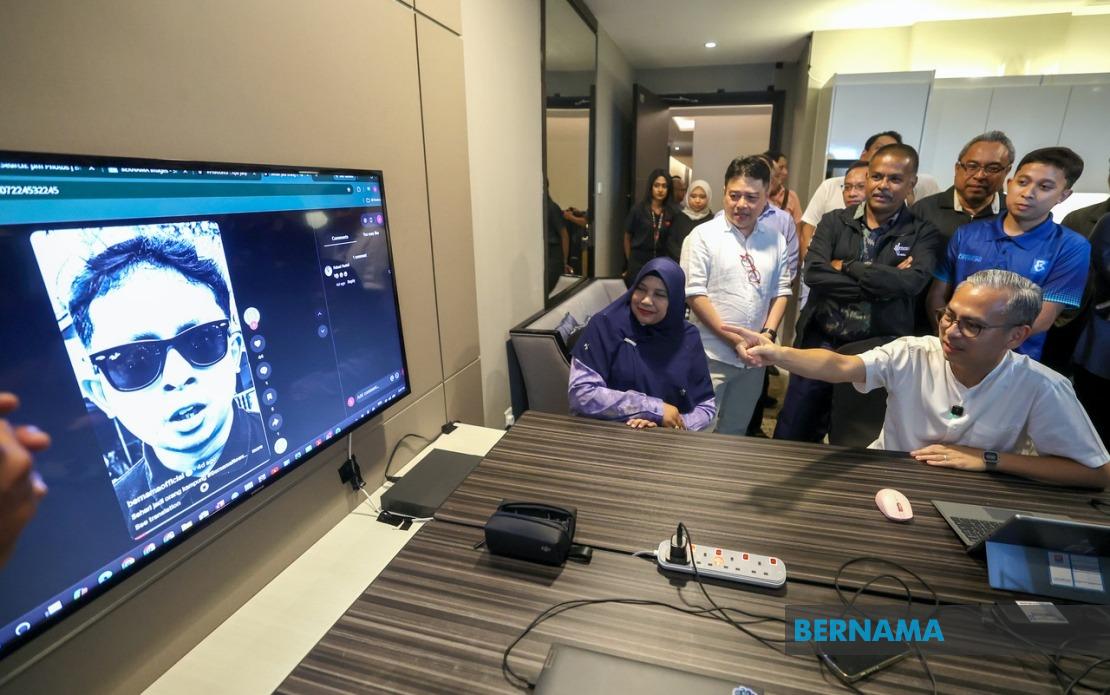
Communications Minister Datuk Fahmi Fadzil has lauded the Malaysian National News Agency (Bernama) for its dedication to delivering reliable election coverage throughout the Johor state poll, underscoring the critical role that professional journalism plays in maintaining public trust during pivotal electoral moments.
During an inspection of Bernama's operations centre in Johor Bahru on July 7, Fahmi observed firsthand the infrastructure and human resources mobilised to track developments across all 56 contested seats. His visit revealed a coordinated newsroom operation where journalists, sub-editors, editors, and television personnel worked in tandem to process and disseminate information to Malaysian audiences. The minister's emphasis on the "satisfactory" facilities and support systems reflected recognition that modern election coverage demands robust technical capacity alongside editorial excellence.
The breadth of Bernama's assignment underscored the logistical complexity of state-level election reporting. Forty-four personnel—comprising reporters, camera operators, and photographers—had been stationed strategically to blanket Johor's geographic span, from the southern peninsula's Tanjung Surat to the northern regions bordering Pahang. This dispersed deployment meant that no constituency could escape journalistic scrutiny, a requirement essential for maintaining electoral transparency across a state encompassing diverse communities and socioeconomic contexts.
Fahmi's appreciation extended specifically to Bernama's leadership. Chief Executive Officer Datin Paduka Nur-ul Afida Kamaludin and Editor-in-Chief Arul Rajoo Durar Raj received particular commendation for orchestrating the logistical and editorial coordination underlying the coverage. The minister's extended visit—spending more than an hour at the operations centre—demonstrated official recognition that election coverage represents a public service demanding ministerial acknowledgment. By visibly endorsing Bernama's effort, Fahmi signalled that government values the role of credible information dissemination in sustaining democratic participation.
The timing of Fahmi's remarks proved significant given the electoral context. With 172 candidates competing for the 56 Johor seats and early voting already underway ahead of the Saturday polling date, voters required timely, verified reporting to make informed choices. Bernama's scale of deployment and operational readiness addressed this democratic imperative. The agency's capacity to coordinate coverage from a single operations base while maintaining correspondent networks throughout the state exemplified institutional capability that smaller news organisations might struggle to replicate.
For Malaysian newsrooms and communications professionals, Fahmi's statement carried broader implications regarding journalistic standards during elections. His emphasis on "accurate and comprehensive information" as a public entitlement underscored government acknowledgment that voters deserve factual, multi-sourced reporting rather than propaganda or fragmentary accounts. This framing positioned professional news agencies as infrastructure supporting democratic governance—a positioning increasingly contested in media environments dominated by social platforms and partisan commentary.
The minister's visit also reflected evolving government communication strategies. Rather than controlling information flow through official channels alone, state apparatus now appears to endorse pluralistic—though still partially state-controlled—news gathering as legitimate. Bernama, as Malaysia's statutory news agency, occupies unique terrain: neither fully independent nor purely propagandistic, it functions as an official information conduit that nonetheless maintains editorial processes resembling mainstream journalism. Fahmi's validation of Bernama's operations suggested that contemporary governance accepts such hybrid models as preferable alternatives to outright censorship or information vacuums.
The Johor state election context illuminated why election coverage mattered acutely to political communication. State-level contests in Malaysia's most developed and populous states carry outsized significance for national political trajectories. Johor's 56 seats represented substantial electoral stakes, with outcomes potentially reshaping coalitional alignments within federal parliament. Comprehensive, accurate reporting from regional elections therefore possessed cascading relevance for national politics—making Bernama's 44-person deployment investment justified and newsworthy.
Bernama's operational model also demonstrated how state news agencies navigate contemporary media fragmentation. By maintaining systematic correspondent networks, editorial hierarchies, and quality-control processes, the agency could plausibly claim coverage superiority over aggregator platforms or social-media-dependent outlets. Fahmi's commendation implicitly argued for Bernama's continued relevance in an era when government information might theoretically bypass traditional news intermediaries entirely. The minister's visit thus functioned partly as institutional endorsement, reasserting Bernama's value proposition within competitive Malaysian media ecology.
The scale of Bernama's election deployment—stretching across Johor's vast territory from urban centres to peripheral constituencies—illustrated how modern election journalism requires spatial distribution and logistical sophistication that many private news organisations cannot afford. This reality positioned state-supported news agencies as quasi-public goods. Voters in remote constituencies or smaller towns might receive election coverage primarily through Bernama reporting and Bernama Television broadcasts, making the agency's professional standards consequential for democratic access to information across geographically dispersed populations.
Looking forward, Fahmi's remarks established a template for government recognition of journalistic effort during future electoral cycles. By praising professionalism rather than controlling editorial content, the Communications Ministry appeared to endorse a model where state institutions support news infrastructure while respecting editorial independence. Whether this approach holds during politically contentious phases remains uncertain, but the Johor exercise suggested contemporary Malaysian governance accepts that democratic legitimacy correlates with public access to plausible, professionally-gathered information—even when originating from state-affiliated sources.
The broader significance of Fahmi's visit extended beyond Johor's immediate electoral context. It reinforced international perceptions that Malaysia maintains functioning news institutions and respects informational plurality, even if constrained by state involvement. For Southeast Asian media observers, the episode illustrated how hybrid governance models navigate tensions between authoritarian impulses and democratic norms, permitting official agencies sufficient operational autonomy to retain credibility while preserving government capacity to influence agenda-setting and framing.

