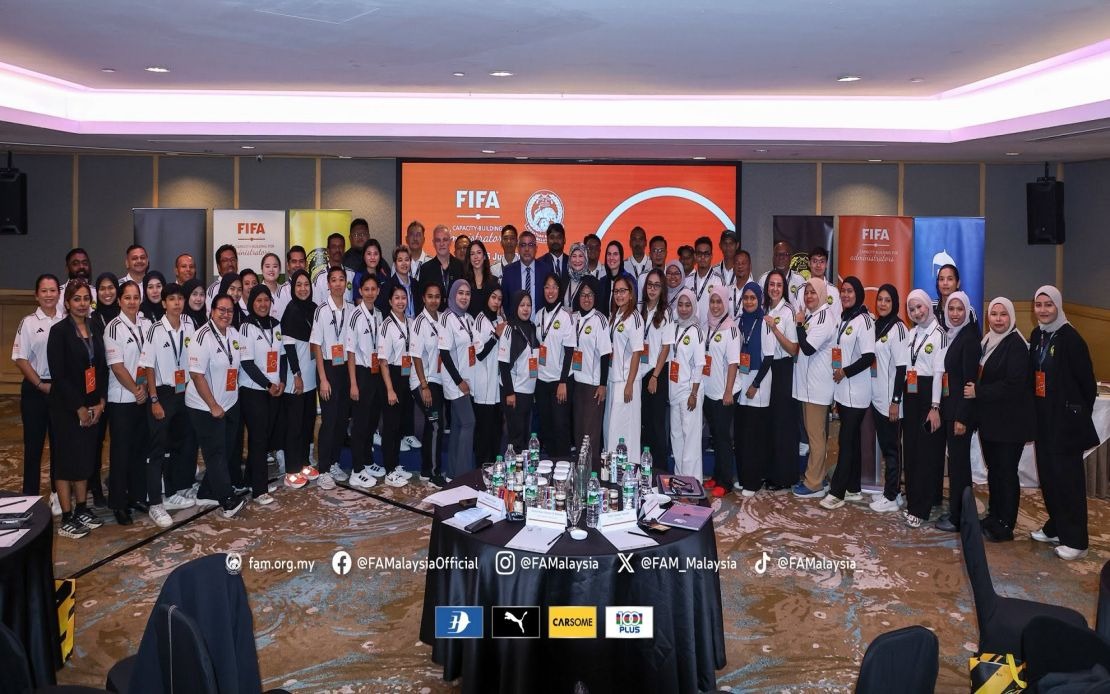
The Football Association of Malaysia (FAM) has initiated a strategic initiative to elevate the administrative infrastructure underpinning the nation's women's football ecosystem through a partnership with FIFA. Beginning in late June, the Capacity-Building For Administrators 2026 programme represents a deliberate shift in how the federation approaches women's football development, recognising that sustained growth requires robust organisational foundations alongside technical excellence.
The four-day programme, conducted by FIFA Women's Football Development Experts Safia Abdeldayem and Pema Choden Tshering, targets team managers and administrative officers across Malaysian women's football. Rather than concentrating solely on tactical and technical instruction, which has traditionally dominated grassroots sports development across Southeast Asia, this initiative addresses a critical gap in leadership and institutional competence. The curriculum encompasses four primary modules: Women's Leadership, Women's Competition, Club and Players' Rights, and Strategic Planning—each designed to cultivate a more professional and sustainable operating environment for women's football at the domestic level.
The Women's Leadership component acknowledges that advancing women's football requires qualified female administrators and decision-makers in positions of influence within the sport's governance structures. This reflects a broader regional challenge, where women remain significantly underrepresented in sports administration across Southeast Asia despite increases in female participation as athletes. By equipping participants with contemporary leadership frameworks, FAM attempts to catalyse cultural and structural change within football administration, potentially creating role models who demonstrate that women can effectively manage clubs, competitions, and national programmes.
Understanding competition structures and their legal frameworks forms another pillar of the programme. The Women's Competition module provides managers with knowledge of how professional and semi-professional leagues function, regulatory requirements, and best practices for organising matches and tournaments. This knowledge transfer is particularly valuable in Malaysia's context, where women's football has experienced periodic expansion but often lacks consistent, professional competition formats. Participants will gain insight into how competitions are structured in established women's football nations, potentially informing improvements to domestic league operations and club standards.
The Club and Players' Rights segment addresses a frequently overlooked dimension of women's football development: the contractual and legal protections surrounding player welfare. In many Southeast Asian contexts, women footballers operate with minimal contractual clarity, limited access to professional benefits, and inadequate dispute resolution mechanisms. By educating administrators on players' rights and clubs' responsibilities, FAM works to establish minimum standards for professionalism and equity. This module becomes particularly significant given ongoing debates about equal treatment and compensation in women's sports across the region.
Strategic planning—the programme's final major component—enables managers and administrators to develop long-term roadmaps for their respective teams and organisations. This forward-looking approach contrasts with reactive management patterns that often characterise smaller sports federations and clubs. Participants learn to establish realistic objectives, allocate resources efficiently, monitor progress, and adapt strategies in response to changing circumstances. Such competencies prove essential as Malaysian women's football seeks to compete at higher levels in regional and continental competitions.
The programme's design reflects FAM's recognition that women's football's trajectory depends not merely on producing skilled players, but on building capable administrative cadres. Datuk Noor Azman Rahman, FAM's secretary-general, and Datuk Suraya Yaacob, a FIFA Women's National Team Competitions Committee member, were present at the initiative's launch, signalling institutional commitment at the federation's highest levels. Their participation underscores that capacity-building in administration commands the same strategic attention as player development.
From a regional perspective, Malaysia's initiative aligns with FIFA's broader agenda to professionalise women's football administration globally. Many Southeast Asian nations struggle with inconsistent governance standards, inadequate funding mechanisms, and weak institutional frameworks supporting women's football. By adopting FIFA's capacity-building model, FAM positions itself as a potential regional leader in women's football administration, potentially influencing practices across the AFC Women's Football Committee sphere and inspiring peer federations to invest similarly in administrative development.
FAM's explicit commitment to expanding opportunities for women in football leadership carries implications beyond sport itself. The federation acknowledges that increasing the representation of female administrators and managers strengthens the entire ecosystem. This perspective recognises that women's football development benefits from having women in positions where they shape policies, allocate budgets, and set strategic priorities. Such representation also sends powerful signals to young female players about leadership pathways available within the sport, potentially encouraging retention and sustained engagement beyond playing careers.
The emphasis on creating a sustainable, professional ecosystem addresses a fundamental challenge in developing nations' sports contexts, where initiatives often lack institutional resilience and depend excessively on individual effort or external funding. By systematising knowledge transfer through structured modules and expert-led instruction, FAM attempts to embed best practices into institutional memory. Future administrators can build upon competencies established through this programme, creating cumulative improvements rather than starting anew with each generation of managers.
Looking ahead, the success of this programme will likely be measured not only by immediate participant satisfaction but by observable improvements in women's football governance and competition standards. Malaysian clubs adopting enhanced administrative practices, improved player contracts, and more professional tournament organisation would indicate meaningful impact. Additionally, whether participants transition into elevated administrative roles—and whether women's representation in football administration increases—will reveal whether the programme translates learning into systemic change.
FAM's partnership with FIFA reflects growing recognition that women's football's expansion requires investment in people and institutions, not merely facilities or equipment. As Malaysia continues positioning itself as a regional football hub, strengthening women's football administration through systematic capacity-building demonstrates strategic thinking aligned with long-term competitive ambitions and gender equality objectives within sport.