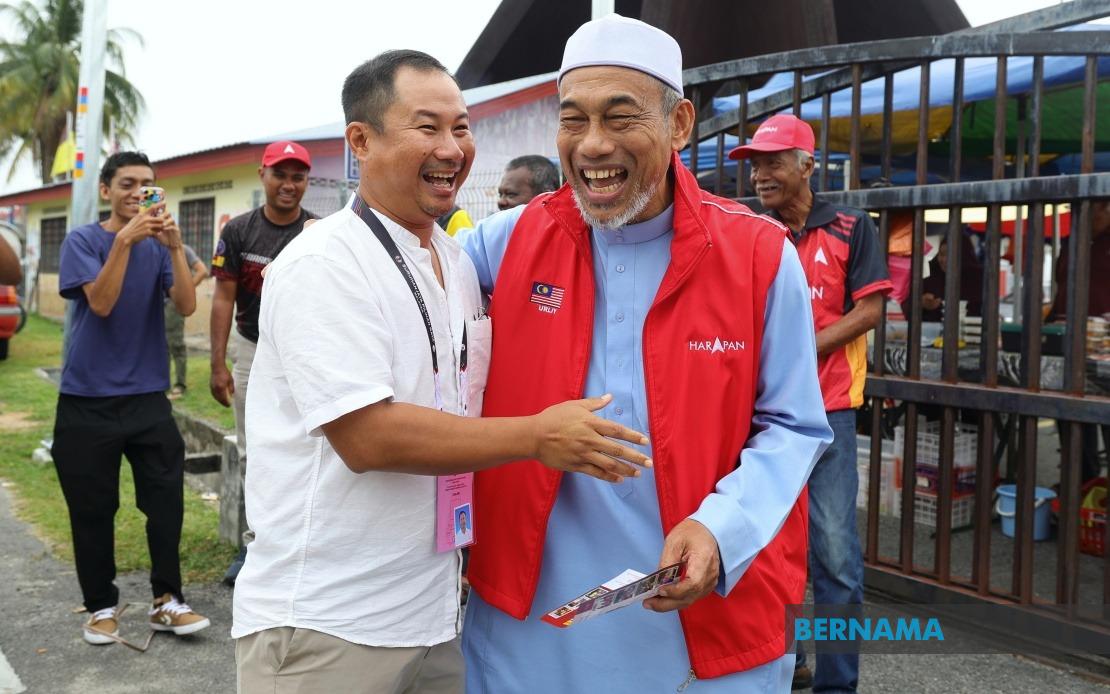
The Negeri Sembilan State Election campaign took an unusually personal turn in Klawang this week as two political rivals discovered they shared more than just a contest for the same seat—they shared blood. During a campaign stop at Kuala Klawang weekend market on the election trail's second day, incumbent Datuk Bakri Sawir of Pakatan Harapan and his opponent Danni Rais of Perikatan Nasional found themselves canvassing voters in the same marketplace, creating a rare spectacle of family rivalry unfolding before the electorate.
The simultaneous appearance of the cousins proved magnetic for market-goers and traders, many of whom seized the chance to interact with both candidates as they worked through the crowded stalls and food courts. The unusual scene drew cameras and phones, with onlookers capturing moments of handshakes, casual conversation, and photographs alongside the two men. Despite representing opposing political coalitions and competing fiercely for the Klawang seat's 13,355 registered voters, the encounter remained notably free of tension, suggesting a family bond that transcends electoral ambition.
What distinguished this campaign moment from typical election clashes was the absence of acrimony. Rather than trading barbs or attempting to out-maneuver one another, Bakri and Rais conducted their separate campaign activities with restraint and even managed to share a laugh or two as they passed through overlapping sections of the market. This cordial atmosphere reflected a growing recognition among some Malaysian politicians that electoral contests can proceed without descending into personal hostility, particularly when familial ties are involved.
Datuk Bakri, speaking to reporters during the campaign stop, reframed the entire contest to emphasize principles over personality. He explicitly rejected the notion that competing against a cousin represented anything extraordinary or worthy of special attention. Instead, he positioned the election itself as the true focus—a mechanism through which both candidates could present their respective visions and services to constituents. This philosophical approach challenges the increasingly polarized nature of Malaysian electoral politics, where contests between family members sometimes become vehicles for larger ideological battles.
The incumbent candidate underscored the importance of conducting the campaign according to established regulations and maintaining respect for democratic institutions. He cited a recent incident involving the Jelebu District Council's intervention regarding the improper installation of campaign flags on a stadium fence, noting that both his team's swift compliance demonstrated their commitment to orderly conduct. Bakri's emphasis on following the rules reflected broader concerns about maintaining electoral integrity during a period when state and national political temperatures run high.
Bakri extended his call for disciplined campaigning beyond his own team, urging all political parties and their machinery to ensure the election period proceeds in an orderly and respectful manner. He specifically highlighted the role of party organizations in setting the tone for their respective campaigns, warning that failure to respect electoral law undermines the legitimacy of future demands for civic compliance. This perspective suggests a candidate focused not merely on winning office but on preserving the broader institutional framework that makes electoral competition meaningful.
The Klawang state seat has emerged as genuinely competitive territory in this election cycle, with the three-way contest involving not just Bakri and Rais but also Bersatu's Muhammad Adib Musa. The presence of three substantial candidates reflects broader fragmentation within Malaysian politics, where the traditional two-coalition binary has given way to more complex multi-party dynamics. This development transforms electoral contests into more unpredictable affairs where vote-splitting and coalition mathematics assume greater significance than in previous election cycles.
With 13,355 registered voters in the constituency, the race promises to be closely watched as an indicator of shifting political sentiments in Negeri Sembilan. The state has historically occupied a middle ground in Malaysia's political landscape, and Klawang's outcome could signal whether traditional Pakatan Harapan support has eroded in favor of the Perikatan Nasional coalition or whether voters remain skeptical of both major political groupings. The tight voter roll suggests that individual campaign effectiveness and local issues will likely prove decisive.
The Election Commission has structured the voting process around an early voting date of July 28, with the main polling day scheduled for August 1. This timeline provides all three candidates and their respective parties with approximately two weeks to consolidate support, though the compressed campaign period typical of Malaysian state elections means strategic resource allocation becomes critical. The staggered voting arrangement, meanwhile, could influence turnout patterns and potentially advantage whichever camp can better mobilize their early voters.
The cordial dynamic between Bakri and Rais stands in contrast to increasingly acrimonious campaigns witnessed in other Malaysian constituencies, where personal attacks and inflammatory rhetoric have become commonplace. Their approach suggests that competitive elections and mutual respect need not be mutually exclusive, even when family honor and political ambition intersect. Whether this model gains traction elsewhere or remains an anomaly will partly depend on whether voters reward candidates who maintain civility, or whether they continue responding to more aggressive political messaging.
For broader Southeast Asian observers, the Klawang contest illustrates how Malaysia's democratic processes continue navigating significant transitional pressures. The emergence of three-way contests, the fluidity of coalition politics, and the occasional moments of grace between competitors all reflect an electoral system in flux. As Negeri Sembilan voters prepare to make their choice on August 1, they will be sending signals not just about local preferences but about what standards of political conduct they expect to see upheld in their state's governance.

