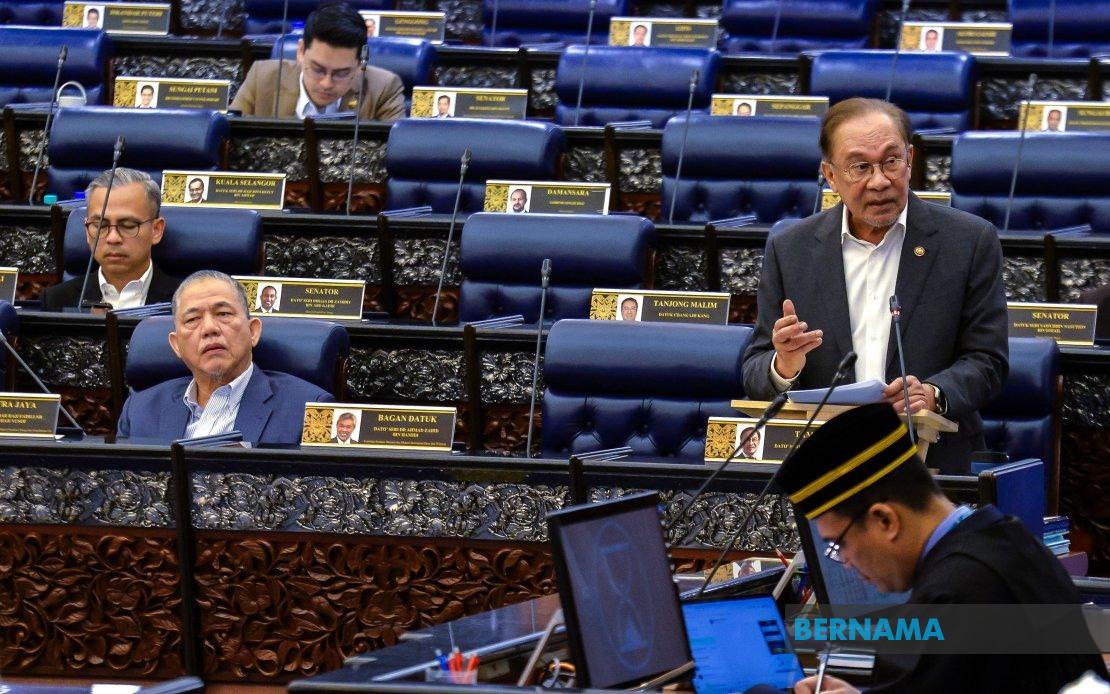
Prime Minister Datuk Seri Anwar Ibrahim has moved to dispel concerns about fairness in federal fund distribution, asserting that the allocation system prioritises the development requirements of each state rather than their relative tax-generating capacity. Speaking during parliamentary question time on June 30, Anwar underscored that most states receive substantially higher allocations from Putrajaya than they contribute in tax revenue, with only Selangor and Penang—the country's two most economically advanced states—collecting more revenue than they receive in federal disbursements. This clarification comes at a time when questions persist about the equity of the distribution mechanism and its effectiveness in supporting less developed regions.
The Prime Minister's emphasis on needs-based allocation represents a deliberate policy approach by the MADANI Government to redirect resources toward areas requiring urgent intervention. Rather than mechanically matching federal funding to tax contributions, the administration assesses each state's particular circumstances to determine appropriate investment levels. This methodology acknowledges the reality that wealthier, more industrialised states naturally generate higher tax revenues, yet such an approach would systematically disadvantage less economically developed regions that have greater infrastructure deficits and higher poverty concentrations. By rejecting a purely revenue-based formula, Anwar signalled the government's commitment to bridging development gaps across Malaysian states.
Anwar outlined the diverse priorities guiding allocation decisions, reflecting the breadth of national development challenges. These include substantial investments in flood mitigation infrastructure, critical given Malaysia's vulnerability to seasonal flooding that affects millions of residents and causes billions in economic losses annually. The Pan Borneo highway upgrade represents another major allocation focus, addressing connectivity deficits in East Malaysia and supporting regional economic integration. Water drainage system improvements reflect ongoing concerns about urban and rural water management, while poverty eradication initiatives target vulnerable populations in less developed areas. Educational infrastructure and school development further demonstrate the government's multi-sectoral approach to ensuring that allocations address fundamental human development needs across the federation.
During his parliamentary response to Datuk Seri Doris Sophia Brodi, the GPS representative from Sri Aman, Anwar specifically addressed allegations that certain states face marginalisation or receive insufficient funding. The question itself reflects regional anxieties, particularly among Sarawak representatives, about whether federal distribution mechanisms adequately serve East Malaysian interests. Anwar's response sought to provide reassurance by pointing to concrete commitments to states including Kedah, Terengganu, and Kelantan, positioning these investments as evidence of equitable treatment. For Malaysian observers, the parliamentary exchange illustrates ongoing tensions between federal and state-level governance, with regional representatives regularly scrutinising the fairness of national resource distribution.
The comparative assertion that the MADANI Government has increased allocations to Kedah, Terengganu, and Kelantan relative to the previous administration carries particular significance. These three states have historically faced development challenges and social vulnerabilities, making enhanced federal support a visible marker of the current government's policy priorities. By explicitly contrasting present allocations with those under the previous administration, Anwar positioned the MADANI Government as more responsive to regional equity concerns. This framing serves both a political and substantive purpose—demonstrating governmental commitment to identified problem areas while establishing a baseline against which future performance can be measured.
Understanding Malaysia's federal allocation system requires recognition of the constitutional framework governing centre-state fiscal relations. The Federation provides states with revenue sources including licensing fees and certain taxes, yet states remain dependent on federal transfers for substantial portions of their budgets. This dependency structure means that allocation formulas carry significant weight in state governance capacity, infrastructure development, and public service delivery. States with lower revenue bases—typically those with smaller urban centres and less developed manufacturing sectors—rely heavily on federal disbursements to fund education, healthcare, and infrastructure projects. The allocation methodology thus directly shapes development trajectories across Malaysian territories.
The tax revenue contribution comparison Anwar cited reveals fundamental economic asymmetries within the federation. Selangor and Penang, as major commercial and industrial hubs, naturally generate disproportionate tax revenues through corporate income taxes, property transactions, and commercial activities concentrated in these areas. Conversely, less urbanised states with predominantly agricultural economies or smaller populations cannot generate equivalent revenues regardless of allocation amounts. A purely revenue-based distribution system would perpetuate and deepen these disparities, creating perverse incentives where development investments concentrate in already-wealthy areas. Anwar's defence of needs-based allocation thus reflects sound fiscal federalism principles, even if the political messaging around such technical matters often becomes contested.
For Southeast Asian readers observing Malaysia, this allocation debate resonates with broader regional patterns. Many developing nations struggle with centre-periphery fiscal relations, regional inequality, and fair distribution of national resources. Malaysia's experience—involving a multi-ethnic federation spanning peninsular and insular territories with significant economic disparities—parallels challenges faced by Indonesia, the Philippines, and Thailand. The Malaysian government's explicit commitment to needs-based rather than capacity-based allocation provides a relevant model for regional policymakers considering fiscal federalism reforms. However, implementation challenges and political contestation around distribution remain constants across the region.
The parliamentary question-and-answer format through which this allocation debate occurred reflects Malaysia's continuing parliamentary traditions, despite recent political turbulence. That regional representatives can directly challenge the Prime Minister on resource distribution matters underscores institutional mechanisms for accountability, even while substantive disagreements persist. Datuk Seri Doris Sophia Brodi's question originated from GPS, the Sarawak-based coalition partner, indicating that such concerns operate within rather than outside governmental coalitions. This intra-coalition discussion of federal-state relations reflects both the complexity of managing Malaysia's federal system and the necessity for ongoing dialogue about resource equity.
Moving forward, the sustainability of the needs-based allocation approach depends on consistent implementation and measurable outcomes. Federal allocations to infrastructure and poverty alleviation programmes must translate into visible improvements in targeted states, or political pressures for formula changes will intensify. Transparency in allocation methodologies and regular reporting on how funds are utilised would strengthen public confidence in the system's fairness. For Malaysian states and citizens concerned about development equity, monitoring actual disbursement patterns against announced allocations remains essential, as policy statements require validation through implementation evidence.

