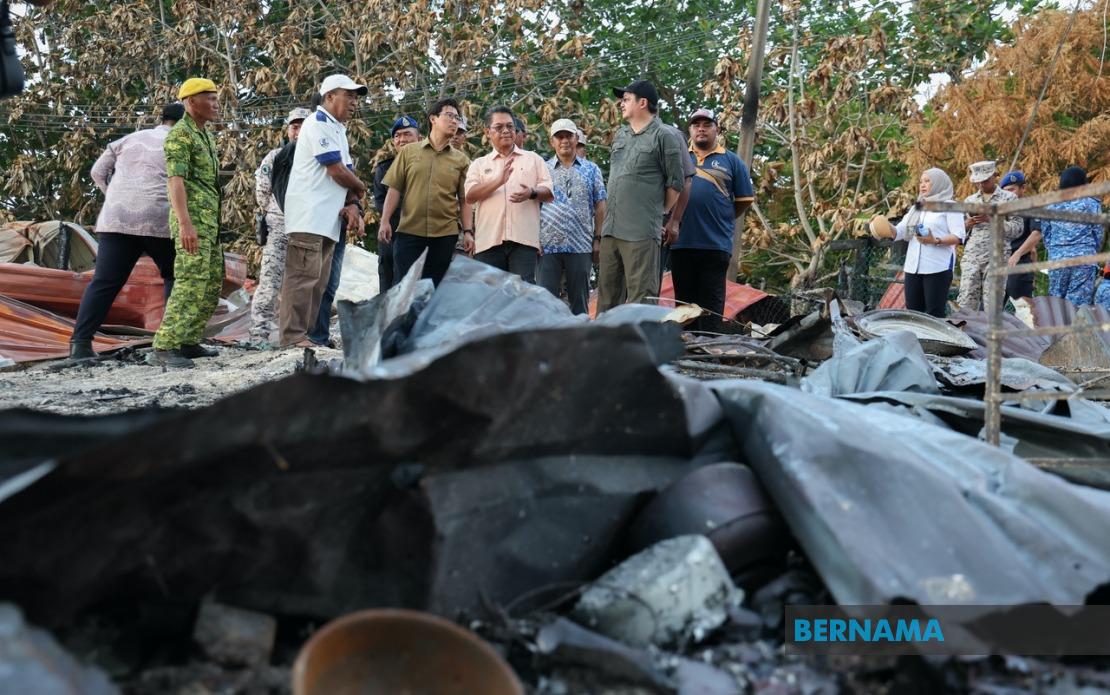
The Prime Minister's Department (JPM) has swiftly mobilised resources to assist residents devastated by a fire that swept through Pulau Nunuyan Laut in Sandakan yesterday morning, with federal officials announcing initial support packages for 29 household heads affected by the disaster. The blaze, which erupted around 3 am, destroyed 28 residential structures and rendered more than 100 people homeless, marking one of the more significant fire incidents in the eastern Sabah region in recent months. The rapid governmental response underscores the administration's commitment to disaster relief operations in East Malaysia, though the complexity of the relocation process—involving privately-held land—suggests longer-term challenges ahead.
Datak Mustapha Sakmud, Minister in the Prime Minister's Department responsible for Sabah and Sarawak affairs, disclosed that the Implementation Coordination Unit had already begun executing relief measures beyond monetary assistance. Among the initial steps taken was the provision of wheelchairs for elderly residents unable to navigate the aftermath of displacement, a detail that reflects the coordinated approach to addressing vulnerable populations within the affected community. The minister's emphasis on supporting the elderly highlights how post-disaster operations must extend beyond generic relief packages to accommodate specific demographic needs, particularly in island communities where mobility challenges are compounded by limited infrastructure.
The fire's impact on educational continuity emerged as a priority concern for government officials. Mustapha stressed that authorities would not tolerate disruptions to children's school attendance stemming from the tragedy, framing the restoration of the jetty—a critical transport link used by schoolchildren daily—as an urgent infrastructure matter requiring immediate intervention. This focus on preserving educational access demonstrates how disaster recovery extends beyond rebuilding homes to encompassing the broader social fabric that keeps communities functioning. The jetty, apparently damaged or rendered unsafe by the fire, represents a lifeline for young residents whose families depend on maritime transportation to reach educational facilities on the mainland.
Coordination between federal agencies and local municipal authorities has become the operational backbone of the relief effort. Mustapha disclosed that he had specifically tasked the Sandakan Municipal Council (MPS) alongside relevant government departments to conduct a comprehensive needs assessment covering all affected households. This multi-agency approach seeks to identify not only immediate survival requirements but also longer-term reconstruction needs, ensuring that relief efforts remain responsive to evolving community demands rather than confined to initial emergency responses. The involvement of MPS president Datuk Walter Kenson in fieldwork, conducting joint site visits with the federal minister, signals a unified front in disaster management that observers will scrutinise for effectiveness in actual implementation.
The relocation question poses considerable complexity, as affected residents currently occupy privately-held land—specifically two separate plots with different ownership arrangements. Walter outlined plans whereby the Rural Development Department would engage in negotiations with property owners while simultaneously exploring options within government-controlled village reserve land as alternative settlement sites. This dual-track approach acknowledges the legal constraints surrounding land use while seeking viable solutions that do not perpetuate the precarious housing arrangements that characterised Pulau Nunuyan Laut before the disaster. The involvement of two distinct landowners complicates negotiations and raises questions about the timeline for securing agreements that satisfy both displaced residents' needs and private property rights.
Long-term habitability planning has already entered discussions among officials, with authorities committing to provide essential utilities including electricity and water supply at any relocated settlement site. The intention to construct a new jetty at the resettlement location reflects recognition that Pulau Nunuyan Laut's island geography necessitates maritime infrastructure for basic functioning. These commitments represent a departure from temporary emergency housing toward planned, adequately serviced communities—an approach that seeks to prevent a recurrence of the vulnerability that arguably characterised pre-fire conditions on the island.
The incident raises broader questions about informal settlements and disaster preparedness in Malaysian coastal regions. Pulau Nunuyan Laut, like many island communities across Sabah and Sarawak, likely developed organically without comprehensive disaster mitigation infrastructure or building safety standards. The fact that residents occupied private land without formal tenancy arrangements suggests limited regulatory oversight and minimal formal building codes—conditions that increase fire risk and complicate official response mechanisms. Future policy discussions may examine whether federal and state governments should establish clearer frameworks for formalising land rights in such communities and implementing mandatory fire safety measures.
The speed of the federal response reflects the political sensitivity surrounding disaster management in East Malaysian states, where governance capacity and development disparities remain politically charged issues. By deploying senior ministerial representation and demonstrating coordinated inter-agency action, the federal government signals commitment to Sabah's development and welfare concerns. However, the execution phase—particularly regarding land negotiations, resettlement logistics, and sustained infrastructure provision—will ultimately determine whether this incident becomes a catalyst for improved disaster resilience or merely another crisis absorbed into ongoing administrative routines.
For Malaysian policymakers monitoring disaster preparedness, the Pulau Nunuyan incident illustrates how island communities require specialised response mechanisms acknowledging their geographic isolation and infrastructure constraints. Lessons learned may inform discussions on building codes, emergency supply chains, and evacuation procedures applicable across Malaysia's archipelagic regions. The coming weeks will reveal whether the coordination demonstrated in initial relief efforts translates into durable solutions for the displaced residents and whether relocation discussions progress swiftly enough to prevent prolonged uncertainty among affected families.

