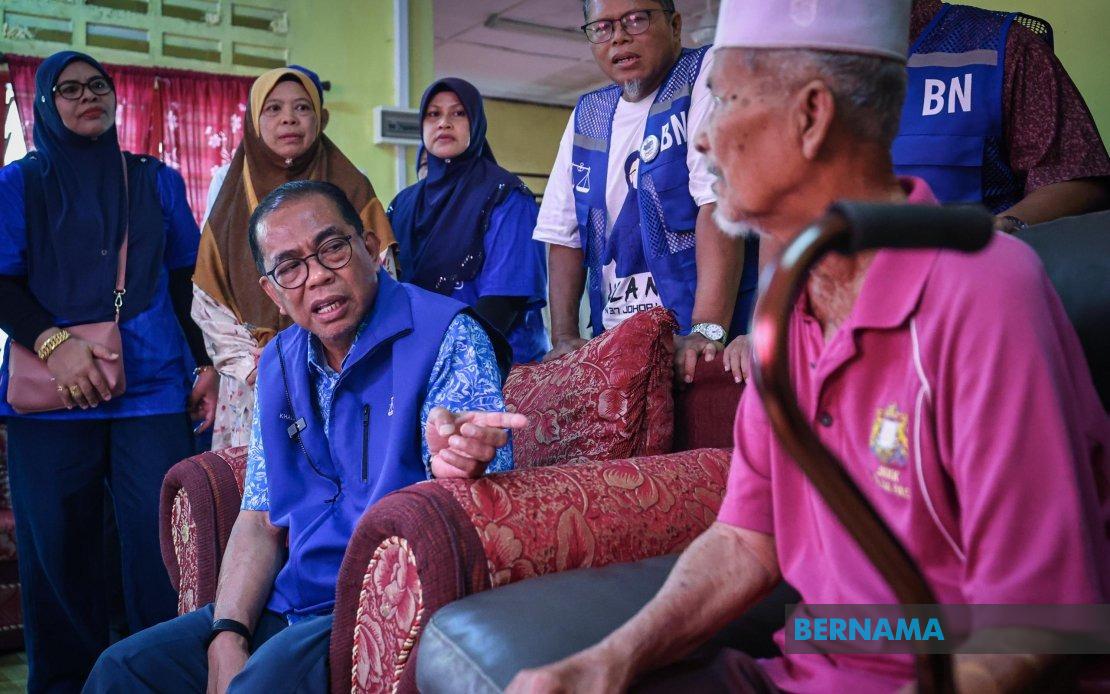
Datuk Seri Mohamed Khaled Nordin, the Defence Minister and UMNO vice-president, has sought to reassure voters in Johor that constitutional safeguards prevent political conflict between federal and state governments, even when they operate under different political coalitions. Speaking after attending a community engagement event in Kota Tinggi on July 9, Mohamed Khaled emphasised that the division of powers between Putrajaya and state capitals is not a matter of political convenience but rather a fundamental legal arrangement enshrined in Malaysia's founding document.
The constitutional framework governing federal-state relations represents a cornerstone of Malaysia's governance structure, allocating specific jurisdictions and responsibilities to each tier of administration. Mohamed Khaled underscored that these delineations exist to ensure both levels respect each other's authority whilst collaborating for national and regional progress. This assurance carries particular weight in Johor, where voters face the prospect of determining a state government that may operate independently of the ruling federal coalition.
According to Mohamed Khaled, the UMNO leadership has consistently maintained that the Federal Constitution serves as an impartial arbiter between competing political interests at different administrative levels. The constitutional arrangement requires that whichever party or coalition commands the federal government must extend cooperation and respect to state governments, whilst state administrations are equally bound to work constructively with federal authorities. This reciprocal obligation, he stressed, transcends partisan considerations and remains binding on all parties regardless of electoral outcomes.
The minister's comments arrive as Johor prepares for the 16th state election scheduled for July 11, in which 172 candidates will vie for 56 state assembly seats. With approximately 2.73 million registered voters participating, the election represents a significant test of Barisan Nasional's political standing in a state it has dominated through much of independent Malaysia's history. In the 2022 election, BN secured 40 of the 56 contested seats, maintaining substantial legislative control despite broader political volatility affecting the coalition nationally.
Barisan Nasional is positioning itself as the continuity candidate, contesting all 56 seats and projecting confidence in securing another mandate to form the state government. Mohamed Khaled articulated the coalition's optimism by reference to its track record and the public trust it claims to have accumulated. The BN narrative centres on demonstrating that experience and proven delivery matter more than ideological positioning, a message designed to resonate with voters concerned about governance stability and development continuity in Southeast Asia's most industrialised state.
The timing of Mohamed Khaled's constitutional reassurances suggests awareness that voters harbour legitimate concerns about potential institutional friction should a non-BN state government emerge. In Malaysia's political context, where federal-state relations have occasionally generated tensions, particularly during periods of divided government, such anxieties are not merely theoretical. The Defence Minister's intervention seeks to anchor expectations in constitutional law rather than political preference, reducing perceived risks associated with voting for opposition parties or alternative coalitions.
Johor's economic significance and its status as a major contributor to national revenue amplify the importance of stable federal-state collaboration. The state hosts critical petrochemical, manufacturing, and agricultural sectors that operate across state boundaries and interface with federal infrastructure projects. Any breakdown in inter-governmental coordination could disrupt economic activity and investment confidence. By emphasising constitutional protections, Mohamed Khaled attempts to inoculate the state's business environment against political uncertainty, signalling that regardless of the election outcome, institutional mechanisms will ensure functional cooperation.
The federal-state relations framework also carries implications for resource allocation and development funding. States depend on federal disbursements for numerous infrastructure and social programmes, whilst the federal government relies on state cooperation for implementing national policies across diverse regional contexts. The constitutional allocation of revenues and the division of taxation powers create numerous interdependencies that demand ongoing negotiation and collaboration. Mohamed Khaled's remarks implicitly acknowledge these practical realities whilst asserting that constitutional structures render them resilient to political fluctuation.
For Malaysian voters more broadly, the Johor election exemplifies a maturing political system in which coalitions can alternate between federal and state levels without triggering systemic dysfunction. This pattern, increasingly common across the federation, reflects public willingness to vote strategically at different electoral contests rather than simply endorsing or rejecting particular coalitions wholesale. Mohamed Khaled's constitutional framing validates this voter behaviour by insisting that institutional design accommodates such flexibility without compromising governance quality or federal-state cooperation.
The message carries particular relevance for Southeast Asian democracies grappling with similar questions about centre-periphery relations and coalition management across multiple electoral contests. Malaysia's experience suggests that written constitutional limits on executive power and clear delineation of jurisdictional boundaries can effectively constrain political conflict even when competing coalitions control different governmental tiers. This constitutional success, however, depends upon all participants accepting legal constraints and prioritising institutional functionality over partisan advantage, a condition Mohamed Khaled implicitly urges Johor voters to trust will hold.
As the Johor campaign enters its final days, the constitutional framing offered by the Defence Minister represents an attempt to shift voter focus from partisan considerations to institutional resilience. By anchoring his assurances in law rather than political goodwill, Mohamed Khaled suggests that voting choices carry lower political risk than they might appear. The effectiveness of this messaging will become evident on election day, though the underlying constitutional realities he described will continue shaping federal-state dynamics regardless of the outcome.

