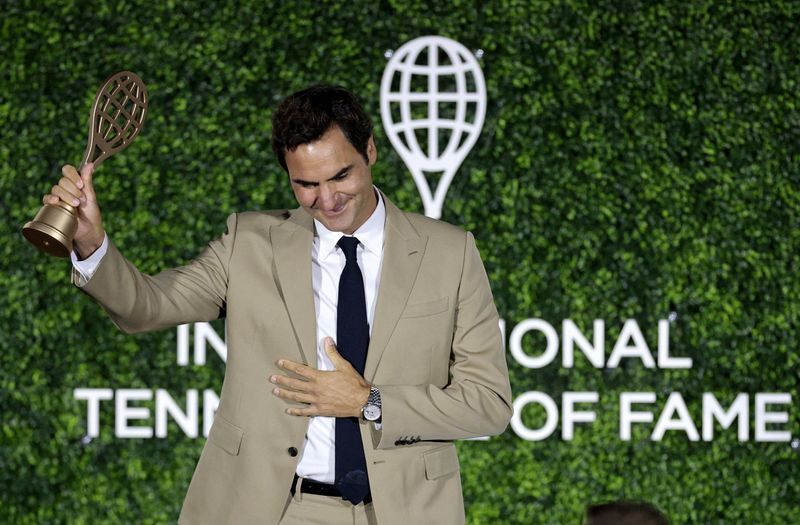
Roger Federer's induction into the International Tennis Hall of Fame on Saturday became a deeply personal reflection on a career that transcended sport itself. The 45-year-old Swiss champion, visibly moved throughout the ceremony at Newport, Rhode Island, told attendees that he remains in the midst of writing his love letter to tennis, a sport that he said "meant the world" to him far beyond the trophies and accolades it had brought. Speaking alongside broadcaster and journalist Mary Carillo, also inducted that day, Federer articulated a philosophy that sets him apart from many of his peers—that the pursuit itself mattered more than the recognition that followed.
Federer's dominance across four decades of professional tennis is reflected in numbers that remain staggering. His eight Wimbledon titles stand as a men's record, achieved during a 310-week tenure as world number one. Beyond the grass courts of London, he claimed six Australian Open crowns, five U.S. Open titles, and a single French Open championship. Yet as he stood before the hall during his acceptance, Federer made clear that these accomplishments, while significant, represented only part of what had driven his competitive life. His 103 ATP Tour titles and retirement in 2022 marked the end of an era in men's tennis, one defined not merely by winning but by the manner in which victory was achieved.
The elegance for which Federer became renowned extended to nearly every aspect of his presentation on court. His signature headband became so central to his identity that he revealed during his speech that he had worn more than five thousand of them throughout his career—a detail delivered with characteristic wit. He mentioned too the peculiarity of nearly always wearing two pairs of socks, small idiosyncrasies that somehow coalesced into an overall package of sophistication. This attention to aesthetic detail was not superficial; rather, it reflected a deeper commitment to the art of the game itself, to playing in a manner that engaged audiences as much through beauty as through tactical superiority.
Central to Federer's philosophy was his willingness to innovate and experiment. He traced his evolution from serve-and-volley specialist to a player who developed transitional approaches, positioning himself beyond or directly on the baseline in ways that confounded opponents. His tactical boldness extended even to the unconventional—the SABR, or Sneak Attack by Roger, represented a whimsical yet calculated risk-taking that separated him from more orthodox competitors. Federer explained that these court innovations reflected a mentality that transcended winning individual points or matches; they represented a commitment to pushing the boundaries of what was considered possible within the sport.
Yet the Swiss legend's reflections made abundantly clear that his greatest source of fulfillment extended far beyond the white lines of the court. His emotional gratitude toward coaches, medical staff, and family members, particularly his wife Mirka, underscored the human scaffolding that had supported his career. Federer spoke with evident depth about the importance of character off the court, acknowledging his role as husband, father, and friend alongside his identity as a tennis player. This holistic view of achievement—one that integrated personal relationships with professional accomplishment—resonated throughout his address and distinguished his induction from purely celebratory recollections of past glory.
Federer's connection to Switzerland and to tennis itself was deeply rooted in childhood experience. Recalling his years as a ball boy in Basel at age thirteen, he emphasized how witnessing the sport firsthand had ignited a passion that would span four decades. His pride that Switzerland would enter the Hall of Fame alongside his name reflected not nationalistic pride alone but genuine gratitude for the environment that had nurtured his development. This geographic and cultural anchor provided Federer with a grounding that, throughout his career, had kept him tethered to humility and perspective.
The generational breadth of Federer's playing career offered him a unique vantage point from which to view tennis. He emphasized the privilege of competing against and alongside figures from different eras—from Andre Agassi and Lleyton Hewitt in one generation to Andy Roddick, Rafael Nadal, and Novak Djokovic in subsequent ones. This spanning of tennis history meant that Federer had absorbed lessons from multiple playing styles and philosophies, incorporating elements and adapting to transformations in the sport's pace and globalization. His encounters with these champions had shaped not only his tactics but his understanding of what excellence demanded.
Federer's induction speech pivoted deliberately toward the future, using his retirement as an opportunity to address the next generation of players rather than merely retrospect. He expressed concern that as professional tennis accelerates and becomes increasingly global, the sport might lose touch with the amateur spirit and camaraderie that once defined player relationships. His message was a call to preserve certain values even as the game's technical and physical demands continue to escalate. He urged contemporary and future players to maintain authenticity, to ask difficult questions, and to take calculated risks that might introduce elements never before witnessed.
The broader significance of Federer's words carries implications for how excellence itself is understood and pursued in contemporary sport. In an era often dominated by metrics, rankings, and quantifiable achievement, Federer's emphasis on the journey, the relationships, and the artistic expression embedded within competition offered a counternarrative. For Malaysian and Southeast Asian tennis enthusiasts, his message resonates as a reminder that the development of the sport in the region—whether through the emergence of young players or through grassroots initiatives—depends not solely on titles won but on cultivating a culture that values innovation, character, and the human connections that sport facilitates.
Federer's statement that his induction was "not a goodbye" proved particularly poignant. Though his playing career has ended, he positioned his role in tennis as continuing in different forms. His invocation of tennis as standing "at the intersection of everything I care most about"—family, friendship, past, and future—suggested that his contribution to the sport would evolve rather than cease. This perspective may define his post-playing legacy as profoundly as his competitive accomplishments, offering a template for how elite athletes might transition from competition to stewardship of their sports.

