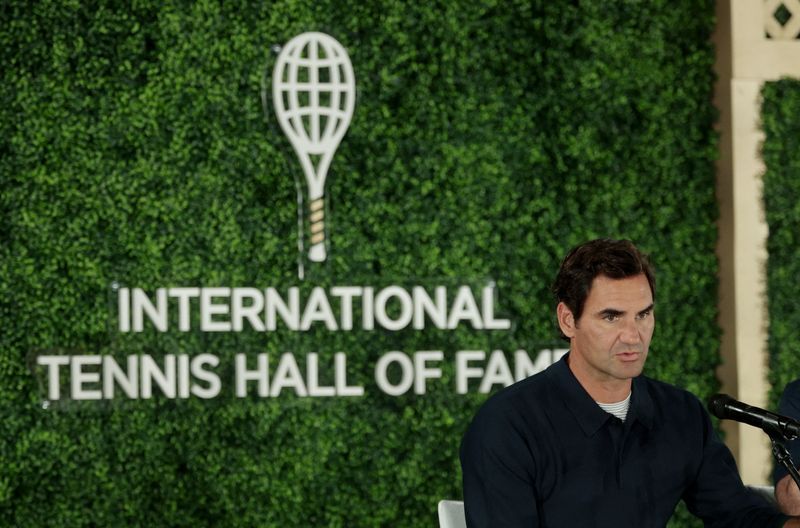
Roger Federer views his induction into the International Tennis Hall of Fame not merely as a capstone to an extraordinary playing career, but as a milestone prompting deeper contemplation about the imprint he has left on professional tennis. The 45-year-old Swiss maestro, who will formally enter the Hall of Fame in Newport on Saturday alongside broadcaster Mary Carillo, acknowledged during a Friday news conference that this particular honour carries a fundamentally different weight than the trophies and rankings that characterised his two decades on court.
Federer's competitive achievements stand among the most formidable in modern sports. His eight Wimbledon titles remain a men's record, complemented by six Australian Open victories, five U.S. Open crowns, and the 2009 French Open that completed his career Grand Slam. Beyond singles glory, he captured Olympic doubles gold with Stan Wawrinka in 2008 and proved instrumental in Switzerland's 2014 Davis Cup triumph. His 103 ATP Tour titles and unprecedented 310 weeks spent as world number one underscore a dominance few athletes across any discipline have achieved. Yet Federer himself seeks to reframe how his career should ultimately be assessed.
During remarks moderated by Hall of Fame president Patrick McEnroe, Federer expressed hope that his contribution would transcend the statistics and technical brilliance—including his iconic one-handed backhand—that define highlight reels. Instead, he emphasised his behind-the-scenes advocacy for systemic improvements to professional tennis, highlighting collaborative work with ATP leadership, Grand Slam organisers, player councils, and broader sport governance. This positioning reflects a mature understanding of legacy, one increasingly common among retired elite athletes who recognise their influence extends beyond match outcomes.
One concrete area where Federer claimed meaningful impact centres on player economics. He pointed to substantial increases in prize money flowing not only to champions but also to early-round competitors, fundamentally altering the financial viability of professional tennis for rank-and-file players. This democratisation of earnings has profound implications for the sport's accessibility and sustainability, particularly for emerging talents from less wealthy nations who can now sustain careers without independent family wealth. Federer also highlighted improved working conditions across multiple domains—enhanced facilities for players, better accommodation for media personnel, upgraded medical support infrastructure, and superior stadium standards globally.
For Malaysian and Southeast Asian readers, Federer's emphasis on structural improvements carries particular resonance. The region has produced promising tennis talent, yet infrastructure gaps and limited prize purses have historically constrained player development. Federer's contributions to elevating baseline compensation and facilities standards create an environment where young players from across Asia can pursue professional careers more viably, potentially nurturing the next generation of regional tennis champions.
Federer's reflections also touched upon the psychological dimensions of his rise from gifted Swiss teenager to global sports icon. He acknowledged embracing rather than resisting the intense competitive pressure that accompanied his ascent, describing a deliberate mindset that relished performing on prestigious courts like Centre Court at Wimbledon rather than lesser-known grounds. This psychological resilience, cultivated over decades, allowed him to thrive where many contemporaries buckled under similar external demands.
However, Federer cautioned that the relentless external scrutiny surrounding elite professional sport can become psychologically corrosive. He described moments when judgmental commentary and constant evaluation threatened to overwhelm his mental wellbeing, reducing players to binary categorisation—winners or losers—that strips away the intrinsic joy of competition. Despite these pressures, Federer credited his own resilience and intentional emotional management for maintaining happiness during his playing years and beyond.
Looking toward a post-playing future, Federer has left open multiple avenues for continued engagement with tennis. He expressed genuine interest in potentially captaining the Laver Cup, mentoring emerging players, or transitioning into broadcast commentary—roles that would enable him to contribute expertise and institutional knowledge to sport development. His current practice of attending three to four events annually demonstrates active commitment to remaining connected with professional tennis rather than simply retiring into isolation.
Federer's stated motivation for continued involvement centres on the fulfillment derived from meaningful contribution to sport's evolution. He recognises that his greatest satisfaction increasingly stems not from competitive achievement but from stewarding institutional improvements that benefit the broader tennis ecosystem. This philosophical shift, common among retired champions, reflects genuine passion for sport transcending personal glory.
As Federer transitions into this next chapter, his Hall of Fame induction serves as formal recognition that tennis greatness encompasses far more than individual titles or rankings. For a sport often consumed by obsessive score-keeping and statistical hierarchies, Federer's articulated legacy—rooted in systemic advocacy, player welfare, and structural reform—offers a refreshing counterpoint. His influence on professional tennis' institutional trajectory may ultimately prove as consequential as his unparalleled shot-making, establishing a template for how retired champions might leverage their platform and credibility toward advancing their sport's long-term health and sustainability.

