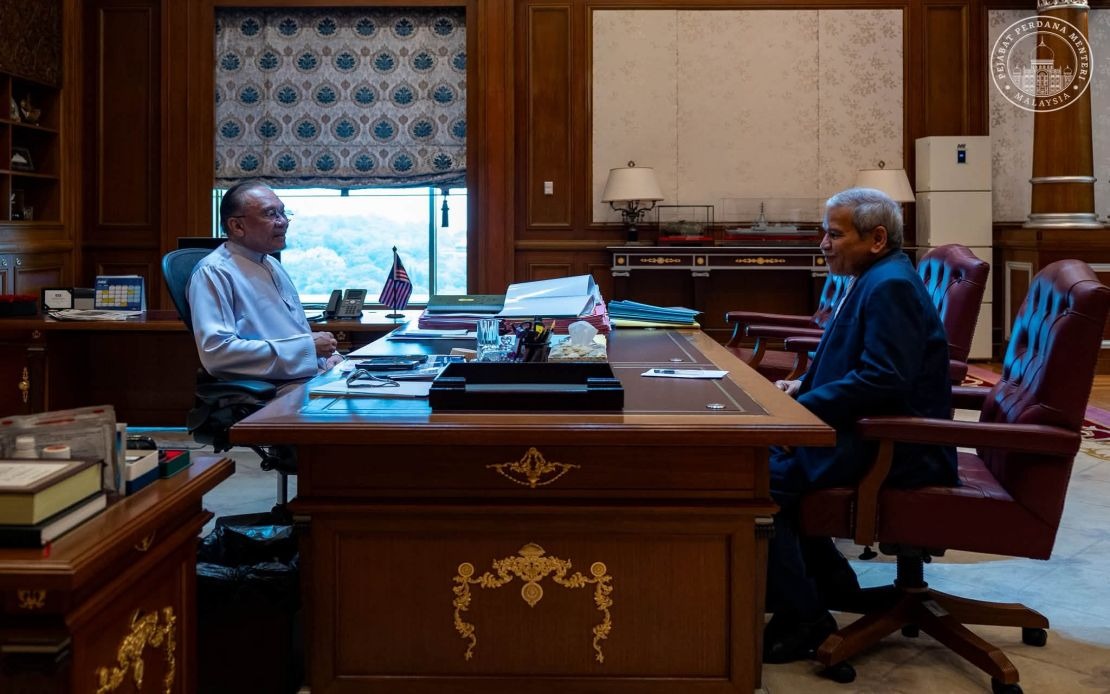
Prime Minister Datuk Seri Anwar Ibrahim has reiterated the government's commitment to fortifying the Federal Land Development Authority (FELDA) as a critical institution responsible for enhancing the welfare and dignity of settlers across the country. Anwar made these remarks during a courtesy meeting with newly appointed FELDA chairman Tan Sri Ahmad Badri Mohd Zahir at Putrajaya, underscoring the administration's determination to restore the organisation's capacity to deliver meaningful support to its beneficiaries.
The timing of this statement coincides with Ahmad Badri's assumption of office on July 15, marking a leadership transition at FELDA following the completion of his predecessor Datuk Seri Ahmad Shabery Cheek's tenure on June 30. The appointment signals a deliberate effort by the government to inject fresh momentum into the institution as it navigates contemporary economic challenges and shifting demographic realities among the settler community.
Anwar, who concurrently holds the portfolio of Finance Minister, framed FELDA's revitalisation within a broader context of intergenerational equity. He emphasised that strategies to enhance settler welfare must operate in tandem with initiatives aimed at boosting the organisation's economic resilience and long-term viability. This dual approach reflects recognition that FELDA's relevance depends not merely on sustaining current programmes but on adapting them to address emerging needs across different age groups within the settler population.
The Prime Minister's remarks drew particular attention to the challenges confronting younger-generation settlers, suggesting that previous policies may not adequately address the circumstances and aspirations of those entering the FELDA ecosystem today. This acknowledgment indicates awareness within government circles that the original settler communities established during FELDA's founding era now include adult children and grandchildren with different economic profiles, skill sets, and expectations than their predecessors. Younger settlers increasingly seek opportunities beyond traditional agricultural pursuits, necessitating institutional flexibility and diversified income-generation pathways.
Anwar's confidence in Ahmad Badri's capacity to execute this modernisation agenda reflects expectations that the new chairman will champion both continuity and reform. The appointment appears designed to balance respect for FELDA's institutional history with pragmatic adaptation to contemporary realities. Ahmad Badri's mandate encompasses restoring institutional credibility, which has occasionally been questioned in public discourse, while simultaneously charting a course that maintains relevance for coming decades.
The government's pledge of unwavering support under the MADANI framework—Anwar's overarching governance philosophy centred on inclusive prosperity—underscores political investment in FELDA's trajectory. Rather than positioning FELDA as a legacy institution gradually fading in importance, the MADANI Government appears determined to reconceptualise it as an evolving platform for socioeconomic development. This positioning carries implications for how FELDA allocates resources, invests in infrastructure, and engages with settler communities around modernisation and enterprise diversification.
FELDA's institutional role extends beyond individual settler welfare to encompass broader questions about land management, agricultural sustainability, and rural development strategy in Malaysia. The authority oversees vast tracts of productive agricultural land and manages complex relationships between government policy, settler interests, and commercial viability. Strengthening FELDA thus carries implications for Malaysia's agricultural output, rural employment patterns, and the socioeconomic stability of predominantly rural constituencies where settler communities predominate.
The emphasis on addressing younger settlers' specific concerns suggests potential policy innovations in areas such as mechanisation support, value-added agricultural products, agritourism development, and non-agricultural enterprise opportunities within settler schemes. These areas represent potential friction points between traditional FELDA programming and contemporary settler expectations, particularly as younger participants seek income levels and lifestyle flexibility comparable to urban alternatives.
Anwar's remarks also carry subtle political dimensions relevant to Malaysia's broader electoral landscape. Settler communities represent meaningful voting blocs in numerous constituencies, and their economic satisfaction directly influences electoral outcomes. By publicly emphasising FELDA's importance and pledging robust government backing, the Prime Minister signals responsiveness to settler concerns while implicitly encouraging confidence in the administration's commitment to rural constituencies and agricultural communities.
The leadership transition at FELDA provides an opportune moment for comprehensive institutional review. Ahmad Badri's appointment, coupled with government endorsements of his agenda, creates space for examining operational efficiencies, financial management, governance structures, and programme delivery mechanisms. Whether this translates into substantive operational changes or remains largely rhetorical will become apparent through implementation patterns emerging over coming months.
For Malaysian readers and regional observers, FELDA's trajectory carries significance beyond its immediate settler base. The authority's experience provides instructive lessons about managing state-sponsored agricultural settlement schemes, sustaining rural development initiatives across decades, and adapting institutional frameworks to shifting economic circumstances. Regional neighbours implementing comparable programmes find FELDA's successes and challenges instructive as they navigate their own rural development imperatives in an increasingly integrated regional economy.
Moving forward, the test of government commitment lies in translating supportive rhetoric into concrete resource allocation, policy innovations, and institutional reforms that demonstrably improve settler circumstances while enhancing FELDA's long-term sustainability. This requires balancing fiscal prudence with investment imperatives, maintaining agricultural productivity while supporting diversification, and honouring historical commitments to earlier settlers whilst creating viable pathways for younger generations. The effectiveness with which Ahmad Badri and his team execute this complex mandate will substantially determine whether FELDA remains a vital institution or gradually diminishes in relevance to Malaysia's evolving economic landscape.

