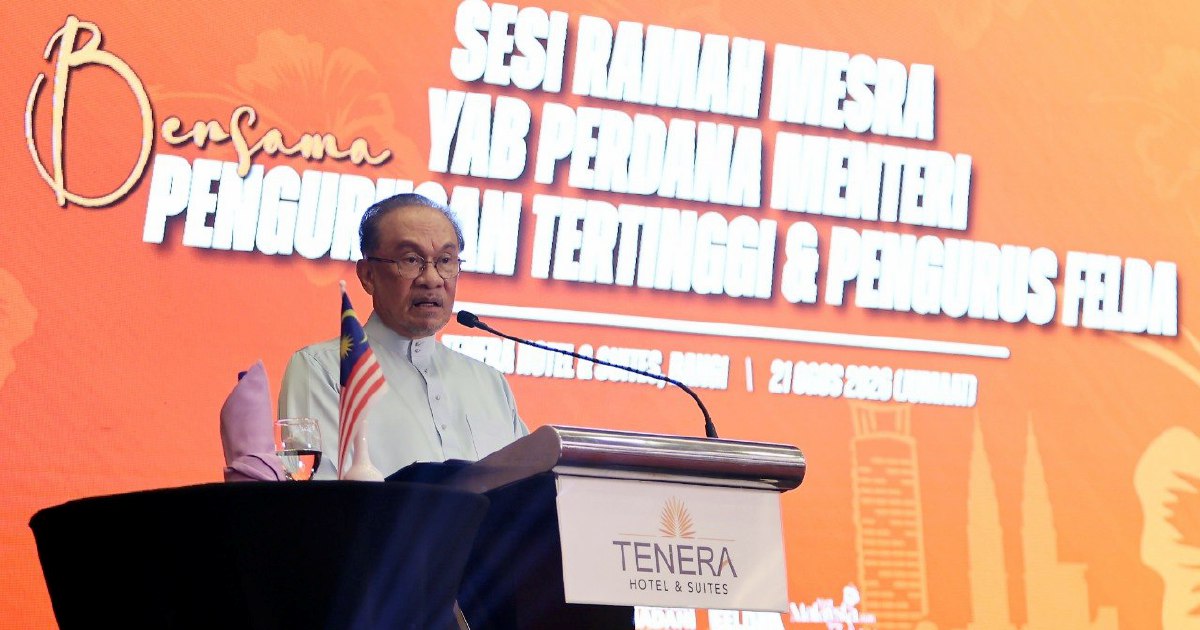
Prime Minister Datuk Seri Anwar Ibrahim confirmed that a specially appointed task force has begun investigating longstanding issues affecting the Federal Land Development Authority (Felda), signalling the government's commitment to addressing structural and operational concerns within the organisation. Speaking in Bangi, Anwar indicated that comprehensive findings from the inquiry would be made public once the investigative process reaches its conclusion, underscoring an approach of transparency in addressing governance challenges at the statutory body responsible for managing significant agricultural land holdings and settler interests across Malaysia.
The establishment of this task force reflects mounting pressure on Felda over several years, particularly regarding land management practices, financial accountability, and the welfare of settler families who depend on the authority's operations. The investigation appears designed to conduct a thorough examination of internal processes and external relationships that have drawn public scrutiny and parliamentary questioning. By initiating this formal inquiry, the government signals recognition that Felda—a pillar of rural development policy since its founding decades ago—requires contemporary oversight and potential operational reforms.
Felda has historically played a central role in Malaysian rural development, overseeing vast tracts of land development schemes and serving as custodian of settler livelihoods across numerous states. However, the organisation has faced mounting criticism regarding efficiency, transparency, and whether current management structures adequately serve beneficiary interests. The task force's mandate presumably encompasses reviewing administrative systems, financial management, land allocation procedures, and mechanisms for settler engagement and dispute resolution. Such an investigation could prove consequential for establishing clearer governance standards and accountability frameworks within the authority.
The timing of this announcement aligns with broader government efforts to strengthen institutional integrity across public bodies. The Prime Minister's public confirmation of the task force's commencement signals political will at the highest level, suggesting that findings will carry weight in potential policy discussions or structural adjustments. For settlers and stakeholders, the investigation represents an opportunity for their grievances and concerns to be formally documented and examined through a structured process, potentially leading to practical improvements in service delivery and operational responsiveness.
Malaysia's agricultural sector, particularly smallholder and settler-based farming communities, carries significant social and economic importance beyond mere production figures. Felda's performance directly affects rural household incomes, asset values, and intergenerational wealth accumulation in farming families. Any inefficiencies or mismanagement within the authority therefore extend beyond administrative concern into questions of equity and rural prosperity. The task force's work carries implications for how effectively Malaysia can sustain productive agricultural communities in an increasingly competitive regional and global landscape.
The investigative approach adopted here reflects evolving standards of institutional accountability in Malaysia's public sector. Rather than relying solely on routine audits or departmental reviews, the government has opted for a dedicated task force model, suggesting expectations of deeper, more critical examination. This methodology allows for focused expertise to be directed at specific problem areas while operating with sufficient independence from routine administrative constraints. The structure itself communicates a message that standard oversight mechanisms may have been inadequate in addressing the scope of issues warranting attention.
Settlers and their representatives have long advocated for greater voice in Felda's decision-making processes and clearer pathways for addressing grievances. The formal investigation potentially creates opportunities for these stakeholders to present documented concerns and substantive evidence regarding operational deficiencies. Whether the task force includes settler representation or conducts public hearings remains important for ensuring that beneficiary perspectives genuinely inform its findings and recommendations.
From a Southeast Asian perspective, Malaysia's experience with Felda holds relevance for regional agricultural policy discussions. Similar land development authorities operate across the region, and questions regarding their governance and effectiveness resonate across boundaries. A transparent investigation and subsequent reform efforts could provide valuable case studies for peer institutions grappling with comparable challenges around sustainability, financial management, and stakeholder accountability in large-scale agricultural schemes.
The promise of public disclosure of findings represents a departure from approaches that might have kept such investigations confidential or restricted to ministerial briefings. This transparency expectation shapes how the task force must conduct its work and document its conclusions, ensuring that rationales for any recommendations are comprehensible to the public, parliament, and particularly to affected settler communities. The quality and credibility of the investigation will largely depend on whether it addresses root causes rather than merely surface symptoms of institutional dysfunction.
Looking forward, the effectiveness of this task force will be measured not merely by the comprehensiveness of its report, but by whether its recommendations translate into meaningful operational changes within Felda. Implementation mechanisms, resource allocation for reforms, and clear accountability for oversight will ultimately determine whether the investigation catalyses genuine institutional renewal or becomes archived as another commissioned report without commensurate follow-through. Stakeholders across Malaysia's agricultural sector will be monitoring both the investigation's progress and the government's subsequent response to its findings.

