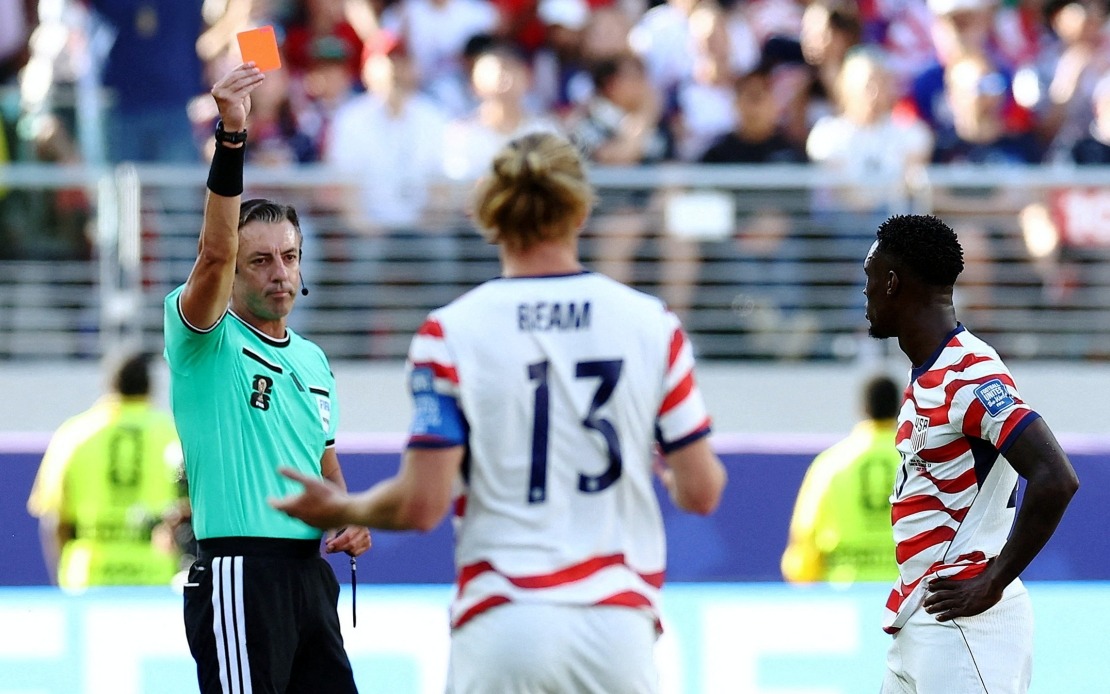
Football's governance came under scrutiny on Sunday when FIFA announced it would suspend enforcement of a one-match ban against United States striker Folarin Balogun, permitting him to participate in Monday's critical World Cup knockout encounter against Belgium in Seattle. The decision sparked immediate controversy from the Belgian Football Association, which characterised the ruling as inconsistent with established tournament protocols and threatened legal exploration of the matter.
Balogun earned his red card during the American team's 2-0 group-stage victory over Bosnia and Herzegovina on July 1, when he stamped on defender Tarik Muharemovic in an incident that clearly warranted dismissal under football's disciplinary framework. The FIFA Disciplinary Committee found his conduct violated Articles 14 and 66 of the FIFA Disciplinary Code and initially handed down a standard one-match suspension. However, invoking Article 27 of the same code, FIFA opted to suspend the implementation of this penalty for a probationary period extending one year into the future, effectively allowing the player to take the field against Belgium.
The timing of this decision proved contentious. Balogun had emerged as a vital offensive weapon for the United States throughout the tournament, having already netted three goals by the time of his dismissal. His availability for the knockout phase represented a substantial competitive advantage, raising questions about whether other teams sent off during group play received comparable leniency. The suspension's postponement hinged on FIFA's interpretation that Article 27 permits the disciplinary committee discretionary authority to defer enforcement, a provision that Belgium's governing body insists contradicts the tournament's explicit automatic suspension framework.
Belgium's objection rested on a carefully reasoned legal argument grounded in the competition regulations themselves. The Royal Belgian Football Association emphasised that Article 66.4 unambiguously mandates automatic suspension from the subsequent match following any red card dismissal, a principle that had supposedly governed every other red card incident during this World Cup tournament. This consistent application across previous cases strengthened Belgium's position that the Balogun exception represented a departure from established fairness standards rather than an acceptable exercise of discretionary authority.
The Belgian federation further reinforced its complaint by citing Article 10.5 of the FIFA World Cup 2026 Competition Regulations, which stipulates that any player or team official receiving either a direct red card or accumulating two yellow cards "will automatically be suspended from their team's subsequent match," with additional punishments potentially following. This language appeared deliberately designed to eliminate ambiguity and prevent the very interpretation FIFA had just adopted. The federation noted that this automatic suspension principle had been formally reaffirmed through FIFA World Cup 2026 Circular No. 16, distributed to all participating member associations on May 12, and reiterated repeatedly during tournament coordination meetings and official workshops.
FIFA's reasoning centred on the technical distinction between imposing a sanction and enforcing it, arguing that while a one-match ban remained formally in place, its implementation could be deferred under Article 27's probationary mechanisms. The governing body warned that should Balogun commit another infraction of comparable severity during his one-year probationary period, the suspended suspension would automatically activate without requirement for further disciplinary proceedings, operating independently of any additional sanctions imposed for the new offence. This conditional framework attempted to preserve some consequences while still granting immediate eligibility.
For Malaysian readers and Southeast Asian football observers, the incident highlights broader questions about competitive fairness and the consistency of international sports governance. When major tournaments involve substantial financial stakes and global audiences, discretionary rulings favouring particular teams inevitably generate accusations of bias, whether intentional or merely perceived. The fact that Belgium, a strong footballing nation, faced elimination in the knockout round against an American team suddenly strengthened by Balogun's availability underscored the material consequences of FIFA's interpretive choice.
The dispute also exposed potential contradictions embedded within FIFA's own regulatory architecture. When multiple articles of the disciplinary code appeared to offer conflicting guidance, FIFA selected the interpretation most favourable to the United States rather than applying the tournament-wide automatic suspension principle that had governed all other red cards. This divergence from precedent troubled Belgium and, by extension, any other team that might reasonably expect consistent application of discipline across a global competition.
Belgium's announcement that it was investigating "all potential options" to protect its rights signalled the federation's willingness to pursue formal appeals, legal challenges, or other remedies available within FIFA's governance structure. Such escalation, while unlikely to reverse the immediate decision before Monday's match, could establish important precedent regarding FIFA's authority to suspend enforcement of automatic suspensions during knockout tournament phases. The Belgian federation's explicit invocation of fairness principles and transparent tournament protocols suggested this represented not merely a tactical complaint but a principled objection to what it perceived as arbitrary governance.
The United States, pursuing its first quarterfinal appearance since 2002, benefited substantially from retaining Balogun's proven goal-scoring threat. His three tournament goals had positioned him among the competition's leading marksmen, and his absence would have significantly diminished American attacking capability against Belgium's formidable defence. The match therefore acquired an additional layer of significance, with the result potentially shaped by a disciplinary decision that split international football opinion.
As the tournament progressed toward its climactic stages, FIFA's handling of the Balogun suspension served as a reminder that technical interpretations of regulations, when applied inconsistently or contrary to established practice, could generate substantive questions about whether the world's premier football competition operated according to genuinely neutral standards. Belgium's formal protest ensured that governance questions would persist alongside discussion of Monday's sporting encounter, embedding administrative controversy within what should have been a straightforward disciplinary matter.

