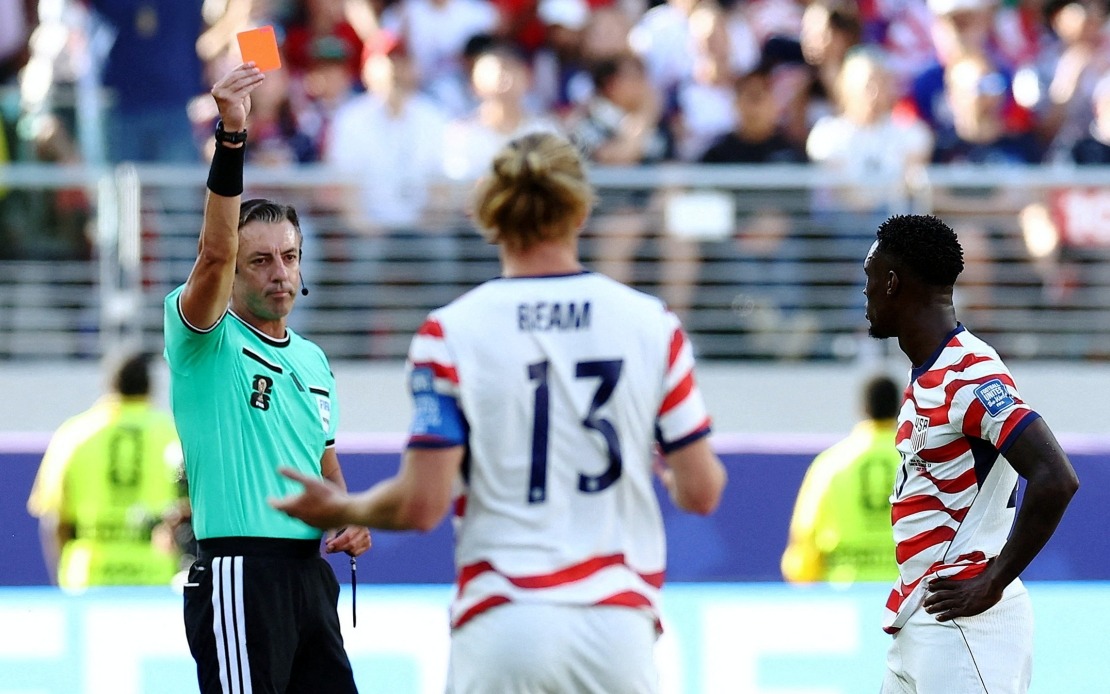
FIFA has moved swiftly to defend Brazilian referee Raphael Claus after US President Donald Trump publicly questioned his integrity following a controversial red card decision during the 2026 World Cup tournament. The diplomatic clash between the world's top football body and the American leader underscores the intense scrutiny surrounding match officials at the tournament, even as FIFA insists its referees represent the highest standards of professional conduct.
Claus sent off US striker Folarin Balogun during the last-32 encounter against Bosnia and Herzegovina following a VAR review. The incident sparked immediate backlash from Trump, who labelled the official "suspect" and prompted FIFA president Gianni Infantino to personally review the decision at the American leader's request. The situation highlighted the political dimensions that can surround major sporting events and the expectations placed on referees when domestic interests are at stake.
In what appeared to be a carefully orchestrated response, FIFA issued a formal statement positioning Claus as "one of the world's leading professional referees and a valued member of Team One" at the tournament. The statement further emphasised that throughout his career, Claus "has consistently demonstrated the highest standards of professionalism and integrity." This measured defence reflected FIFA's broader strategy to insulate its match officials from political pressure whilst simultaneously addressing concerns raised by a sitting head of state.
Pierluigi Collina, FIFA's chief of referees, provided more personalised backing for the Brazilian official. Collina noted that Claus was participating in his second World Cup, having previously officiated at Qatar in 2022, and described him as "an experienced and highly respected referee." By emphasising the longevity and reputation of Claus within the international refereeing community, Collina effectively positioned the decision as consistent with established refereeing standards rather than as a controversial judgment call. The timing of this endorsement underscored FIFA's determination to prevent individual controversies from undermining confidence in the entire refereeing framework.
The controversy itself took an unusual turn when Balogun's red card was suspended on Sunday, ultimately allowing him to participate in the last-16 tie against Belgium. The United States subsequently lost that match 4-1 in Seattle, a result that may have further inflamed tensions given the initial disciplinary decision. This sequence of events raised questions about the consistency of disciplinary processes and whether external political pressure had influenced the reversal of Claus's decision.
For Malaysian and Southeast Asian observers, the incident illustrates the vulnerability of match officials to external pressure in high-stakes tournaments where national pride and sporting outcomes intersect. The willingness of a political leader to publicly question an official's judgment, combined with FIFA's measured but firm response, demonstrates the delicate balance that governing bodies must maintain between respecting political concerns and protecting the independence of their officials.
Claus's prospects at the tournament remain strong, with FIFA officials suggesting he could potentially be assigned to officiate the final. The fact that Brazil was eliminated in the last-16 stage removes any potential conflict of interest regarding nationality, a factor that typically influences the selection of officials for major matches. This decision-making criterion reflects FIFA's effort to ensure that perceived biases do not undermine the credibility of tournament outcomes.
FIFA president Gianni Infantino, whilst not directly addressing Trump's criticism by name, issued a broader statement defending the quality and selection process for match officials. Writing on Instagram, Infantino emphasised that the 2026 World Cup represented an "overwhelming success," with match officials forming a crucial part of that achievement. He stressed that referees had been selected through a "rigorous process which considered their skills, consistency, and quality over a sustained period," positioning the selection framework as both transparent and evidence-based.
Infantino's statement further reinforced a core principle central to football governance: the necessity of respecting referees and the rules they enforce. His assertion that "without referees, there is no football" articulated a philosophical position about the structural importance of match officials to the sport itself. This framing attempted to elevate the conversation beyond individual decisions to questions of sporting principle and institutional integrity.
The broader implications of this dispute extend to how international sporting bodies navigate relationships with powerful political actors. The fact that Infantino felt compelled to personally review a match decision at the behest of the US president suggests that FIFA operates within a complex political ecology where neutrality and independence must be carefully managed. For viewers across Southeast Asia, this incident serves as a reminder that major tournaments remain venues where national pride, political interests, and sporting outcomes become deeply intertwined.
Moving forward, the handling of this controversy may establish precedents for how FIFA responds to future political pressure regarding refereeing decisions. Whether FIFA's defence of Claus will insulate him from further scrutiny, or whether Trump's criticism will embolden other political leaders to question official decisions, remains an open question. What is clear is that the 2026 World Cup has already become a stage not merely for sporting competition but for contests over legitimacy, fairness, and institutional authority.

