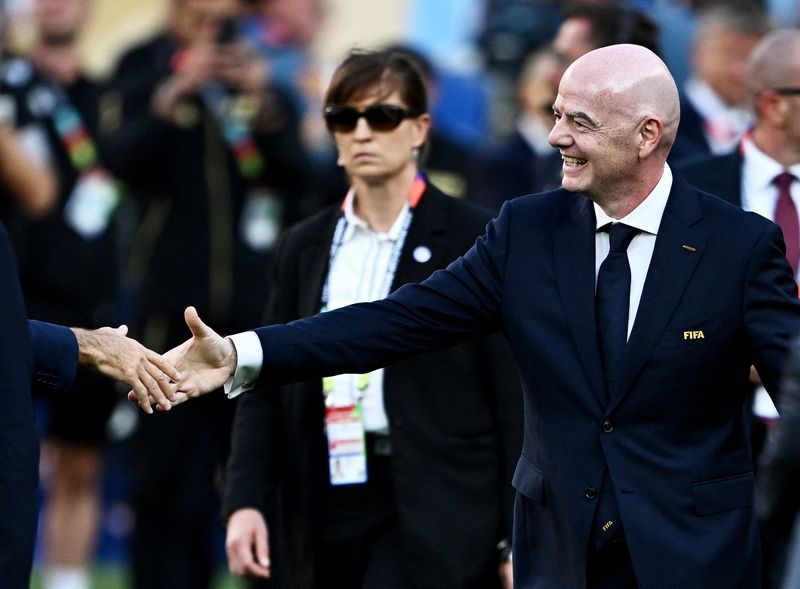
The battle for FIFA's leadership has crystallised into a stark geographical divide, with Mexico and Argentina's football associations publicly endorsing President Gianni Infantino even as his handling of a controversial World Cup commercial rights proposal triggers unprecedented reproach from other football powers. The Mexican Football Federation's declaration of support proves particularly noteworthy because it marks a rupture with CONCACAF, the regional confederation overseeing North American and Caribbean football, which recently demanded a thorough examination of Infantino's tenure.
Infantino's proposal to monetise portions of World Cup commercial rights, subsequently withdrawn after fierce opposition, has become the flashpoint in a broader governance crisis at world football's governing body. The Swiss administrator, who has led FIFA since 2016, suddenly confronts a reelection campaign in March markedly different from the smooth coronation anticipated merely weeks ago. Yet the global football community remains fragmented on whether his transgressions warrant removal, with continental confederations adopting conflicting positions that reflect deeper tensions within international sport.
The Confederation of African Football threw its full weight behind Infantino on Thursday, providing unanimous backing for his continued leadership at a moment when his position appeared increasingly precarious. This African endorsement carries considerable weight given the continent's 54 FIFA members, representing nearly a quarter of world football's voting membership. Yet this show of solidarity from the Global South stands in sharp contrast to the determined opposition emerging from Europe's football establishment, where UEFA has hardened its stance by committing to boycott FIFA competitions including the World Cup.
Asia's confederation reinforced Europe's position by announcing solidarity with both UEFA and CONCACAF, effectively positioning the two football supercontinents against Infantino. This alignment suggests that Infantino faces opposition from regions representing the sport's most developed commercial markets and competitive elite. The continental configuration of support and opposition reveals uncomfortable truths about football's internal fault lines, where wealthier federations demanding transparency and accountability stand against confederations emphasising institutional process and loyalty to established FIFA frameworks.
South America's CONMEBOL, which hosts Brazil, Argentina, and Uruguay among its ten members, adopted a carefully calibrated middle position that technically favours Infantino while expressing serious reservations about his methodology. CONMEBOL's statement rejected any attempt to unseat Infantino through processes circumventing the full membership vote of all 211 FIFA associations, effectively preventing a rushed coup while simultaneously highlighting alarm over his "repeated unilateral actions" and erosion of dialogue-based governance. Argentina's football association subsequently adopted this framework, releasing a supportive letter that acknowledges the proposal's failures while framing Infantino's continuation as necessary for institutional stability.
Mexico's federation directly mirrored CONMEBOL's procedural emphasis, insisting that only a comprehensive vote among all member associations could legitimately challenge Infantino's authority. The FMF's backing carries significance because Mexico served as co-host of the recently completed World Cup, lending it particular standing in discussions about football's premier tournament. By opposing any institutional process outside FIFA's formal structures, Mexico and South America have effectively erected procedural barriers that protect Infantino from removal efforts, even while individual national associations abandon him.
Croatia's decision to withdraw support, following earlier defections from England and Albania, underscores deepening cracks in Infantino's previously commanding coalition. These European federations justified their withdrawal by citing governance failures and the need to reassess their positions in light of recent developments surrounding the 2026 World Cup preparations. The Croatian Football Federation's statement reflects a pattern where established football powers, particularly those with strong governance traditions and media scrutiny of FIFA decisions, have begun distancing themselves from Infantino's leadership style.
The commercial rights proposal itself, now abandoned, exemplified precisely the governance failures that critics identify as symptomatic of Infantino's presidency. FIFA subsequently apologised to member associations for missteps surrounding the proposal and pledged to review processes that permitted such a controversial initiative to advance without adequate consultation. Yet even this admission of error has failed to assuage concerns among federations questioning whether apologies and procedural pledges constitute sufficient reform, particularly given Infantino's pattern of unilateral decision-making that CONMEBOL and others have explicitly criticised.
Players' union FIFPRO has escalated rhetoric beyond governance quibbles, characterising Infantino's commercial rights proposal as a "profound abuse of presidential power" rather than mere administrative misstep. This framing transforms the dispute from a technical disagreement about processes into a fundamental question of whether Infantino has exceeded legitimate presidential authority. FIFPRO's intervention reflects broader recognition that FIFA governance failures carry consequences for footballers themselves, whose collective bargaining position and commercial interests become hostage to presidential overreach.
FIFA's official response has maintained that all actions complied with its regulations, framing the controversy as relating exclusively to communication and process rather than substantive rule violations. This legalistic defence appears increasingly hollow to critics who argue that regulatory compliance provides insufficient cover for decisions that bypass collective deliberation and exploit information asymmetries. The gap between FIFA's procedural innocence claims and the substantial opposition from major confederations and stakeholders suggests deeper legitimacy problems extending beyond the specific commercial rights proposal.
Infantino's reelection prospects remain uncertain despite continental support from Africa and South America, primarily because no serious challenger has materialised to contest him in March. The absence of an alternative candidate paradoxically strengthens Infantino's position procedurally while weakening it substantively, as member associations find themselves choosing between accepting his leadership or endorsing radical institutional disruption. For Malaysian and Southeast Asian football stakeholders, Infantino's governance questions carry practical implications regarding World Cup expansion, tournament scheduling, and resource distribution decisions that will increasingly affect regional confederations and national associations.
The FIFA presidency contest ultimately reflects deeper questions about international sports governance in an era when traditional hierarchical authority structures face unprecedented pressure from demands for transparency and accountability. Infantino's survival likely depends on his ability to convince sufficient member associations that institutional continuity outweighs governance reform, particularly given the absence of compelling alternative leadership. Whether continental divisions harden further or moderate before March's Congress will determine whether FIFA emerges from this crisis with renewed legitimacy or with governance questions festering beneath a restored but contested leadership.

