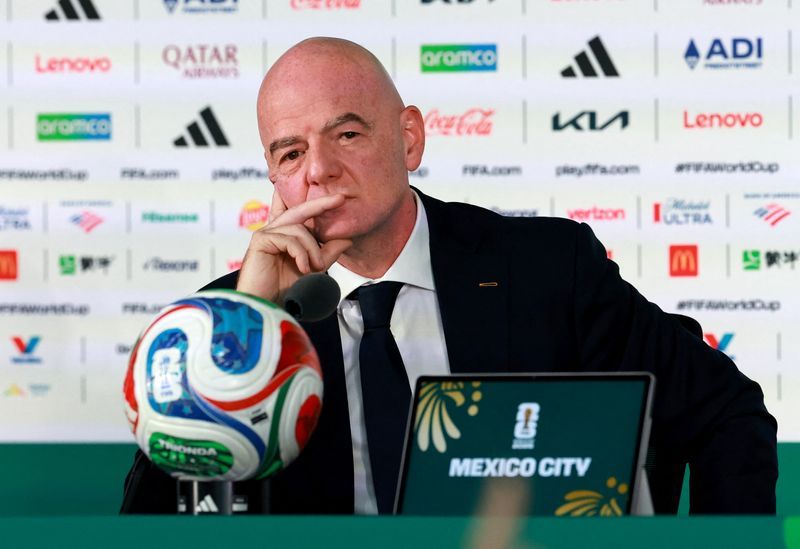
The gathering of FIFA's leadership in Rabat on Wednesday appeared to draw a line under the most turbulent period of Gianni Infantino's presidency, with the organisation's management board and Secretary General Mattias Grafstrom publicly endorsing their chief ahead of next year's presidential election. Yet beneath the carefully choreographed display of unity and the official apologies to the 211 member federations lies a deeper institutional malaise that will not be easily papered over. The bungled attempt to monetise portions of the World Cup's commercial future has exposed fundamental rifts in how the world's most powerful sporting body makes decisions, consults stakeholders, and communicates with those it governs.
FIFA's formal acknowledgement that its proposal to sell slices of World Cup commercial rights "should have been handled differently" represents a significant retreat, and the organisation has committed to reviewing the processes that sparked unprecedented internal revolt among national associations. The statement carefully focused blame on procedural missteps rather than governance rule breaches, positioning the controversy as a communication failure rather than a systemic failure. Yet this distinction rings hollow to many observers watching from within football's institutional ecosystem. The very fact that a proposal of such magnitude could advance so far through FIFA's machinery without meaningful consultation suggests problems that extend far beyond messaging and timeline management.
European Leagues, an umbrella body representing over 1,300 professional clubs across the continent, has become a focal point for dissent. The organisation's complaints about a compressed four-week assessment window for a separate proposal to expand the 2030 World Cup from 48 to 64 teams demonstrates a pattern rather than an isolated incident. What frustrates stakeholders is not merely the speed of decision-making but the structural exclusion from the process itself. FIFA has repeatedly presented stakeholders with near-final decisions rather than inviting genuine participation in their development. For professional leagues generating enormous revenue and wielding significant political influence, this approach feels increasingly untenable.
The breadth of criticism extends across football's power structure in ways that will complicate Infantino's path toward re-election in March. While he retains commanding support among smaller associations, particularly across Africa and Asia where FIFA's development programmes remain essential to national football infrastructure, traditional powerhouses have grown impatient. UEFA, European football's governing body, has openly questioned his leadership, while CONCACAF and the Asian Football Confederation have registered formal complaints. This split between FIFA's most dependent member federations and its most autonomous regional confederations presents a long-term structural challenge that cannot be resolved through a single Rabat summit.
The personal dimension of recent events cannot be overlooked. Mattias Grafstrom's internal memo to staff, which lamented a "sad and reproachable series of events" while cryptically noting that "individuals, unstable moments and unfortunate episodes come and go," suggested deeper anxieties within FIFA's senior leadership. Although Grafstrom avoided naming Infantino directly, observers interpreted the language as criticism thinly veiled in bureaucratic circumlocution. The subsequent public display of bonhomie—a photograph of Infantino and Grafstrom smiling and offering thumbs-up gestures at the women's Africa Cup of Nations—appeared designed to dispel speculation about tensions between the president and his top administrator, yet the very need for such performative displays underscores the fragility of internal relationships.
For Malaysia and other Southeast Asian nations watching from the periphery, these governance battles carry significant practical implications. FIFA's development funding and tournament opportunities shape the resources available to regional football programmes. Uncertainty about how FIFA makes strategic decisions—and whether smaller confederations will lose influence to larger commercial interests—creates unpredictability for national football associations planning their long-term strategies. The Asian Football Confederation's formal objections signal that Asian football leaders are not passive observers in this governance debate but active participants demanding greater voice in decisions affecting their members.
The presidential election scheduled for March 2027 represents a critical juncture, though Infantino appears to have secured his immediate position. No viable challenger has emerged, and the combination of support from developing football nations and technical control of FIFA's administrative apparatus provides him with formidable advantages. However, the crisis has fundamentally altered the political landscape within which any FIFA leadership must operate. Future proposals involving commercial strategy, tournament formats, or governance reform will encounter demands for transparency and consultation that did not previously exist. The expectation of stakeholder engagement has been irreversibly elevated.
What distinguishes this moment from previous FIFA controversies is the institutional memory it creates. Unlike the scandals that preceded Infantino's appointment—which football leaders sought to overcome through reform and fresh leadership—the current crisis stems directly from decision-making under his watch. This means that for the remainder of his tenure and potentially beyond, every major strategic initiative will be measured against the standard established by this failure. The question of how FIFA actually governs itself, not merely how it enforces rules on the pitch, has become central to the organisation's credibility.
The reconciliation achieved in Rabat should therefore be understood as tactical rather than strategic. Infantino has bought time and secured immediate political backing, preventing the formation of a serious challenge to his re-election. But FIFA as an institution has not solved the underlying problem: how to balance the autonomy and commercial interests of large confederations and national associations with FIFA's centralised authority and commercial ambitions. The abandoned proposal may be dead, but the tensions that produced it remain alive. What emerges from this period is not consensus about FIFA's future governance but agreement to defer deeper structural questions until after the election, when the political calculus may shift entirely.
For world football, the implications are substantial. FIFA's credibility depends not merely on the rules it establishes but on the legitimacy of its decision-making process. When that process loses credibility—when federations feel unheard and excluded—the foundation upon which FIFA's authority rests becomes vulnerable. The Rabat meeting temporarily stabilised that foundation, but only by committing FIFA to reforms whose ultimate scope and meaningfulness remain undefined. The real governance debate is just beginning.

