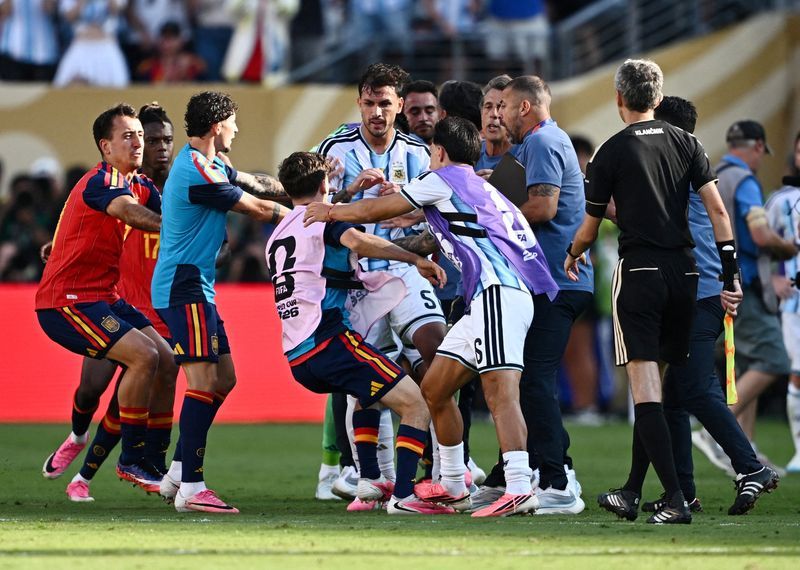
World football's governing body FIFA has initiated a formal disciplinary inquiry into the violent altercation that broke out between Spain and Argentina at the conclusion of their World Cup final, following Spain's 1-0 extra-time victory. The appointment of a dedicated disciplinary and ethics prosecutor signals FIFA's intent to thoroughly examine the incident and determine what sanctions, if any, are warranted against the players and coaching staff involved in the unsavoury conclusion to what should have been a momentous occasion in international football.
The match itself was decided by an extra-time strike from Spain's winger Ferran Torres, securing the Spanish national team their second World Cup title. However, the sporting achievement was overshadowed by the manner in which the fixture concluded, with tensions that had simmered throughout the encounter boiling over once the final whistle was blown. The chaotic scenes that followed highlighted the intense emotions running high between two proud footballing nations competing for the sport's greatest prize.
Argentina's disciplinary woes had begun to compound their challenge during the latter stages of regular play when midfielder Enzo Fernandez received a second yellow card and was sent off in the 93rd minute. Playing with ten men during the additional thirty minutes had clearly tested the resolve and composure of the South American outfit, and this frustration manifested itself in the physical confrontation that followed the match conclusion. The sending-off had fundamentally altered the match dynamics in Spain's favour, giving the European side a numerical advantage they ultimately exploited.
The flashpoint came when Argentine midfielder Leandro Paredes initiated contact with multiple Spanish players, notably defender Eric Garcia and midfielder Gavi, in what appeared to be a deliberate provocation. Rather than remaining isolated, this initial clash rapidly escalated into a broader melee involving numerous players from both squads, with pushing, shoving, and aggressive posturing becoming commonplace across the pitch. The scenes were reminiscent of the worst excesses of international football, where competitive spirit crosses the line into uncontrolled aggression.
Both teams required physical intervention to be separated, with coaching staff and match officials forced to position themselves between the warring factions to prevent further escalation. Argentina's head coach Lionel Scaloni, despite his own emotional investment in the outcome, worked diligently to restrain his players and de-escalate the volatile situation. His efforts, while commendable, underscored the difficulty of managing player conduct when passions run at their highest following such a momentous competition.
For Malaysian and Southeast Asian observers of international football, this incident carries broader implications about player discipline and the responsibilities of national teams to uphold standards of sportsmanship on the world stage. The World Cup final represents the pinnacle of the sport, broadcast to billions worldwide, and violent conduct at such a high-profile event reflects poorly on the international game's reputation. Nations competing in major tournaments bear responsibility for ensuring their representatives conduct themselves with dignity and professionalism, irrespective of match outcomes.
FIFA's decision to appoint a dedicated prosecutor indicates the organisation recognises the severity of the incident and the need for a comprehensive examination of events. The investigation will likely scrutinise video footage, match officials' reports, and witness statements to establish a clear timeline and identify those directly responsible for instigating or perpetuating the brawl. This process is essential for maintaining the integrity of international football competitions and establishing clear consequences for misconduct.
The investigative process undertaken by FIFA serves as a deterrent to future instances of similar behaviour, signalling that even at the highest levels of football, players and officials who resort to physical aggression face consequences. The absence of an announced timeframe for the investigation's conclusion suggests FIFA intends to conduct a thorough examination rather than a rushed judgement, allowing all relevant evidence and testimony to be properly considered before sanctions are determined.
The incident also raises questions about pre-match tensions and whether tournament officials adequately prepared players and coaching staff for managing the emotional intensity of a World Cup final. Some observers argue that heightened security measures and more robust pre-match briefings about acceptable conduct could prevent such confrontations, though others contend that the competitive nature of football at the highest level inevitably produces moments of tension that occasionally boil over.

