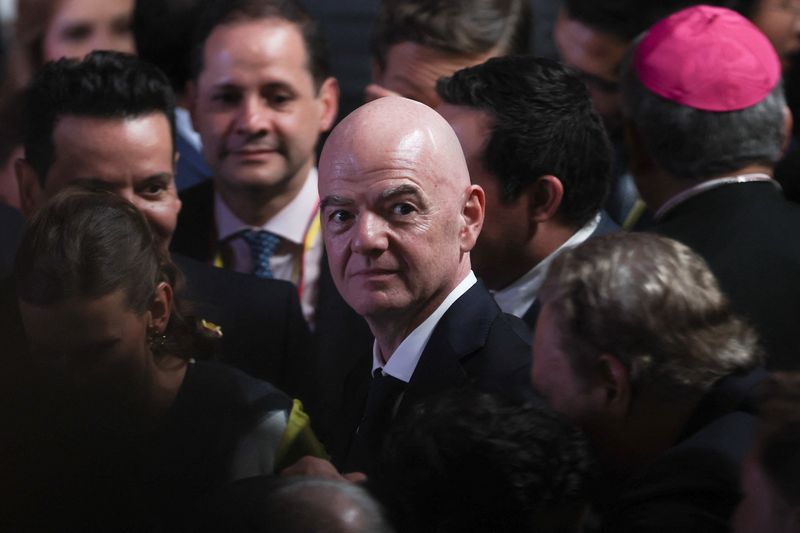
Gianni Infantino's leadership of FIFA has become increasingly contentious following backlash from three continental confederations, yet the Confederation of African Football's president Patrice Motsepe is advocating for a democratic resolution rather than political pressure to force the Swiss administrator out of office. Motsepe's position represents a significant stance within global football governance, suggesting that the appropriate venue for resolving questions about Infantino's future leadership lies not in backroom negotiations or public campaigns calling for resignation, but rather through FIFA's formal electoral machinery scheduled for Morocco next year.
The controversy surrounding Infantino stems primarily from his attempt to secure private investment for FIFA competitions, a proposal that encountered fierce resistance from UEFA, the Asian Football Confederation (AFC), and CONCACAF—three of football's six continental confederations. This attempted commercial restructuring triggered what observers have characterised as an open revolt within world football's governing body, with these powerful regional organisations explicitly questioning the FIFA president's conduct and publicly urging him to step aside. The initiative, which would have fundamentally altered the financial architecture of tournaments including the World Cup, exposed deep fissures within FIFA's decision-making structure and highlighted ongoing tensions between commercial modernisation ambitions and the conservative preferences of established football confederations.
Motsepe's intervention occurs at a critical juncture for FIFA's institutional credibility. Speaking to international media on Wednesday, the CAF president articulated a vision of proper governance grounded in established procedures rather than extra-constitutional pressure campaigns. His argument rests on the principle that FIFA's Congress—comprising delegates from all 211 member associations—represents the legitimate forum for such consequential decisions about the organisation's leadership. By framing the matter as fundamentally about democratic participation, Motsepe positioned himself as a defender of institutional processes at a moment when FIFA's legitimacy has been questioned by some of world football's most powerful confederations.
The scheduled elections represent a significant test for FIFA's internal democracy. If Infantino intends to seek re-election, the electoral process will provide all member associations with an opportunity to register their confidence or lack thereof through formal voting. Motsepe suggested that alternative candidates should be encouraged to declare their intentions, creating a genuine contest rather than an uncontested coronation. This approach assumes that FIFA's membership, when given the chance to cast ballots, will make choices reflecting their respective interests and values. For Malaysian and Southeast Asian football leaders, this democratic framework offers a mechanism through which smaller member associations might exercise influence proportional to their formal voting rights, even if their confederations collectively exercise less institutional power than UEFA or AFC.
Motsepe also defended the importance of subjecting leadership to scrutiny and accountability, though he insisted this scrutiny should operate within FIFA's established frameworks rather than through public campaigns targeting specific individuals. His position acknowledges the legitimacy of questioning governance practices and demanding adherence to standards of due process. However, he distinguished between legitimate oversight mechanisms and efforts to force resignations through external political pressure. This nuance became significant given the unprecedented nature of three continental confederations simultaneously calling for an incumbent leader's removal, an action that challenged FIFA's conventional modes of internal dispute resolution.
The CAF president's endorsement carries particular weight given Africa's substantial voting bloc within FIFA. With numerous African member associations, the CAF represents approximately one-quarter of FIFA's total membership. Motsepe confirmed that African football continues to support Infantino, citing his loyalty to African football's development and his responsiveness to the continent's interests. This backing is consequential; any presidential candidate requires widespread support across multiple confederations to secure election. African votes could prove decisive in March's contest, making Motsepe's public statements strategically important signals about the likely voting preferences of a significant portion of FIFA's membership.
The tension between Infantino's vision for FIFA's commercial evolution and the preferences of established confederations reflects broader fault lines within global football governance. His investment initiative represented an attempt to generate revenue streams independent of traditional broadcasting and sponsorship agreements. Such financial innovation might theoretically allow FIFA to invest more heavily in development programmes benefiting smaller nations and confederations. Conversely, established powers fear losing control over competition structures and commercial arrangements through which they historically derived substantial benefits. This structural conflict extends beyond personality or governance style to fundamental disagreements about FIFA's proper role and financial architecture.
Motsepe's advocacy for electoral resolution rather than forced resignation also implicitly challenges the assumption that public pressure from powerful confederations should determine FIFA's leadership. His position suggests that smaller associations possess rights within FIFA's system that warrant protection against domination by larger confederations, even when those confederations unite in opposition to particular policies or personnel. For regional football organisations throughout Asia, this principle carries significance, as it defends the idea that voting weight should not be concentrated entirely in hands of traditional powerbrokers. The March 2025 Congress will likely reveal whether this democratic vision reflects practical reality or rather masks continuing power disparities within world football.
The upcoming elections will ultimately test whether Infantino retains sufficient support across FIFA's membership to overcome the organised opposition from major confederations. The outcome will signal whether the organisation's membership prioritises commercial innovation and Infantino's agenda, or whether it prefers alternative leadership less committed to controversial investment schemes. Regardless of the result, the process itself will provide a significant moment for evaluating FIFA's institutional health and capacity for democratic self-governance during periods of significant internal disagreement. For football administrators throughout the region, observing how FIFA navigates this leadership succession offers instructive lessons about managing governance crises within sports organisations operating across multiple jurisdictions and cultural contexts.

