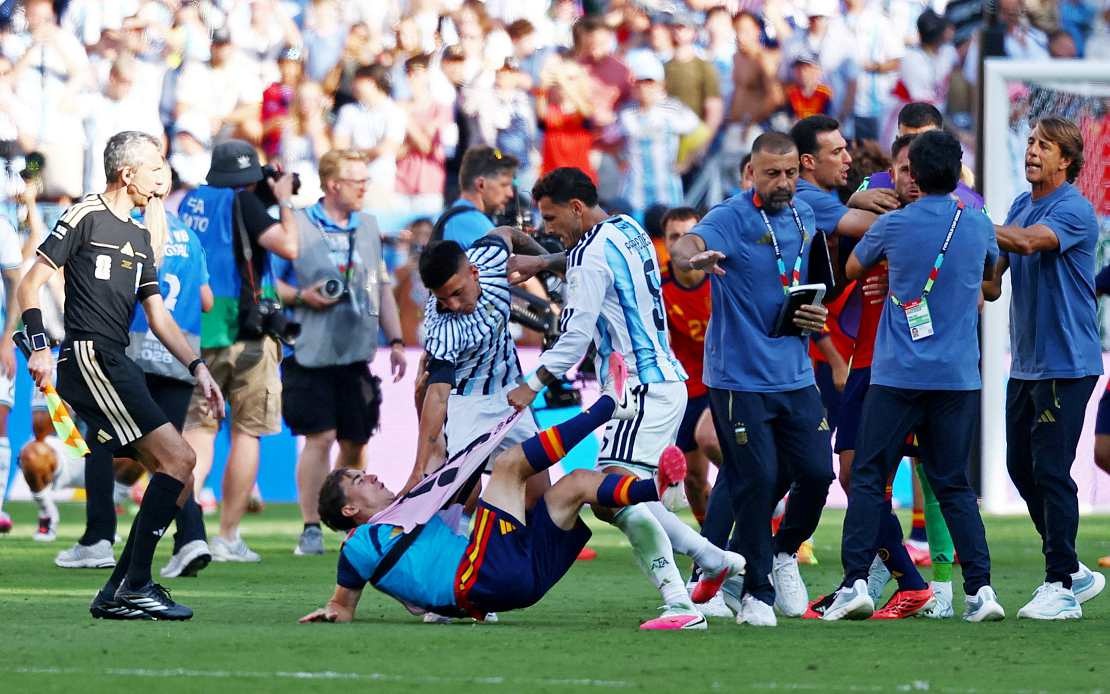
FIFA has formally opened a disciplinary investigation into Argentina's actions during and after their World Cup final loss to Spain, signalling that the governing body intends to scrutinise conduct that extended beyond the final whistle in New Jersey. The move represents a significant step in holding nations accountable not just for what occurs during match play, but for their comportment in the immediate aftermath of high-stakes encounters. A Disciplinary and Ethics Prosecutor has been appointed to examine potential breaches of FIFA's rulebook, with the investigation set to determine whether players and officials crossed lines that warrant sanctions.
The flashpoint that triggered FIFA's formal response occurred as Spain's players celebrated their victory. Argentina midfielder Leandro Paredes was captured on camera appearing to throw punches at members of the Spanish squad, an action that caught the attention of match officials and subsequently the reviewing authorities. Beyond this specific incident, Argentina's overall physical approach throughout the tournament had already drawn criticism from observers and commentators who felt the South American side pushed the boundaries of acceptable conduct. The intensity of Argentine challenges had been a talking point since their semi-final encounter against England, where such aggressive play became a recurring theme in tactical discussions.
FIFA's investigation framework stems from a comprehensive review of match commissioner reports filed during the tournament. Under Article 36 of FIFA's disciplinary code, the organisation has broad powers to appoint prosecutors who can examine incidents that may violate the governing body's rulebook. The appointment of a formal investigator suggests that FIFA believes the alleged breaches are substantial enough to warrant more than a cursory review, indicating the governing body takes the matter seriously and intends to reach a conclusion that may include meaningful consequences.
A separate and unresolved question hangs over whether FIFA will also investigate Argentina's display of a banner asserting Argentine sovereignty over the Falkland Islands following their semi-final victory over England. This political gesture potentially contravened Article 34.3 of the tournament regulations, which govern what teams are permitted to display and communicate during official matches and celebrations. The precedent for FIFA acting on such matters is mixed but increasingly firm. In 2014, the Argentine Football Association (AFA) faced financial penalties after a friendly against Slovenia involving similar political messaging, demonstrating that FIFA's disciplinary committee had identified this specific conduct as problematic in the past.
The contrast between FIFA's handling of Argentina's alleged breaches and its treatment of other nations' infractions reveals an inconsistent application of rules that merits examination. UEFA, Europe's governing confederation, has shown a harder edge in policing political gestures at its tournaments. Following Euro 2024, Spanish players Rodri and Alvaro Morata received one-match suspensions after chanting about Spain's claims to Gibraltar in the immediate aftermath of tournament success. This UEFA precedent demonstrates how continental bodies have sometimes imposed more severe punishments than FIFA's typical approach, creating questions about whether FIFA's standards truly match those of its counterparts.
FIFA's track record on political expression reveals a selective enforcement pattern. The governing body previously warned the English Football Association that captain Harry Kane would face sporting sanctions, beginning with a yellow card, if he appeared wearing a 'OneLove' rainbow armband during the 2022 World Cup in Qatar. That nation crimininalises homosexuality, yet FIFA prioritised preventing players from making human rights statements over addressing the fundamental contradiction of hosting a major tournament in such a jurisdiction. The contrast between this strictness on symbolic human rights advocacy and the apparent inconsistency in addressing territorial political claims creates a credibility gap.
For Malaysian and Southeast Asian football observers, the Argentina investigation carries implications for understanding how international football's governing structures operate. FIFA's willingness to mount formal investigations into post-match conduct demonstrates that player discipline extends beyond the ninety minutes of play, a principle that could affect teams throughout the region competing in continental and World Cup qualifiers. The investigation also underscores how political messaging in football continues to occupy a contested space in international sport, with different governing bodies applying varying standards based on geography and political considerations.
The investigation timeline and potential outcomes remain uncertain, with FIFA promising to release further details once the prosecutor completes their examination. Historical precedent suggests that findings could range from financial penalties to player suspension, depending on the severity of the conduct and how FIFA interprets the relevant disciplinary code provisions. The outcome will likely influence how national teams approach post-match behaviour in future tournaments, particularly regarding celebrations that venture into political or territorial expression.
Argentina's conduct during the tournament, when examined holistically, reflected a team playing with considerable intensity and occasional disregard for conventional disciplinary limits. Enzo Fernandez's dismissal in the semi-final for accumulating two yellow cards demonstrated that the referee crew actively monitored and sanctioned physical play. The subsequent incidents in the final and the territorial banner display suggest a pattern rather than isolated events, potentially strengthening FIFA's case if the investigation proceeds toward disciplinary action.
The broader context of FIFA investigations into tournament conduct demonstrates that football's international governance structures continue evolving their approach to player discipline and political expression. The Argentina case will likely become a reference point for how strictly FIFA intends to police both physical conduct and political messaging in future tournaments, with implications for teams globally and particularly for ambitious football nations in Southeast Asia seeking to progress through qualification pathways and continental competitions.

