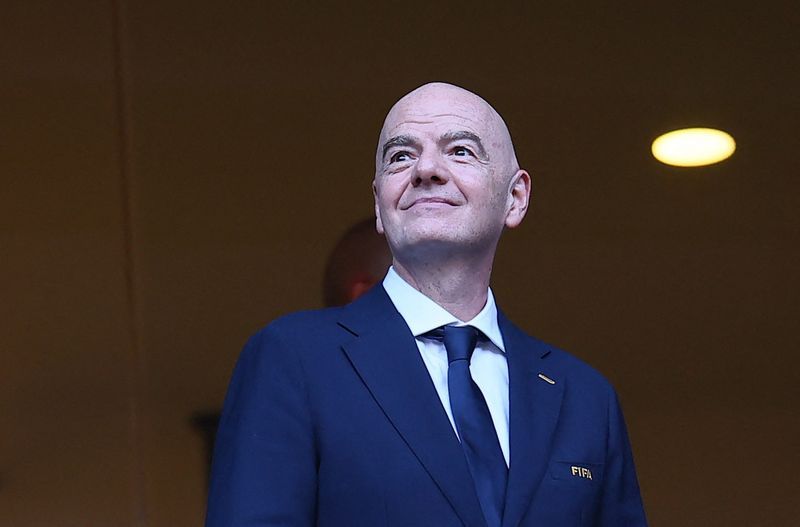
The reverberations from FIFA President Gianni Infantino's shelved proposal to privatise World Cup commercial rights show no sign of subsiding, with reports indicating that three major regional football confederations have begun coordinating efforts to pressure him into resignation. The Swiss-Italian administrator, who has led world football's governing body since 2016, retreated from his contentious plan late Friday after three days of unprecedented upheaval within FIFA's administration, but the damage to his political standing appears irreversible.
Infantino's abandoned scheme sought to raise $4.2 billion by creating a new commercial entity that would have brought private investment into World Cup operations—a structural innovation that would have marked the first time the tournament operated with such outside capital. While the president issued an apology acknowledging how the proposal had fractured relationships within global football, his characterisation of the withdrawal as necessary for unity masked a deeper reality: his previously secure grip on power had been fundamentally compromised by the decision to move forward without consulting key stakeholders.
The scale of opposition to Infantino has become starkly visible in the public positions adopted by national associations and continental confederations. Five European football federations, including the Football Association of England, have formally rescinded their backing for his reelection scheduled for the FIFA Congress in Morocco next March, whilst Denmark announced they would never support his candidacy. Conversely, football bodies from Morocco, Qatar, Kuwait, Lebanon, and Sri Lanka have declared their continued allegiance to the 56-year-old administrator, though these declarations of loyalty appear insufficient to offset the growing rebellion.
With 211 national federations holding votes at the Congress, the publicly declared positions represent merely a fraction of the total electorate. However, the damage inflicted by Infantino's strategy of approaching poorer associations with lucrative financial incentives—promising dividends of between $20 million and $40 million per federation beginning in the new year—whilst simultaneously blindsiding the wealthier confederations, has evidently severed crucial alliances. This tactical miscalculation has proven catastrophic for his political survival prospects.
The regional confederations have responded with unprecedented candour about their loss of faith in his leadership. UEFA, the European confederation, and CONCACAF, which oversees football across North and Central America and the Caribbean, issued sharply critical statements on Saturday asserting they no longer retained confidence in his stewardship of the organisation. The Asian Confederation (AFC), traditionally more circumspect in its criticism, stopped short of such direct denunciation but nevertheless characterised the lack of consultation preceding the proposal as entirely unacceptable and called for fundamental institutional reforms within FIFA.
According to reporting in the Times of London, UEFA, CONCACAF, and the AFC have reportedly begun developing a coordinated strategy to remove Infantino from his position, with discussions reportedly extending to the possibility of establishing rival competitions should he refuse voluntary departure. Such a scenario would represent an existential threat to FIFA's authority and legitimacy, yet the severity of the confederation's frustration appears to have driven them toward considering such extraordinary measures. The confederations have maintained strategic silence regarding these discussions, with neither CONCACAF, the AFC, nor FIFA providing immediate responses to inquiries about the report, whilst UEFA declined all comment.
Infantino's immediate priority must be preventing the convening of an Extraordinary Congress, which would occur automatically if forty-three or more FIFA member associations submit formal written requests for such a meeting. This threshold represents a plausible risk given the current climate of discontent, making the next weeks critical for his survival. Successfully containing that threat would provide him with a seven-month window to undertake the delicate work of repairing fractured relationships with alienated confederations and reinforcing support among his core constituencies.
The president's historical political strength has derived from his cultivation of influence among associations outside Europe, particularly in less wealthy nations that depend upon FIFA distributions to sustain their football operations. His predecessors, Joao Havelange and Sepp Blatter, similarly constructed their dominance through this geographic strategy of building support among associations lacking independent financial resources. The current proposal was explicitly designed to reward this constituency with substantially increased financial transfers, though the secretive manner of its development simultaneously exposed these poorer associations to accusations of serving narrow oligarchic interests.
Opposing camps seeking to unseat Infantino face their own organisational challenges. They must identify and galvanise support around a credible alternative candidate before the November 18 deadline for election nominations. Any viable challenger must demonstrate genuine understanding of the financial pressures facing less prosperous associations whilst simultaneously persuading the wealthier, more established football nations that FIFA's governance structures require fundamental reform. This balancing act has historically proven extraordinarily difficult, yet the current momentum against Infantino suggests that a sufficiently compelling alternative might succeed in breaking his grip on power before the Morocco Congress convenes.
The political dynamics surrounding this FIFA leadership contest carry implications extending beyond administrative circles into the broader commercial and sporting structures underpinning international football. Malaysia and other Southeast Asian nations, represented through the AFC, occupy positions within this unfolding power struggle that could prove consequential for the regional distribution of FIFA resources and decision-making authority. Should the confederation successfully lead efforts to replace Infantino, the AFC's leverage within FIFA governance structures would substantially increase, potentially translating into more favourable conditions for Asian football development initiatives and greater influence over future World Cup hosting decisions.

