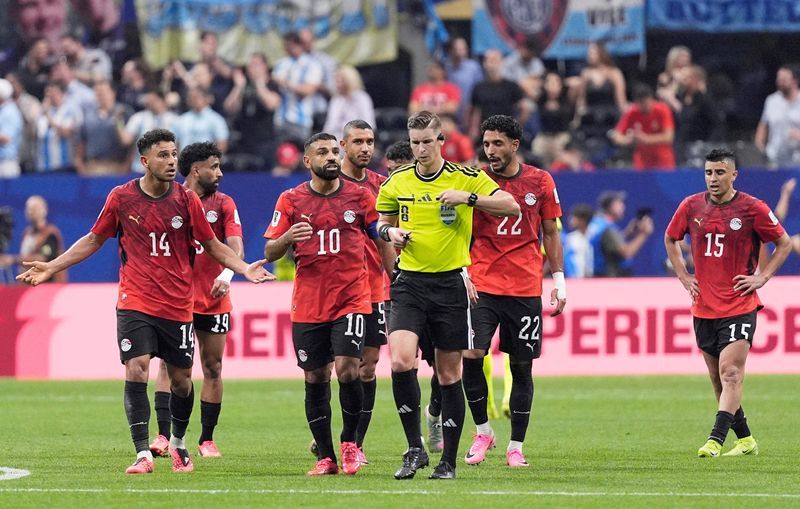
FIFA's head of refereeing, Pierluigi Collina, has moved to quash growing criticism surrounding Argentina's narrow 3-2 World Cup round-of-16 triumph over Egypt, issuing a forceful statement asserting that accusations of bias lack foundation and that all match officials operated with uncompromised independence. Speaking through an interview published on the official FIFA website on Thursday, Collina acknowledged that scrutiny of refereeing decisions forms an inherent part of football culture, yet he drew a firm line at challenges to the integrity of those entrusted with officiating the tournament's most significant matches.
The Egyptian Football Association's formal complaint centred on several flashpoints that tilted the match's trajectory. Most significantly, Egypt protested the disallowance of Mostafa Zico's second-half goal, which officials ruled out after identifying what they determined to be a foul by Marwan Attia on Argentina defender Lisandro Martinez during the buildup play. Equally contentious was the failure to penalise a challenge on Mohamed Salah in the seconds immediately preceding Argentina's stoppage-time winner, scored by Enzo Fernandez following a remarkable comeback from two goals down. Coach Hossam Hassan suggested post-match that external pressure may have influenced the referee's decision-making to ensure Argentina's progression.
Collina's defence of these decisions rested primarily on the proper application of video assistant referee technology and the principles governing when contact constitutes a punishable offence. Regarding the disallowed goal, Collina stated that VAR correctly identified a foul during the attacking phase and that the system functioned as intended by recommending the original on-field decision be overturned. He articulated a philosophy that official intervention depends not on whether an infringement appears "obvious" but on whether match officials failed to detect it initially, thereby justifying VAR review and potential reversal. This interpretation reflects FIFA's broader stance on how technology should supplement rather than substitute human judgment.
On the unpunished contact involving Salah, Collina elaborated that both the referee and VAR personnel classified the interaction as "normal football contact" rather than a foul warranting a penalty. He distinguished between a defender making incidental contact after successfully playing the ball from a player stepping directly on an opponent's foot, characterising only the latter as a punishable offence. This clarification reveals the subjective terrain upon which refereeing decisions necessarily operate, particularly in crowded penalty areas where contact is virtually inevitable during competitive play.
Collina's statement carried an undertone of concern about the potential consequences of questioning officiating integrity. He warned that unfounded allegations could incite threats against referees and their families, framing such accusations not merely as sporting critique but as potential sources of personal danger. This stance positions FIFA's refereeing apparatus as a professional institution worthy of protection from reputational assault, particularly when decisions fall within legitimate interpretations of the laws of the game.
The broader context involves the strategic importance of World Cup progression and the enormous resources invested by national federations in tournament campaigns. Egypt's elimination following this contentious match amplifies the emotional and financial stakes surrounding the officiating decisions, transforming routine refereeing questions into matters of national sporting pride and institutional credibility. For Egypt, the defeat represented not merely a lost match but a perceived injustice that potentially altered the tournament's outcome through inconsistent application of the rules.
Collina's framing of VAR's role within the tournament's officiating framework emphasises consistency in rule application over subjective assessments of fairness. By insisting that foul identification should occur uniformly regardless of context or perceived obviousness, FIFA endeavours to establish transparent, mechanistic criteria for intervention. However, this approach inherently raises questions about whether such mechanical standards adequately capture football's dynamic nature, where marginal fouls often involve split-second judgment calls.
The Argentina-Egypt controversy illuminates broader tensions within modern football regarding how technology should mediate between human decision-making and competitive fairness. Different confederations and leagues interpret VAR protocols with varying degrees of interventionism, creating inconsistency that confuses players, coaches, and supporters accustomed to different standards. For Southeast Asian football, which has increasingly invested in professional refereeing development and technology integration, the FIFA position provides important guidance on international match standards.
Collina's assertion that FIFA maintains satisfaction with VAR implementation throughout the tournament suggests institutional confidence in the system's overall effectiveness, despite isolated controversial moments. This confidence, however, exists in tension with legitimate questions about whether the technology genuinely improves decision-making or simply relocates the subjectivity involved in officiating to a different decision-maker reviewing footage. The Egypt incident demonstrates that video replay does not eliminate ambiguity but rather transfers the burden of interpretation to personnel working under different conditions than the original referee.
For regional football bodies, the FIFA statement carries implications regarding how disputes should be managed and escalated. By emphasizing that constructive discussion represents normal discourse while unfounded allegations cross ethical boundaries, Collina establishes expectations for how federations should lodge complaints. This framework potentially constrains legitimate institutional critique while protecting officials from what FIFA characterises as reputation-damaging accusations.
The unresolved tension between Collina's position and Egyptian grievances reflects football's persistent struggle with refereeing consistency across matches and competitions. While officials must operate with autonomy to avoid external influence, the absence of transparent reasoning for key decisions leaves stakeholders uncertain whether consistency has genuinely been achieved or merely asserted. The sporting public, particularly in nations with intense investment in tournament participation, understandably demands clarity about how decisions align with stated principles.

