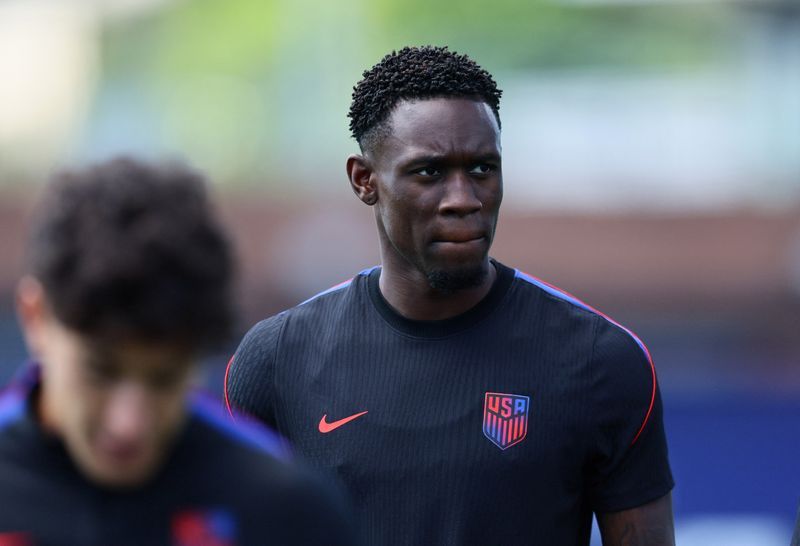
FIFA's decision to suspend the automatic suspension stemming from Folarin Balogun's red card has ignited a major controversy that reaches far beyond the football pitch. The United States striker received the dismissal during qualifying play, but FIFA President Gianni Infantino opted to defer the one-match ban that would typically follow such a sanction—a move that came shortly after U.S. President Donald Trump personally contacted Infantino requesting the reversal. This extraordinary intervention by a sitting head of state into a sporting discipline matter represents a significant departure from football governance norms and has prompted urgent questions about whether political pressure can override established sporting rules.
The suspicion of improper political influence has become the central issue dominating reactions from football associations across Europe. Germany's DFB president Bernd Neuendorf explicitly demanded that FIFA issue an immediate public statement addressing the reported telephone call between Trump and Infantino, arguing that any appearance of state-level interference in tournament decisions fundamentally undermines the credibility of international competition. This concern reflects a principle deeply embedded in sports governance: that competitions must operate independently of political considerations to maintain their legitimacy and trustworthiness among participating nations and global audiences.
FIFA attempted to provide legal justification for its decision by citing Article 27 of the FIFA Disciplinary Code, which grants the Disciplinary Committee discretionary power to suspend the enforcement of previously imposed sanctions. However, this invocation of discretionary authority has collided directly with Article 66.4 of the same code, which explicitly states that red cards automatically trigger suspension for the subsequent match. The Belgian Football Association highlighted this contradiction, noting that no previous red card during the World Cup had been subject to such discretionary suspension, establishing a troubling double standard during an active tournament.
The regulatory inconsistency carries profound implications for competitive fairness. Multiple European football authorities stressed that Balogun's situation had established an unprecedented precedent that now raises awkward questions about future disciplinary decisions. If one player's suspension could be deferred through high-level political intervention, what prevents similar requests from other nations? This uncertainty threatens to corrode the predictability and uniformity that underpin fair competition. Other players who had already served their automatic suspensions under the same rules faced an implicit injustice—they accepted their one-match bans while Balogun benefited from special treatment.
The reaction from Germany's Neuendorf proved particularly pointed, with the DFB leader questioning FIFA's timing in what he sarcastically described as moving the World Cup calendar to observe "April Fool's Day" on July 5. His barbed comment underscored the sense that the decision appeared arbitrary and divorced from established sporting logic. The German association framed this not as defense of any national team interest but rather as a principled defense of football itself—suggesting that the sport's fundamental character depends upon transparent, consistently applied rules that no external actor, regardless of political standing, can circumvent for particular advantage.
Other prominent voices in international football echoed these concerns about institutional credibility. Observers noted that FIFA's credibility faced genuine jeopardy when its leadership appeared susceptible to direct pressure from national governments. This vulnerability becomes especially pronounced during major tournaments where tournament outcomes carry enormous symbolic weight for participating nations and generate intense media scrutiny. The optics of an American leader successfully lobbying the world football body to alter a disciplinary outcome involving an American player created an unmistakable appearance of favoritism that no amount of technical legal citation could fully dispel.
The decision also raised uncomfortable questions about the composition and independence of FIFA's disciplinary infrastructure. If Article 27 truly permitted such discretionary intervention, then the fundamental design of football's disciplinary system appeared flawed—creating opportunities for politically connected nations to secure advantages unavailable to others. The criticism from multiple European associations suggested that FIFA had exposed a gap in its regulations that either should not exist or should be far more tightly circumscribed to prevent precisely these kinds of scenarios.
From a Southeast Asian perspective, this incident carries important lessons about tournament governance and the protection of sporting integrity in major international competitions. Smaller nations participating in global tournaments depend entirely upon rules being applied consistently and fairly, without regard to the political influence any particular country can exert. When major football powers demonstrate the ability to secure favorable treatment through political channels, it fundamentally disadvantages emerging football nations that lack equivalent leverage with international sports bodies. The precedent established here suggested that governance structures might bend under pressure from powerful states—a concerning development for nations seeking equitable treatment in Asian and international competitions.
The controversy also highlighted the tension between FIFA's attempts to maintain legitimacy as a global sports administrator and the reality that powerful nations may increasingly view international sports bodies as legitimate venues for advancing national interests. If Trump's intervention could produce results with respect to World Cup regulations, what prevents similar attempts across other international sporting contexts? This instrumentalization of sports governance threatens to politicize football at precisely the moment when global competition should provide a neutral platform for athletic excellence.
FIFA's handling of the situation raised fundamental questions about whether the organization possessed the institutional independence required to govern the world's most popular sport. The organization faced pressure to either defend its decision transparently or acknowledge that it had erred—yet neither path appeared attractive, given the political sensitivities involved. This dilemma itself testified to how thoroughly the episode had contaminated the governing body's authority and cast doubt upon its ability to manage controversial situations without external political influence.
The long-term consequences of this precedent remain uncertain, but the immediate impact was clear: a major international sporting organization had appeared to bow to political pressure during an active tournament, generating widespread skepticism about whether rules and regulations would be enforced fairly regardless of which nation invoked political leverage. For football administrators and sports governance professionals throughout Southeast Asia and beyond, the episode served as a cautionary illustration of how external political forces could undermine the institutional integrity upon which legitimate competition depends.

