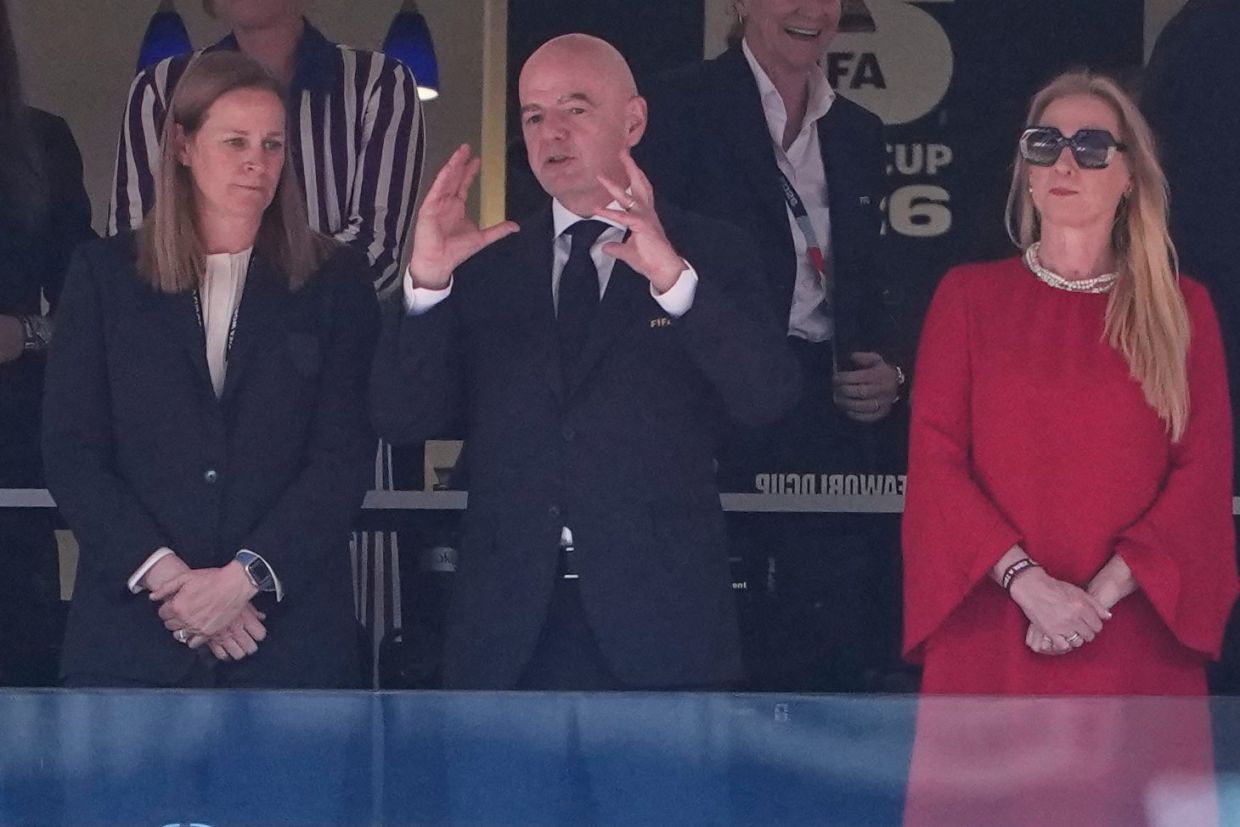
FIFA's hierarchy has emerged from the 2026 World Cup largely unscathed, despite a cascade of controversies that has tested the sport's governing body. League chief Gianni Infantino appears positioned more firmly than ever at the helm, his authority buttressed by record financial performance and unwavering support from major football federations across Asia, Africa, and South America. The tournament, contested across three nations for the first time in its history, has become a money-printing machine that drowns out institutional criticism, suggesting that in modern football governance, financial success functions as a powerful antidote to reputational damage.
The list of grievances lodged against FIFA during this World Cup reads like an indictment of institutional dysfunction. Ticket pricing has proven prohibitive for ordinary supporters, whilst Iran's squad faced severe restrictions. A Somali referee encountered exclusion from officiating, and the awarding of a inaugural FIFA peace prize to President Donald Trump raised eyebrows globally. Most controversially, FIFA allowed a suspended American player to compete following high-level intervention, triggering outrage across Europe and beyond. Sports lawyer Nick De Marco articulated the deeper concern: the question is no longer whether a particular decision was correct, but whether FIFA has fundamentally compromised the integrity of world football itself and its standing as the sport's supreme regulatory authority.
Yet these criticisms, potent as they are, have proven remarkably ephemeral. Once matches conclude and media attention shifts, the intensity of indignation dissipates with striking speed. The narrative swiftly pivots from governance failures to sporting spectacle, leaving FIFA's leadership insulated from meaningful accountability. Infantino has maintained singular focus on his core mandate: maximising revenue. The 56-year-old Swiss administrator has transformed FIFA into what many recognise as the world's most lucrative sporting operation, demonstrating that institutional controversy rarely penetrates when coffers remain full.
The financial dimensions of this World Cup are staggering. FIFA is projected to accumulate approximately $9 billion in direct revenue from the tournament, representing a $2 billion increase over the 2022 Qatar edition. This expansion reflects a strategic pivot initiated when Infantino assumed leadership following the corruption scandals that nearly destroyed the organisation's credibility a decade earlier. He inherited an institution synonymous with bribery and fraud, pursued relentlessly by American prosecutors. Rather than fundamentally restructuring FIFA's culture, Infantino instead pursued a modernisation strategy that married cosmetic reforms with aggressive expansion, effectively transforming the organisation into a more sophisticated money-making operation.
The wealth generation extends far beyond FIFA's own coffers. Concession operators managing stadium food and beverage services are capturing extraordinary margins, with individual spectators spending up to $100 per match in certain venues—nearly double typical spending at American football stadiums. Advertisers have benefited from mandatory hydration breaks strategically introduced during play, effectively converting the sport's traditional two-half structure into an American-style four-quarter format that maximises commercial opportunities. Host cities, which had voiced cost concerns before the tournament commenced, are witnessing tangible economic benefits; Bank of America data from mid-June revealed credit and debit card spending in World Cup cities rising 6.3 percent year-on-year, with non-resident spending surging 16.7 percent. The tournament has become a boon for hospitality, tourism, and retail sectors across participating nations.
Structural changes to the competition itself have dramatically increased FIFA's financial capacity. The expansion from 32 to 48 participating teams has doubled the prize distribution, now reaching a record $871 million. Every federation receives a guaranteed minimum payment of $12.5 million simply for participation. For smaller nations with limited domestic revenue streams, FIFA's disbursements have become crucial. Cape Verde, making a historic knockout-stage appearance, earned over $21 million—equivalent to approximately 0.75 percent of the island nation's entire annual GDP. This monetary generosity has transformed FIFA from an authoritarian body imposing rules into something more akin to a patronage network, creating powerful incentives for federations to maintain loyalty and suppress criticism.
Infantino's political consolidation appears virtually complete as he approaches election in early 2027 at the 77th FIFA Congress in Rabat, Morocco. His re-election represents a formality; he faces no opposition and has secured backing from every major continental confederation. The 211 member associations, each possessing one vote, appear committed to his continued leadership. This will constitute his third consecutive term following his succession of Sepp Blatter in 2015, when the latter stepped down amidst the corruption scandal. The fact that the congress will convene in Rabat, a nation simultaneously hosting the next World Cup, reinforces the intermingling of FIFA's political processes with its commercial interests.
The institutional architecture of modern FIFA ensures that Infantino's position remains remarkably durable regardless of controversy. Member associations across the Global South have become increasingly dependent on FIFA's financial distributions and tournament opportunities. The Royal Moroccan Football Federation has publicly lauded Infantino's contributions to African and global football development. The Asian Football Confederation president Sheikh Salman has declared that FIFA is in its finest institutional position ever. From Kuwait to South Africa, football federations demonstrate steadfast support, suggesting that financial interests override governance concerns amongst the voting body. Politicians and former players may voice objections, but they ultimately lack standing within FIFA's internal democracy.
On-field performance has largely vindicated the expanded format's sporting merit, providing FIFA with legitimate grounds to characterise the tournament as a comprehensive success. Stadiums have maintained full attendance despite elevated ticket prices, suggesting strong consumer demand outweighs affordability concerns. The sport's greatest athletes have delivered spectacular performances, generating compelling television content. Notably, the expanded tournament structure has enabled nine African teams to reach the knockout stages, increasing global representation and validating claims that FIFA's reforms have improved competitive opportunities for developing football nations. The quality of hospitality across host countries has exceeded expectations, contributing to overwhelmingly positive supporter experiences. These genuine sporting and organisational achievements provide the foundation for FIFA to dismiss criticism as the grievances of a disgruntled minority rather than systematic institutional failure.
The controversy surrounding the American player's reinstatement, whilst triggering condemnation from Belgian and British politicians and prominent figures like former Liverpool manager Jurgen Klopp, ultimately reflects a fundamental power asymmetry. Klopp's declaration that football belongs to players and fans rather than political leaders and administrators captures the democratic sentiment, yet lacks enforcement mechanisms within FIFA's hierarchical structure. Trump's reported conversation with Infantino demonstrates how political pressure applied at the highest levels can alter sporting outcomes, yet the federation's capacity to absorb such reputational damage appears infinite when underpinned by financial success and federated support.
The trajectory of FIFA under Infantino suggests a model where institutional governance concerns become subordinate to revenue maximisation and political consensus amongst member federations. The organisation has evolved from a regulatory body vulnerable to corruption scandals into a sophisticated international patronage network capable of distributing vast sums to its constituents. This financial interdependency creates powerful structural incentives for silence. Smaller federations dependent on FIFA's largesse lack motivation to challenge leadership, whilst larger associations benefit sufficiently from tournament expansion and prize distribution to tolerate governance irregularities. Trump's vision of football as a unifying force may oversimplify the sport's political dimensions, but it captures something genuine about how FIFA's money has become a binding agent holding the global football community together, transcending concerns about process, equity, or democratic governance.

