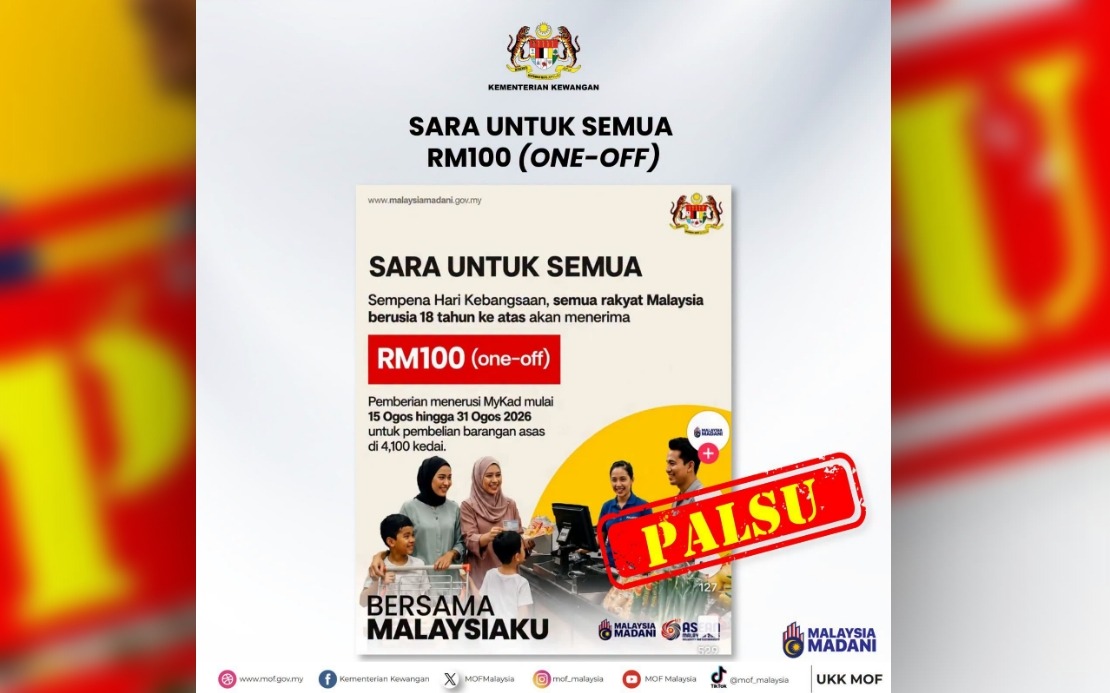
The Ministry of Finance has moved swiftly to dismiss a viral social media post claiming that every Malaysian aged 18 years and above will receive a one-time RM100 payment from the Sumbangan Asas Rahmah (SARA) programme in celebration of the nation's National Day. The ministry, operating from its headquarters in Putrajaya, issued a categorical denial through its official social media channels, underscoring that the poster circulating online contains fabricated information and has no basis in any formal government announcement.
The false claim gained traction among Malaysian social media users, highlighting the ease with which misinformation can spread across digital platforms and potentially mislead citizens about government assistance schemes. The viral nature of such posts underscores a persistent challenge for Malaysian authorities in combating disinformation, particularly when claims involve financial benefits that naturally pique public interest. The ministry's intervention represents a necessary corrective measure designed to prevent further amplification of the falsehood across networks where it had already begun circulating widely.
Malaysians have grown increasingly accustomed to various cash assistance programmes introduced by the government in recent years, ranging from utilities subsidies to direct cash transfers. This background context renders such viral claims more credible in the public imagination, as citizens may reasonably assume that additional financial support measures could materialise around significant national occasions. The SARA scheme itself, established as part of the government's broader social safety net, has created a framework within which citizens might plausibly imagine similar announcements being made, particularly during festive periods when the government traditionally announces spending initiatives.
The Finance Ministry's statement explicitly cautioned the public against believing or sharing the misleading poster, emphasising that no official announcement regarding such a SARA payment has been issued through legitimate government channels. This guidance reflects a broader institutional concern about the spread of false information that could erode public trust in actual government communications and simultaneously burden the ministry with inquiries based on spurious claims. When citizens become accustomed to encountering fabricated announcements, genuine policy announcements risk being dismissed with equal scepticism, creating a challenging information environment for policymakers seeking to communicate effectively with their constituencies.
The ministry further advised Malaysians to access verified information exclusively through its official platforms and approved communication channels before sharing content on personal social media accounts. This guidance points to a structural reality of the modern information landscape, where responsibility for combating misinformation increasingly falls not only on institutional communicators but also on individual citizens exercising greater discernment about sources and accuracy before propagating claims. The Finance Ministry's appeal essentially asks the public to serve as filters against falsehood, applying critical thinking to determine whether information has been officially confirmed before treating it as legitimate.
For Malaysian readers particularly engaged with social media and digital platforms, this incident serves as a practical reminder of the importance of verifying claims before accepting them as factual, especially when such claims carry financial implications or invoke government programmes. The phenomenon of viral false claims has become sufficiently commonplace that citizens across Southeast Asia have developed informal systems for checking information, yet such verification mechanisms remain imperfect and often fail to prevent initial rapid dissemination of falsehoods. The Finance Ministry's response demonstrates that even well-resourced government institutions sometimes find themselves in reactive positions, forced to spend official communication bandwidth denying false claims rather than advancing substantive policy announcements.
The timing of this misinformation, arriving in early August as Malaysia prepares for the celebration of Merdeka Day on August 31st, suggests that false claims exploited the festive season to gain credibility and emotional resonance. Many Malaysians anticipate government largesse during national celebrations, based on historical precedent and the association of such occasions with special announcements and initiatives. Opportunistic actors have therefore long recognised that fabricated claims about holiday-related government benefits can gain rapid traction by aligning with public expectations and desires, even when such claims lack any substantive foundation in actual policy decisions.
For those following Malaysian economic and social policy closely, the Finance Ministry's firm denial also signals the ministry's commitment to protecting the SARA programme's credibility and preventing public perception of it from becoming distorted by false claims. The scheme itself represents a significant government commitment to providing assistance to qualifying Malaysians, and association with fabricated bonus payments could ultimately undermine public understanding of how the actual programme functions and what genuine recipients can legitimately expect. The ministry's decision to issue a clear, direct denial rather than ignore the viral post reflects a recognition that allowing such misinformation to persist unchallenged poses risks to the integrity of the government's communication ecosystem.
Moving forward, this incident illustrates the broader challenge facing Malaysian institutions as digital literacy and source verification remain uneven across the population. The Finance Ministry's appeal for citizens to rely exclusively on official channels for information about government schemes and payments appears increasingly necessary as the sophistication of false claims continues to evolve. For policy communicators throughout Malaysia and the broader Southeast Asian region, the incident underscores the importance of proactive communication strategies that establish clear, accessible official channels where citizens can reliably learn about authentic government initiatives before misinformation about those same initiatives gains widespread circulation and credibility.

