A brazen nighttime assault on a Thai ranger checkpoint in Narathiwat province on Wednesday has left five security personnel dead and six civilians wounded, marking the latest escalation in the long-running insurgency that has plagued Thailand's Muslim-majority south. The incident unfolded at approximately 6.45 pm local time at the 4509 Ranger Company checkpoint positioned on Sami Hill within Rangae District, one of the region's more contested areas. Among the injured were a three-year-old child and an elderly civilian, highlighting the indiscriminate nature of the violence that increasingly spills over into communities and away from military targets.
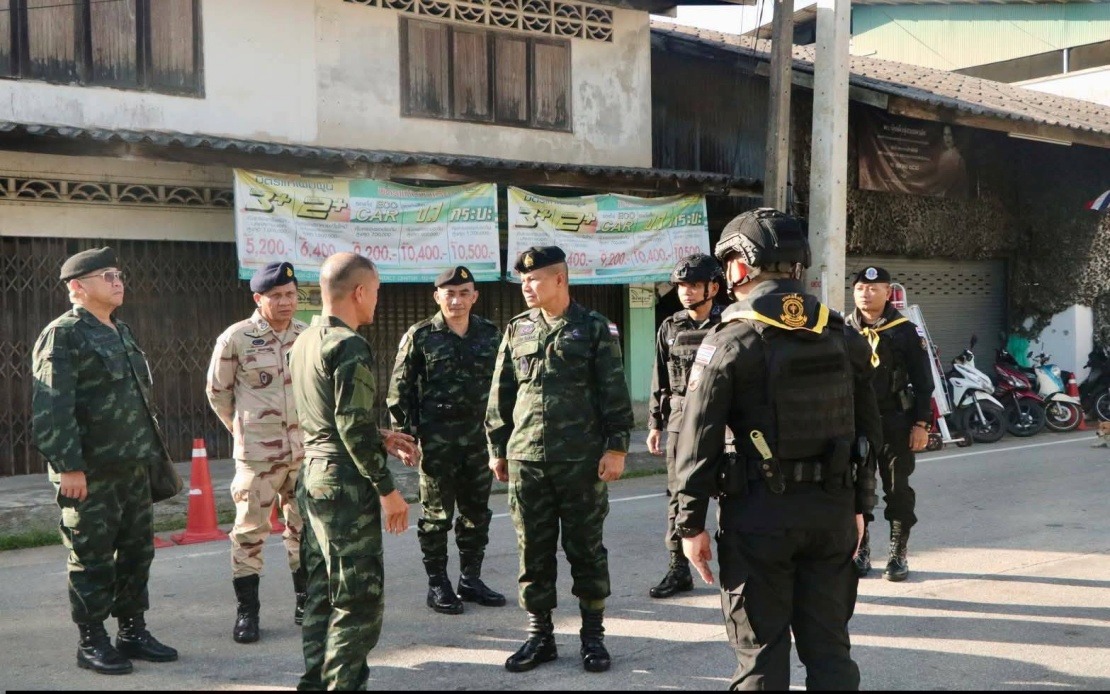
Lieutenant General Norathip Phoyanok, who holds the dual position of Fourth Army Region Commander and Director of the Internal Security Operations Command (ISOC) Region 4, provided details of the assault following an on-site inspection Thursday morning. According to his account, more than six assailants—their faces masked and dressed entirely in dark clothing—descended upon the checkpoint with a combination of automatic weapons and explosive devices, unleashing sustained gunfire while hurling pipe bombs at the defenders. The coordinated nature of the offensive, involving both firearms and improvised explosives, suggests a degree of tactical planning and training that distinguishes this incident from opportunistic attacks.
The attackers fled the scene in a black four-wheel-drive vehicle, disappearing before reinforcements could arrive or establish pursuit. Law enforcement officials have not yet publicly identified the specific militant group responsible, though the sophistication of the operation has prompted investigators to focus on better-organised factions operating in the region. The vehicle description remains the primary lead, and checkpoints along escape routes have been alerted to monitor for the suspect vehicle's movement toward Malaysia or deeper into remote areas within Narathiwat province.
For Malaysia, developments in southern Thailand carry particular significance given the geographical proximity and historical cross-border dynamics of the insurgency. Several militant groups have long maintained networks spanning both nations, and Malaysian security agencies have consistently expressed concern about the potential for violence to metastasize across international boundaries. The incident demonstrates that despite years of counterinsurgency operations, militant capabilities in the region remain substantial, with cells retaining access to weapons, explosives, and vehicles.
Narathiwat Governor Boonchuai Hormyamyen has responded by issuing broad security directives across the province. He has ordered a comprehensive tightening of security protocols involving police, military, and local administrative units throughout the twelve districts of Narathiwat, with particular emphasis along the Malaysia-Thailand border. This reflects the authorities' assessment that the attack may be part of a wider campaign rather than an isolated incident, necessitating a defensive posture across the entire region rather than concentrated efforts at specific locations.
Forensic teams have cordoned off the attack site to conduct detailed evidence collection and analysis. Investigators are examining spent ammunition casings, fragments of the pipe bombs, and any remaining physical evidence that might identify the perpetrators or trace the weapons to specific sources. Such forensic work is considered crucial not only for prosecuting those eventually apprehended but also for understanding the tactical approaches employed by different insurgent groups, information valuable for anticipating future attacks.
The assault underscores the persistent challenge facing Thai security forces in one of Asia's longest-running conflicts. The southern insurgency, rooted in historical grievances and questions of identity and governance in a predominantly Muslim region administered by a Buddhist-majority nation, has claimed tens of thousands of lives since intensifying in 2004. Despite the deployment of substantial military resources and numerous counter-terrorism initiatives, militant groups continue to launch sophisticated attacks against security installations, suggesting that ground-level tactical improvements have outpaced progress in addressing underlying drivers of the conflict.
The involvement of civilian casualties, particularly the injury of a very young child, reflects a troubling trend in which checkpoint attacks and security operations increasingly affect non-combatants. This dynamic complicates both the humanitarian calculus and the strategic narrative surrounding the conflict, as civilian suffering can simultaneously entrench resentment in local communities and generate international concern about the conduct of counter-insurgency operations.
Thailand's security establishment will likely utilise this incident to justify increased military presence and expanded surveillance measures in Rangae District and surrounding areas. Intelligence agencies will prioritise identifying the attackers and their command structure, while military planners may consider repositioning forces or implementing new checkpoint protocols designed to make such assaults more difficult to execute. The investigation into identifying the masterminds behind the operation remains active, suggesting that authorities suspect individuals and networks operating above the attack team.
The provincial response mirrors a broader pattern whereby Thai authorities respond to major incidents with expanded security operations and heightened border vigilance. However, critics argue that this cycle—attack, military response, temporary security improvement, followed by renewed violence—suggests that kinetic approaches alone cannot resolve the underlying political and social dimensions of the conflict. The injury of civilians, particularly the three-year-old girl, provides a stark reminder that security operations and militant attacks alike affect innocent populations who bear no responsibility for the political disputes driving the violence.
Regional observers and analysts will be monitoring whether this incident triggers a new cycle of retaliation and counter-retaliation that typically follows such high-profile attacks. The loss of five rangers suggests pressure on military commanders to demonstrate responsiveness, which historically has led to increased military operations that themselves sometimes result in civilian casualties. Malaysia's security apparatus, while maintaining official neutrality, will likely increase intelligence-gathering activities near the border to prevent any potential spillover or cross-border complications stemming from the heightened tensions.

