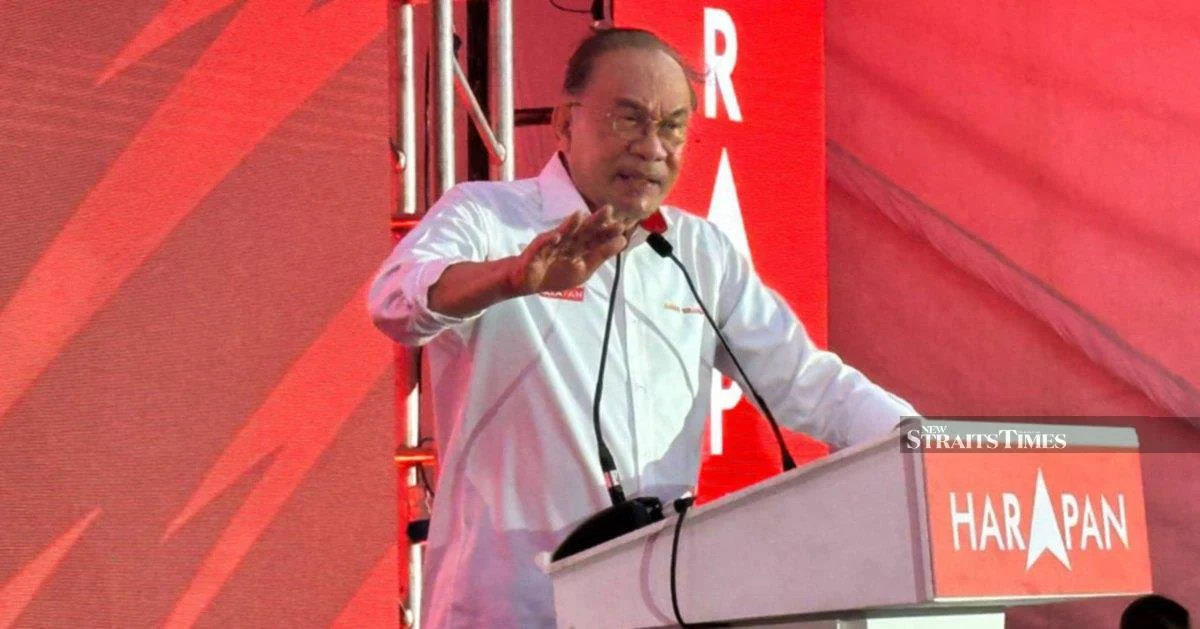
Prime Minister Datuk Seri Anwar Ibrahim visited Tangkak in Johor this week to deliver a clear message to his coalition's ground operations: internal focus and discipline should take priority over external conflicts. Speaking to Pakatan Harapan leaders and campaign workers gathered in the southern state, Anwar emphasised that the coalition's strength lies in its ability to remain cohesive and goal-oriented, particularly as Malaysia's political landscape continues to shift following the 2022 general election.
The directive carries particular weight given the complex nature of Malaysia's current governing coalition. Pakatan Harapan, which anchors the federal government, operates within a broader alliance that includes other political parties. This structural arrangement has occasionally generated friction at both national and state levels, where different coalition members pursue competing interests or adopt conflicting public positions on policy matters. Anwar's message to the Johor machinery suggests that these tensions, if left unmanaged, could undermine the coalition's electoral performance and govern effectively in the state.
Johor represents a strategically important battleground for Pakatan Harapan. The state has historically been a BN stronghold, but the political dynamics have shifted considerably in recent years. By instructing his party machinery to avoid unnecessary confrontation with federal government partners, Anwar appears to be recognising that the coalition's electoral viability depends on presenting a unified front rather than expending energy on internal disputes. This approach reflects a pragmatic understanding that voters punish divided coalitions, regardless of their individual merits.
The emphasis on hard work suggests Anwar believes that Pakatan Harapan's path forward hinges on demonstrating tangible results and competence rather than engaging in blame games. This message resonates particularly in Johor, where the coalition has worked to rebuild credibility after a mixed track record in state governance. By urging leaders to avoid bickering, Anwar is implicitly signalling that the coalition should let its performance speak for itself rather than allowing personality clashes or policy disagreements to dominate the political narrative.
For Pakatan Harapan's machinery on the ground—party coordinators, youth wings, and grassroots volunteers—this directive carries operational implications. Campaign season messaging becomes clearer when leaders publicly agree on strategy and tone. Conversely, when coalition partners contradict one another publicly or engage in visible conflict, it creates confusion among supporters and provides opposition parties with ammunition. Anwar's reminder to focus on work rather than bickering offers a pragmatic framework for maintaining message discipline during electoral cycles.
The broader context matters here as well. Malaysia's political system has become increasingly volatile, with shifting alliances and fluid voter preferences. Parties that maintain internal discipline while demonstrating competence tend to outperform those torn by internal conflict. Anwar's tenure as Prime Minister has required him to manage multiple coalition partners with varying ideological commitments and political interests. His Johor visit suggests he recognises that managing these relationships extends beyond the federal level to state and local structures where tensions are often highest.
Pakatan Harapan's future trajectory depends significantly on how it performs in states like Johor. The coalition cannot afford to squander resources on internal disputes when external challenges remain formidable. Opposition parties, particularly UMNO-led Barisan Nasional, retain substantial organisational capacity and voter bases. In this competitive environment, coalition cohesion becomes a decisive factor. Anwar's message underscores that the coalition's competitive advantage lies not in engaging opponents in rhetorical combat, but in demonstrating effective governance and delivering on electoral promises.
The Johor visit also reflects broader concerns within Pakatan Harapan about party discipline and messaging consistency. When coalition components publicly disagree or engage in tit-for-tat exchanges, it erodes voter confidence in the overall government project. This is particularly damaging for relatively newer coalition configurations that have not yet fully established trust with voters. By explicitly calling for focus on work and avoidance of bickering, Anwar sends a signal that leadership takes this concern seriously.
For Southeast Asian political observers, Anwar's approach offers insights into how coalition governments manage internal diversity while maintaining external credibility. Malaysia's multiethnic, multi-religious democracy requires sophisticated coalition management. When coalition partners can subordinate individual grievances to collective goals, governments function more effectively. Anwar's directive reflects understanding of this fundamental dynamic.
Moving forward, the effectiveness of Anwar's message will depend on whether it resonates with ground-level party workers and regional leaders who sometimes feel their interests are overlooked in national-level calculations. The machinery members in Johor need to internalise that their contribution—whether through voter contact, logistical support, or community organising—matters more than engaging in public disputes. When this cultural shift takes root, it strengthens the coalition's electoral prospects.
Anwar's visit to Tangkak therefore represents more than a routine campaign stop. It constitutes a deliberate effort to recalibrate coalition behaviour toward greater discipline and focus. Whether this message achieves its intended effect will become apparent in upcoming electoral cycles and in how Johor's Pakatan Harapan machinery conducts itself when provocations arise. The Prime Minister's willingness to articulate these expectations publicly suggests he views coalition discipline as central to his government's sustainability.