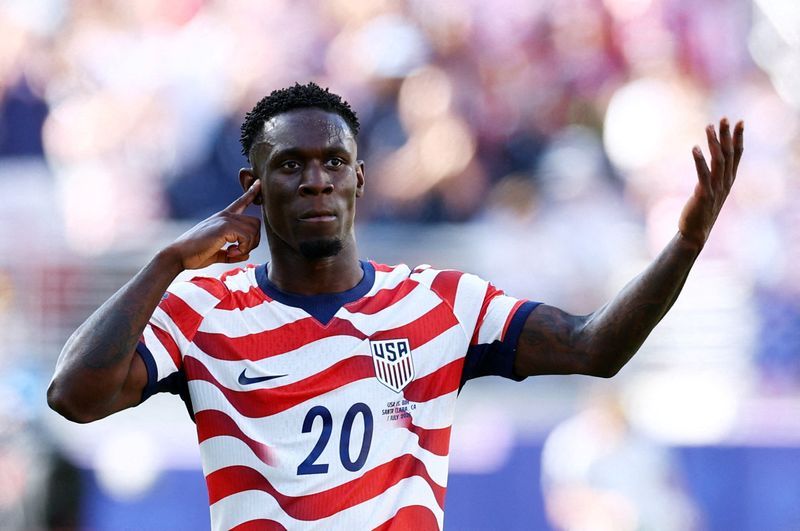
Folarin Balogun faces perhaps the most scrutinised match of his career on Monday when the United States confronts Belgium in the World Cup round of 16, though his presence on the pitch represents far more than a sporting contest. The 25-year-old striker's participation has become entangled in questions of national identity, immigration policy and presidential politics after FIFA controversially suspended a red card that should have kept him on the sidelines. What began as a disciplinary matter evolved into a flashpoint in America's heated debates over citizenship and belonging, with President Donald Trump's public intervention intensifying the scrutiny surrounding both the player and the World Cup's governing body.
Balogun was originally supposed to miss Monday's fixture after receiving a red card during the United States' previous encounter with Bosnia and Herzegovina for what appeared to be an inadvertent kick to an opposing defender's ankle. Yet in a stunning reversal on Sunday, FIFA announced it would suspend the ban, allowing the prolific goalscorer to return to the field. The decision's timing and the circumstances surrounding it have drawn extraordinary attention, particularly given the broader political context in which it occurred.
The player's personal history adds remarkable layers to the controversy. Balogun acquired American citizenship through birth after his Nigerian mother became stranded in New York during a visit, too far advanced in her pregnancy to safely return home by aircraft. She eventually flew back to Britain with her newborn son at one month old, where he spent his formative years developing his soccer skills through Arsenal's academy system. Despite his upbringing entirely outside the United States, he ultimately chose to represent the Stars and Stripes in 2023 after previously competing for England at youth level, citing a vacation to Orlando and the warmth of American supporters as influential factors in his decision.
The intersection of Balogun's origin story and Trump's well-documented opposition to birthright citizenship created an unusual political moment. The president, who has consistently campaigned against the constitutional provision that grants citizenship to anyone born on American soil, personally intervened by calling FIFA President Gianni Infantino to request a review of Balogun's red card suspension. While Infantino denied that Trump's intervention directly influenced the decision, the optics proved striking: a president opposed to the very mechanism that granted Balogun his citizenship was now leveraging that citizenship to keep him in the tournament.
The timing amplified the irony considerably. The Supreme Court had recently handed Trump a significant defeat by declining to overturn the 14th Amendment's birthright citizenship provision, which the president has identified as a central policy objective. Against this backdrop, his appeal to FIFA on behalf of an American citizen born abroad to a foreign national reinforced the complicated relationship between law, identity and political interest that surrounds immigration debates in the United States. Immigration advocates seized on the situation to argue precisely the opposite point from Trump's usual rhetoric: that birthright citizenship represents not a loophole but a defining feature of American opportunity.
Balogun's emergence as a breakout star of this World Cup has independently captured American sporting attention. The striker has netted three crucial goals, positioning the United States team for a potential deep tournament run and earning comparisons to and recognition from major figures like LeBron James. He has largely eclipsed Christian Pulisic, who long served as the charismatic face of American men's soccer despite the sport's historically marginal status in the nation's sporting consciousness. This shift reflects changing demographics and growing investment in developing diverse talent pools within U.S. Soccer, moving beyond the overwhelmingly white player profiles that characterised the programme for decades.
Supporters of birthright citizenship recognised Balogun's story as a potent counterargument to restrictionist immigration rhetoric. The Miami Herald published an editorial declaring that Balogun "prove(s) birthright citizenship isn't a loophole — it's America," positioning his World Cup performances as evidence of the tangible benefits the policy generates. Jorge Loweree, managing director of programmes at the American Immigration Council, emphasised how Balogun's case demonstrates the opportunity birthright citizenship provides to individuals who might otherwise lack such pathways, enabling them to contribute meaningfully to American society.
Historically, the United States stands among only 33 countries, predominantly in the Western Hemisphere, that grant unconditional birthright citizenship. This principle has been embedded in American law since an 1898 Supreme Court decision affirmed that the 14th Amendment encompasses such provisions. The doctrine has shaped immigration policy and national identity for over a century, though it remains contested in contemporary American politics. Recent polling suggests most Americans oppose terminating birthright citizenship, indicating that public sentiment diverges from Trump's stated position on the matter.
Balogun's trajectory through elite soccer structures also merits examination. His development through Arsenal's youth academy in London provided technical training and competitive experience that many American-born players lack access to, creating an interesting dynamic wherein a player technically American from birth received his primary development abroad. His eventual choice to represent the United States rather than England or Nigeria, despite limited formative ties to America, highlights how modern athletes navigate complex questions of representation and opportunity within globalised sports.
The personal dimension of Balogun's decision to commit to U.S. Soccer reflected both rational calculation and emotional connection. He described feeling at home within the American programme and drew particular emphasis to experiencing American supporters' enthusiasm during his Orlando visit, suggesting that cultural and emotional factors, not merely administrative or competitive circumstances, influenced his choice. This contrasts sharply with cynical interpretations of such decisions purely as opportunistic selections based on tournament accessibility.
As Balogun prepares for Monday's crucial encounter with Belgium, his presence on the pitch carries symbolic weight extending far beyond the ninety minutes of play. His story embodies the complicated contemporary moment in which American identity, immigration policy, sporting achievement and political intervention intersect. Whether FIFA's decision withstands scrutiny or influences future disciplinary determinations remains uncertain, but the controversy has already positioned him as an unlikely symbol in debates over what American citizenship means and who legitimately belongs within national communities.
The broader implications for Southeast Asian readers merit consideration as well. Nations throughout this region grapple with their own citizenship frameworks, immigration questions and debates over national identity amid globalisation and economic migration. Balogun's case illustrates how such questions increasingly intersect with cultural soft power, sporting achievement and international diplomacy in ways that transcend traditional legal and political boundaries. The willingness of a sitting president to personally intervene in sporting governance on behalf of an athlete represents a notable example of how states instrumentalise athletics for political messaging, a phenomenon that may resonate across contexts where governments similarly seek to leverage sporting success for domestic political narratives.

